Yan Pei-Ming China, b. 1960
-
 Innocent X Bleu
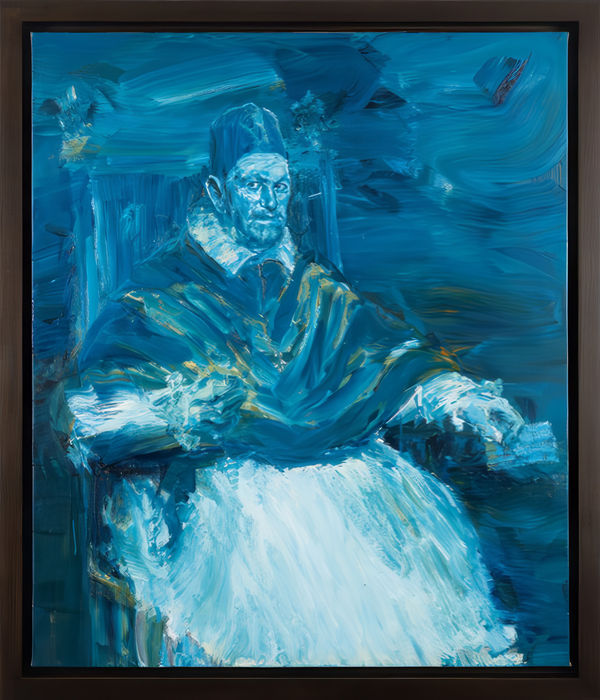
Yan Pei-Ming has gained international recognition first and foremost for his portraits, which include depictions of numerous personalities of contemporary interest such as politicians, actors and popes. Some of his most acclaimed works portray the figures of Mao Zedong, Bruce Lee and Barack Obama. Alongside and against these public figures, Yan Pei-Ming's portraits extend to those of his family as well as himself. His body of work encompasses a wide spectrum of subjects, including history and current events, such as the attack on the World Trade Center in 2001 or reinterpretations of iconic works from art history.
The artist's body of work is invariably indebted to the history of European painting and portraiture. The illustration of status and power in traditional portraiture is particularly significant to his work, which reconnects with the archetypes of centuries-old conventions of representation. In an era of inflationary reproduction and digital exploitation, his subjects express the tension between conventional forms and contemporary relevance, thus allowing interpretation on a classical as well as a modern level. Although the Shanghai-born artist defines himself as a European painter, both in style and subject matter, in recent years he has increasingly drawn upon his Chinese cultural heritage in combination with the Western portraiture tradition.
Yan Pei-Ming's work is characterised by his use of a two-toned monochrome colour palette in black and white or red and white, thereby directing stronger focus towards the subject and composition of his works. In recent works, he has begun to include a wider range colours in his formerly strictly uniform palette, such as tones of blue or green. His paintings are executed with great energy and imagination, consisting of distinctively expressive brushstrokes. While his works often appear almost abstract at close range, they become increasingly sharper with distance, an effect intended to blur the lines between reality and imagination.