Jenny Holzer United States, b. 1950
-
 Blue Tower, 2007
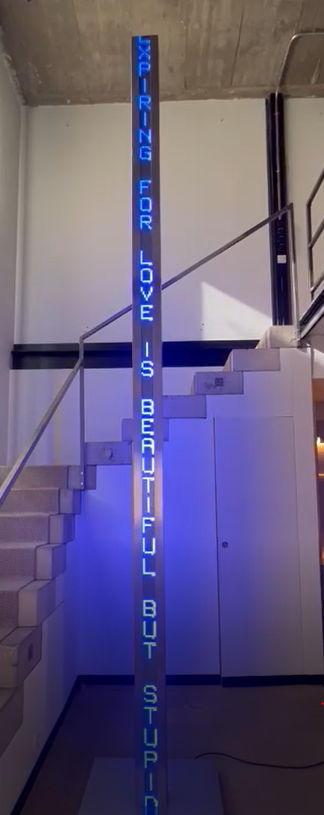
Blue Tower (2007) projects text from four of Holzer’s most important series: Truisms (1977-1979), Inflammatory Essays (1979-1982) on one side, and Living (1980-1982) and Survival (1983-1985) on the other. In total, thirty different rotations of this text can be projected on the tower, each a statement of philosophical, political or moral intent, for example “CHASING THE NEW IS DANGEROUS TO SOCIETY” and “CLASS ACTION IS A NICE IDEA WITH NO SUBSTANCE.” Each series tackles with the way the public engages with text, such as Truisms which references contemporary advertisement and political speech, and Living, which provides short, imperative instructions or ‘life rules’. As a whole, Blue Tower is a compilation of the four earliest series by Holzer, all from her most groundbreaking, historically significant decade of work.
Active since 1977, when her first major series Truisms was pasted in poster-form around New York City, Holzer first began using electronic signage as an art medium in 1982. Projecting phrases such as “MONEY CREATES TASTE” and “ABUSE OF POWER COMES AS NO SURPRISE,” this first installation was the beginning of a long running relationship with technology in Holzer’s oeuvre, with the artist continuing to use light projections and LED signs in both public and institutional spaces for the next forty years. As one of the first artists to identify the fine art potential of light installations, when Holzer first began working with LED, it had traditionally been used for warning signs or large-scale public advertisement. Identifying its wide-reach and theatricality, Holzer’s first installation was projected on the Spectacolor board above Times Square, with the artist stating that she wished her art to be displayed “where people look.” Two years later in 1984, Holzer took it a step further, creating Sign on a Truck, an installation/performance piece where a truck carrying a sound system and bearing an LED display blasted a mixture of interviews, speeches and images while driving around New York City on the eve of the presidential election.
Since these initial projects, light installations have become a trademark and longstanding practice of Holzer’s. LED installations have been included in many of her most important exhibitions and installations, including her 1989 retrospective at the Guggenheim in New York, and the permanent, inaugural installation for Guggenheim Bilbao (1977). Using text as the dominant subject since the beginning of her practice, Holzer’s medium has evolved with the rise of the information age. Indeed, the use of technology in art to address socio-political issues is increasingly implemented by contemporary artists. An example is Josh Kline who works across video, photography and sculpture, which he often combines in multi-media, immersive exhibitions. Working like Holzer in series separated by relevant political issues, he has most recently used 3D printing and AI ‘deep-fakes’ for works which address the current economic impact on the US’s Blue-Collar workforce, and society’s cultish obsessions with celebrity culture.
While Holzer has continued to work in a wide range of material, the merging of politics and aesthetics has remained a constant thread throughout her career. Breaking through relatively early for a female artist in the 1970s, socially accessible art was very much at the forefront of the New York art scene. Holzer herself partnered with Colab, an artists’ collective who engaged with politics through cultural activism from the late 1970s, alongside fellow New York artist and friend Kiki Smith, who has frequently engaged with historic feminist themes and gendered politics.
With her first installations in the 1980s largely focused around obsessive consumerism and misuse of power, in more recent years Holzer has turned her oeuvre’s focus, and therefore her light installations, to war time conflict and human rights abuses. Blue Tower for instance was made around the time that Holzer began work on her most recent and controversial series, where she appropriates text related to the US Iraq-Afghanistan invasion. Beginning in 2003, Holzer began sourcing declassified and redacted government documents related to torture and censorship, reproducing them in silkscreen and oil on linen. LED installations such as Blue Tower and Blue Purple Tilt (2007) which is currently held in the National Galleries of Scotland and Tate Collection, were both made during the conflict and display text from the artist’s previous series. By referencing her early work, Holzer is perhaps reminding us of the dangers of free speech which still exist decades on, bringing her work up to date in a political climate where fake news and cancel culture is making the power of words ever more dangerous.
Holzer emerged as an important player in a Feminist branch of art that arrived in the Post-Minimalism generation of late 1970s America. Described as a ‘neo-Conceptualist’ her work is almost entirely text-based, with the public dissemination of the text crucial to the artform itself. She broke onto the market early in her career when, during her enrolment in the Whitney Independent Study Program, her widespread installation of Truisms across New York attracted the attention of Kasper König, curator and previous director of the Ludwig Museum in Cologne. Her career accelerated with several major travelling museum shows at international venues with a major turning point in 1989 when Holzer was granted a ground-breaking solo exhibition at the Guggenheim in New York. Shortly after she was announced as the US representative at the 1990 Venice Biennale, the first living female American artist to do so. She subsequently was awarded the Golden Lion for her pavilion.
While Holzer is widely institutionally collected and exhibited, her art has always been made to exist outside of a gallery space in the public domain, taking numerous forms including billboards, light projections, clothing, metal plaques and benches. Her phrases only appear in capitals, rarely include punctuation and are sometimes italicised to exude a sense of urgency. Politically charged and focused, her subject matter is hard-hitting and can range from capitalism to gun violence to sex crimes. In the wake of current political events such as the overturn of Roe vs Wade and impeachment of former President Donald Trump, Holzer’s work has been brought to the forefront and has become more relevant than ever. Her text is continually used in political rallies and social projects, such as the #MeToo movement, in which Holzer is a vocal participant.