Tracey Emin United Kingdom, b. 1963
-
 Everything Was Beautiful, Even Me, 2022
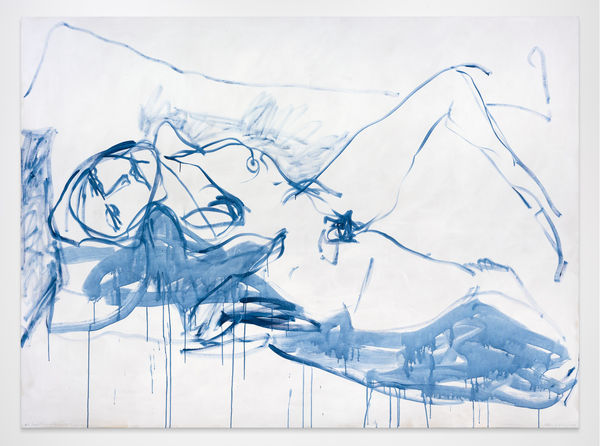
Originally recognised for her installation and appliqué works, Emin returned to painting in 1996, following a six-year hiatus from the practice that followed the completion of her MA at the Royal College of Art. Highly prolific now in the medium, Emin’s paintings and drawings have since come to represent one of the most significant strands of her oeuvre, culminating in her appointment as Professor of Drawing at the Royal Academy of Arts, London, in 2011. Heavily influenced by Edvard Munch and Egon Schiele, Emin’s full-length nudes are highly reminiscent of Schiele’s early twentieth century Expressionist studies, sharing a similar erotic energy, mixed with a sense of eerie morbidity. Some are densely worked and more abstract, the paint layered and dripping in the manner of Cy Twombly, the figure blotted out with angry strokes of white. Others are so delicate and minimal the body threatens to dissolve into the canvas.
Having battled and survived bladder cancer in 2020, Emin’s work has entered a new autobiographical chapter, becoming distinctly more figurative and focused on the strength and fragility of the human body. Like British sculptor Rebecca Warren, who creates pock-marked, undulating sculptures which oppose the traditional idolisation of the feminine form, Emin is unafraid to emphasise the pain, violence and ugliness associated with the female anatomy. Throughout her oeuvre Emin has blatantly and unashamedly addressed traumatic events of her life directly related to her body, including sexual assault, abortions and depression. The most famous example is her record priced work My Bed (1998), a physical record of a depressive four-day period Emin spent bed-bound, surrounded by detritus including her period-stained underwear, condoms and dirty bedsheets.
An explicitly feminist artist, much of Emin’s work has centred around the female experience of reproduction, addressing her own complicated relationship with ideas of having children and most recently her relationship with her mother Pam, who died in 2016 from the same cancer which Emin would battle with herself only a few years later. These themes have linked Emin’s work directly to her friend and mentor Louise Bourgeois, who Emin collaborated with artistically before Bourgeois’ death in 2011, and whose own work similarly explored the female experience through the often painful and disturbing modes of reproduction, sex and motherhood.
Emin’s nude, prostate self-portraits, usually reclined, have gained extra poignancy in the last couple of years as she has faced many sleepless nights following her lifesaving surgery and long recuperation period. The major surgery (a radical cystectomy) Emin endured in 2020 as part of her cancer treatment brings her artistic attention back to her body and its function as a ‘battleground’ and symbolic marker of different chapters in her life and career. Documenting her surgery and recovery in a series of photographic self-portraits, Emin has discussed how “exhausting and terrifying” the return to painting has been, identifying herself with Jackson Pollock in how she believes she paints from ‘inside’ the canvas rather than standing ‘outside’ it: “It’s this battle. But it’s just you and it. And you kind of – it sounds so pretentious - but it’s like a vortex, it pulls you in.”
Arguably the most influential living British female artist, Tracey Emin (b. 1963) emerged onto the art scene in the early 1990s as one of the Young British Artists, a group which also included Sarah Lucas, Damien Hirst, Fiona Rae, Gillian Wearing and Sam Taylor-Wood. Exhibiting her first solo exhibition, My Major Retrospective 1963-1993 (November 1993 – January 1994) at White Cube, with whom she is still represented, Emin first gained public attention after her nomination for the Turner Prize in 1999, where her seminal work My Bed (1998) was presented. Working across media in textile, sculpture, neon installation, painting and assemblage, since the beginning Emin’s overwhelming subject and inspiration has been her own life, ‘oversharing’ frequently dark and traumatic experiences such as her abortions in the 1990s, sexual assault as a teenager and mental health crises. Undergoing extreme surgery for bladder cancer in 2020, Emin’s work has gained a sense of impending mortality as well as a zest for life, with her paintings especially becoming more charged with gestural energy and vibrant colour.
Representing Britain at the 2007 Venice Biennale, that same year Emin was made a Royal Academician and was also appointed Professor of Drawing at the Academy three years later. In 2012 Emin was made Commander of the Most Excellent Order of the British Empire for her contributions to the visual arts. Looking to invest in the future of young British artists, in 2022 the Tracey Emin Foundation funded and opened TKE Studios, an artist residency and studio space in Margate, Emin’s hometown.