Lucian Freud Germany, 1922-2011
-
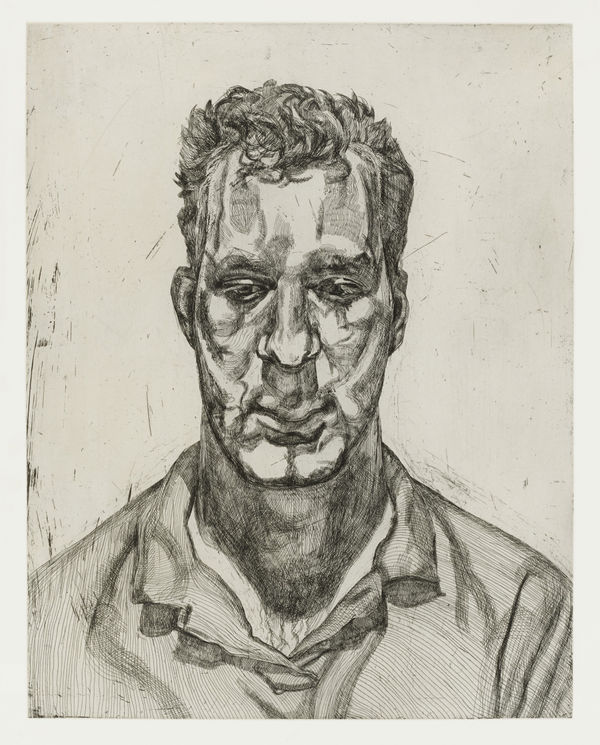
 Kai, 1991 - 92
 -
Self-Portrait: Reflection, 1996
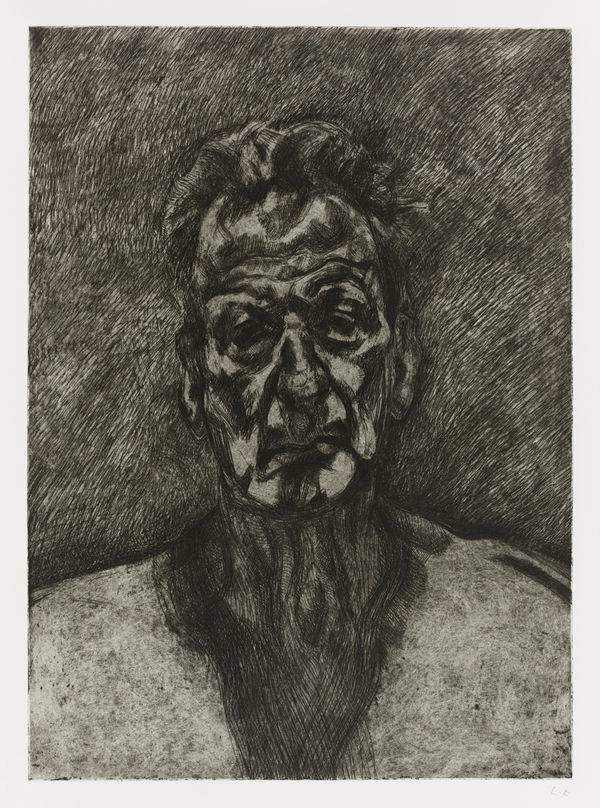
Self-Portrait: Reflection was made in the mature stage of Lucian Freud’s career, once he already was a household name of British art with many exhibitions, including a retrospective at the Hirshhorn Museum & Sculpture Garden, to his name. The present work shows the artist himself in front of a hazy background assuredly, though indifferently, looking toward the viewer. His face is characterised by contours and wrinkles and the hairline has receded, with close similarities between the present work and other late paintings by the artist, such as Self-Portrait (1990-1991) and Painter working (1993). Self-portraits are a particularly significant part of Lucian Freud’s oeuvre. With more than fifty self-portraits executed over a seven-decade career, each of them captures the artist’s psyche as well as the effects of aging. Commenting on the challenges of self-portraiture, Freud has remarked that “[y]ou’ve got to try to paint yourself as another person. Looking in the mirror is a strain in a way that looking at other people isn’t at all” (W. Feaver, Lucian Freud, 2007, p.31). The present work is particularly significant as it is the only etching of Lucian Freud himself. Freud’s commitment to candid depiction, so fervently pursued in his self-portraits, can favourably be compared to the paintings of Tracey Emin. Works such as Everything was Beautiful, Even Me (2022) portray Emin in a fragile state, with the effects of her illness – cancer - incisively exposed.
Freud first experimented with etching in the 1940s and returned to the technique in the early 1980s. Etchings from the 1940s and 1980s are typically very delicate, with the marks of the etching needle often only delineating the contours of the objects, animals, and persons portrayed. From the late 1990s onwards, however, Freud increasingly took on a more vigorous approach, often using the etching needle to create negative images that are characterised by greater spatial depth. The present work epitomises Freud’s negative method; the background of the composition is almost completely dark, with the artist’s facial features protruding as silhouettes left blank by the etching process. Perhaps the closest comparable to the present work is Freud’s 1991/1992 etching of Kai Boyt that depicts a solemn man indifferently looking toward the viewer with eyes and wrinkles protruding as those facial elements left blank by the printing. A feature of Self-Portrait: Reflection that makes it unique to other works, including Kai, is Freud’s rendering of the shirt. Freud asked his printer Marc Balakjian to leave residues of paint on the etching plate before printing to give the shirt a hazy shading. As these paint residues cannot strictly be controlled, each work from the edition of Self-Portrait: Reflection is characterised by a slightly different shading of the shirt.
Kai come from a major retrospective of over fifty etchings by Lucian Freud. The complete group come directly from the estate of Marc and Dorothea Balakjian, printers with whom Freud worked for over twenty-five years until his death. Their exhibition at Lyndsey Ingram Gallery in London (September – November 2022) marks the first time they have been displayed to the public.
While he is predominantly known as a painter, etching was a crucial and long-term aspect of Freud’s artistic practice. First experimenting in the 1940s, he rediscovered the medium decades later, beginning to make large-scale and complex compositions from the early 1980s. Standing the copper upright on the easel, he treated the etching plate like a canvas, rather than working as a traditional printmaker, and continued to work directly from models in real-time. Freud’s great oeuvre of etchings was celebrated in a major exhibition, Lucian Freud: The Painter’s Etchings, at the Museum of Modern Art in New York (December 2007 – March 2008).
B.A.T., annotated from “Bon à tirer” (or “good to pull”) are the very first impressions which are approved by the artist after coming off the press. The most precious of their series, these unique prints set the standard for the rest of the numbered edition. Freud was notably very precise and opinionated when it came to creating the etchings, but also was open to “accident,” according to Marc Balakjian. Reflecting on the printing of Kai in an interview with Lyndsey Ingram, Balakijan said that Kai was accidentally scratched in the studio, but Freud decided to maintain the scratches in the printing because “he could see they were part of the image.”
Freud strongly preferred to paint sitters with whom he was on personal, intimate terms. As such, Kai Boyt was Freud’s stepson, a sitter whom he depicted several times in etching, sketch and paint form. This particular etching was Freud’s first large-scale etched portrait head and is one of the most celebrated of Freud’s oeuvre. Editions of Kai are housed in prestigious collections including the Tate, UK Government Art Collection, Victoria and Albert Museum, Art Institute of Chicago and Metropolitan Museum in New York.
Commenting on Kai, art critic Richard Cork said: “Every now and again, Freud produces an etching so sculptural in feeling that it helps to explain why he placed Rodin’s bronze Balzac with such prominence in his house. The man called Kai appears to have no intention of relaxing, let alone reclining on the artist’s bed. He remains defiantly upright.”
Self-Portrait: Reflection was exhibited in numerous exhibitions throughout the world, including at museum solo exhibitions at the Museum of Modern Art, New York, and the National Portrait Gallery, London. Most recently, the work was included in Lucian Freud’s Self-Portraits, a travelling exhibition held at the Royal Academy of Art in London and the Museum of Fine Arts in Boston. Editions of this work are held in notable collections, including those of Tate, London; Museum für Gegenwartskunst, Siegen; Victoria and Albert Museum, London; Minneapolis Institute of Art, Minneapolis; and the British Museum, London.
Lucian Freud was a British painter and draughtsman and is celebrated as one of Britain’s master portraitists. Notorious for his personal life as well as his artistic practise, Freud’s works are known for their unsettling realism and intense intimacy between artist and model.
Born in Berlin to Jewish architect Ernst L. Freud (son of Sigmund Freud), Freud and his family fled to England in 1933 to escape the Nazi government. A British naturalised citizen from 1939, Freud attended Cedric Morris’ East Anglia School of Painting and Drawing and Goldsmiths College, London. Freud would soon become one of several figurative artists characterised as the School of London. This would also include Francis Bacon, Frank Auerbach, Leon Kossoff, and Reginald Gray. Many of these artists were known to each other and would often act as each other’s models. Bacon and Freud for instance had a twenty-five-year friendship which led to multiple portraits by each of the other.
Beginning his painting career inspired by Surrealism, by the early 1950s Freud had begun to develop his trademark stark realism for which his works are now so recognised. Intensely private, though with a frequently turbulent personal life, Freud tended to only depict friends and family members over his career of more than sixty years. Working from life, Freud was notorious for demanding tortuously long sittings, and for developing intense relationships with his models. Over his career he also did a few commissioned celebrity portraits, including of Queen Elizabeth II and the supermodel Kate Moss.
Internationally successful during his lifetime, Freud was the subject of many retrospectives before his death in 2011, including, among others, at the Hirshhorn Museum and Sculpture Garden, Smithsonian Institute, Washington DC (1987-1988); Tate Britain, London (2002); Museo Correr, Venice (2005); Museum of Modern Art, New York (2008); and Georges Pompidou Centre, Paris (2010).
Freud died in 2011 at the age of eighty-nine. His works are collected worldwide.