Antony Gormley United Kingdom, b. 1950
-
 Drawn Apart, 2000
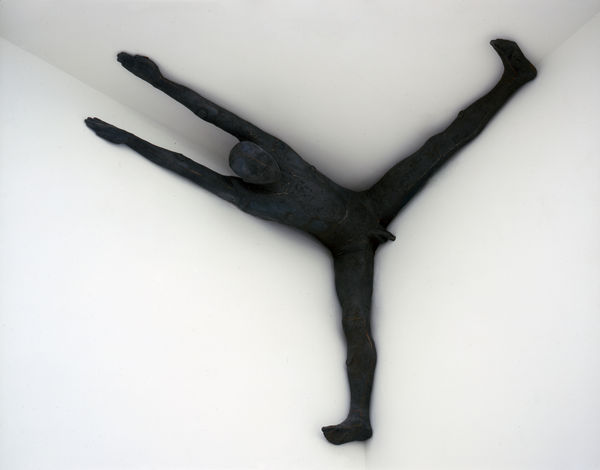
Antony Gormley is widely considered one of the most significant sculptors of his generation, known for renderings of the human form, which he has autonomously explored throughout the last fifty years. While early sculptures from his oeuvre, including the present work, tend to render the human body naturalistically, Gormley’s practice has become more abstract recently, with the artist using simplified geometric cubes, tubes, or wires as compositional elements.
The present work is a quintessential example of Antony Gormley’s sculptural practice and an important work from his oeuvre. It shows a human figure designed to be seated flush to the corner of its viewing space. The limbs are uncomfortably and disconcertingly elongated following the architectonic structure of the room, with the legs drawn apart at a ninety-degree angle and the arms outstretched, reaching upward. Drawn Apart provokes a feeling of unease and discomfort as no person would volitionally choose to strike such a pose. At the same time, the work recalls the ability of humans to adapt to uncomfortable environments by, as one might say, ‘bending over backward’. Magdalena Abakanowicz’s works from the 1980s and 1990s also serve as reminders to the ability of humans to withstand challenges to our nature; Small Figure in Iron House (1989-1990), for instance, shows a calm figure sitting upright, despite being decapacitated and enclosed in an iron cage.
Drawn Apart is part of Gormley’s longest-running series, the Suspended and Gravity Works series (1984-2012), with which the artist sought to undermine the spectator’s certainty of their position in space through sculptural interventions. The artwork was first shown at an iconic show at the White Cube Gallery in 2000, titled ‘Drawn’. In the rectangular exhibition space, the complete edition of eight works was exhibited, with each sculpture placed into one of the eight corners of the gallery, including the ceiling. Collectively, these eight works – known as ‘Drawn’ – “destabilised the room as if it was spinning freely through space” by undermining and subverting the viewers' sense of gravity and spatial orientation. Drawn/Drawn Apart is unique from Gormley's practice, as it is among the few sculptures that surround and encircle the viewer, thereby diverting the traditional relationship between passive artwork and active viewer and agent. Other artists from the collection who have sought to create spatial interventions using sculpture include Alexandra Bircken, who famously hung deflated latex figures from wooden beams and ladders for her 2019 Venice Biennale debut.
Reflecting Gormley's standard practice, Drawn Apart is made from a plaster mould of the artist’s body, which was then sand cast in iron. The sculpture's surface retains the original fabrication details and textures of the plaster casting, including the seamlines of the original mould. Since the rise of modernist sculpture, epitomised in artworks such as Rodin’s Main crispée droite, agrandissement dit aussi "grand modèle” (1898/1926), there has been a gradual shift away from life-size renderings of the human body, with sculpture becoming more self-referential and abstract. While Gormley’s figurative sculptural practice is reactionary to modernism, part of Gormley’s appeal is his ability to bestow his exploration of the classical form with rich metaphysical and philosophical meaning. Kiki Smith’s Virgin Mary (1993) and Mary Magdalene (1993) are good comparisons to Drawn Apart; these works, like Gormley’s sculpture, take the human body as starting point to explore topics ranging from mortality to feminism.