Alex Katz United States, b. 1927
-
 Phyllis, 1975
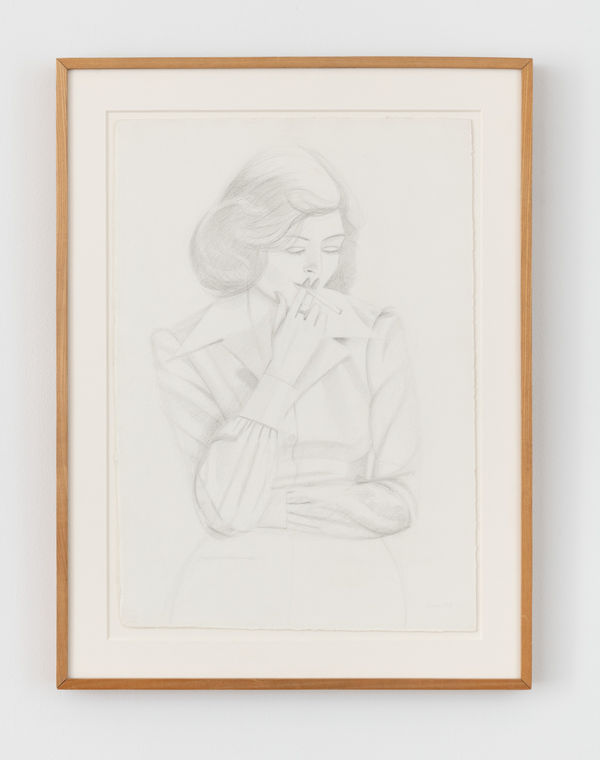
Katz began to seriously practice portraiture in the late 1950s. This coincided with the meeting of his future wife Ada in 1957, who would become his central muse and prove integral to the development of Katz’s trademark sharp, defined, smooth style. The pursuit of figuration was an unusual avenue for an artist in 1950s-60s New York, where Abstract Expressionism was the mode of the day. However, Katz remained steadfast and has maintained a highly recognisable stylised approach throughout his sixty-year career. Critics have noted that one cannot fully call his work realist as there is a strong emphasis on two dimensionality and simplification of his figures’ features. The subject often stands isolated against a plain backdrop with Katz stating that the flattened, clean-cut features are heavily inspired by portrait busts of Ancient Egyptian pharaohs. Indeed, Katz has cited Thutmose’s c. 1340 B.C. bust of Queen Nefertiti, now held in the Neues Museum in Berlin, as one of his favourite works of all time.
While over his career Katz has made various series of dancers, musicians, models and swimmers, his singular portrait subjects have often proved the most popular and tend to be of family, friends or close acquaintances. Figures are often cropped so that they fill the frame and confront the viewer, a composition choice drawn by Katz from elements of cinematography and commercial advertisement. Similar to the vignettes of fellow New York artist Ida Applebroog, while Katz’s figures may appear to lack depth at first glance, there is a vulnerability and intrigue which undercut every individual depicted. Phyllis (1975) is a particularly intimate and detailed example by Katz and one of the rare occasions where a subject is not shown staring directly outwards at the viewer. An unusual amount of detail is given to the apparel and hair, reflecting Katz’s long-term interest in fashion and design, which resulted in collaborations with high-end designers from the 1980s including Norma Kamali and Calvin Klein.
The gesture of smoking a cigarette, head downcast as if in conversation, is possibly influenced by Katz’s group scenes of New York’s art and party crowd, which he painted from the mid-1960s. The woman shown here could herself be a character plucked from such a scene and is exemplary of Katz’s notion of a ‘conceptual absolute’ where he aims to capture instantaneity through the depiction of outward appearance stating that “I can’t think of anything more exciting than the surface of things.” Katz’s attention to generational fashion and style has resulted in a kind of timeless quality to his art and would make for an interesting dialogue with an artist such as Robert Crumb, who seeks to depict women through the superficial, often male-led lens of social media.
Phyllis was almost certainly the foundational image for the woodcut print Carter, Phyllis (1986), from the portfolio A Tremor in the Morning, which shows the same female subject having her cigarette lit by a male companion. Editions of this print are held in multiple institutional collections including the Museum of Fine Arts Houston; Museum of Modern Art and Brooklyn Museum, both New York.
Alex Katz (b. 1927) is one of the leading figurative American artists alive today. Despite having exhibited publicly since 1954, Katz hit a peak in his market in 2019 with prices and institutional recognition on a steady rise ever since. Rejecting the reigning Abstract Expressionist style during his years of study, Katz found more affinity with masters such as Henri Matisse and Pierre Bonnard, pursuing painting ‘en plein air’ and ‘direct painting’ whilst attending the prestigious Skowhegan School. While he is predominantly known for his portraits, throughout his career Katz has also worked in print, works on paper, collage and sculpture, the latter often termed his ‘cut-outs.’ Influenced heavily by contemporary cinema and commercial advertising, his groups of work often examine areas of Katz’s own personal interest, ranging from fashion and dance to the surrounding nature of his summer house in Lincolnville, Maine, which he has shared with the family of friend and fellow painter Lois Dodd for many years.
Now well into his nineties, Katz still maintains a strict work schedule and continues to paint on a large scale, creating several recent public commissions including nineteen painted murals for New York’s fifty-seventh street station and a series of cut-out sculptures of Ada along Park Avenue, both in 2018. Katz has been featured in over 500 group and 200 solo exhibitions worldwide to date, most recently hosting a major career survey at Solomon R. Guggenheim Museum, New York (October 2022 – February 2023).