Bruce Nauman United States, b. 1941
-
 Untitled (from Fifteen Pairs of Hands), 1996
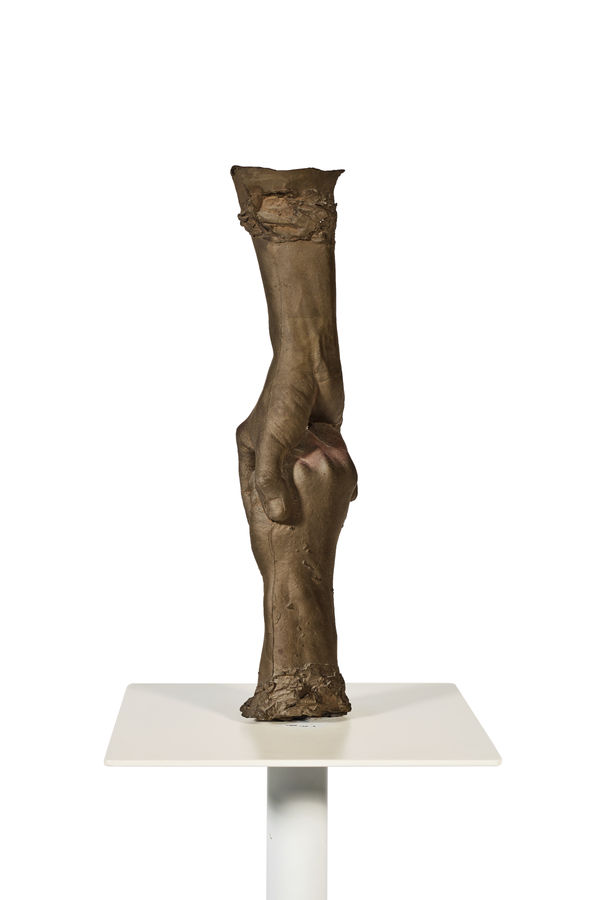
Since 1966, the year Nauman presented his very first solo exhibition, he has been using the body as a vehicle of self-exploration. He began casting in wax, one of few inexpensive materials he could afford at the time, creating works such as Wax Impressions of the Knees of Five Famous Artists, (1966), an arguable parody on other historic methods of celebrity identification such as the Hollywood Walk of Fame or Madame Tussauds. Especially in his early works, the inclusion of Nauman’s body parts has often been for comic effect, such as 1996 sculptural hand series Untitled (Hand Circle) which displays a chain of Nauman’s cast bronze hands making a gesture many would interpret as a lude reference to sex. Nauman has continued to explore and depict the expressive potential of hands up to the present day in neon, lithographs, etchings and film. His 1996 Washing Hands Normal and Washing Hands Abnormal video pieces, where the unseen artist is shown repeatedly washing his hands in a sink, was focused on as a particularly relevant work in his 2020 Tate Modern retrospective due to the presence of the recent Covid-19 Pandemic.
An immensely significant series in the artist’s oeuvre, the entire group of Fifteen Pairs of Hands was exhibited at the 2009 Venice Biennale in Topographical Gardens, a survey of Nauman’s work for which he was awarded the Golden Lion Award for Best National Participation. Drawing on an extensive art historical tradition, the outstretched hand has long been seen as a symbol of divine artistry, eternally immortalised in Michelangelo’s The Creation of Adam on the ceiling of the Sistine Chapel in Rome. The disembodied flexed or clenched sculpted hand has most famously been examined by nineteenth century French sculptor Auguste Rodin who obsessively moulded, carved and cast hands throughout his oeuvre, fascinated by their endless capacity for expression and emotion.
Building on his longstanding investigation into language, in this piece Nauman explored how hands can be used to communicate when words are absent or fail us. While none of the gestures the hands make in Fifteen Pairs relate directly to any official form of sign language, exhibitions of the series in the past have received positive reactions from the deaf community, with one visitor to Nauman’s 2012 Washington exhibition commenting that walking around the casts was like “milling around a small crowd of people…Each set of disembodied hands seems to have a distinct personality.” Identified only by the literal ‘tools of his trade,’ the casting of Nauman’s hands becomes an exercise in self-portraiture, similar to British sculptor Clementine Keith-Roach, who began casting her body parts during pregnancy to explore the role of the maternal figure as a vessel of protection and maternity. Pairing two hands together, in Fifteen Pairs Nauman creates a powerful portrayal of intimacy and human connection, casting his hands held together in prayer, touching fingertips or locked together in fists. Each individual wrinkle, palm crease or muscular ligament is highlighted, with Nauman presenting us with perhaps his most personal piece yet; a monument to the very instruments of his ability and passion – his hands.
The full set of artist's proofs of Fifteen Pairs of Hands are housed in the permanent collection of the Glenstone Museum, Potomac, Maryland. Similar bronze casts of Nauman’s hands from the 1990s are held in collections including the National Galleries of Scotland and Tate Collection; Musée cantonal des Beaux-Arts de Lausanne; Metropolitan Museum of Art, New York; San Francisco Museum of Modern Art and The Broad, Los Angeles.
Born in Fort Wayne, Indiana, Bruce Nauman is considered one of America’s most important conceptual artists. In 1964, shortly after graduating from the University of Wisconsin, Nauman abandoned painting completely and since has worked across a wide range of media, creating series of sculpture, film, neon installation, photographs, holograms, prints, performance, videotapes and ‘interactive environments.’ Granted his first solo gallery show in 1966 at Nicholas Wilder Gallery in Los Angeles, Nauman’s career subsequently accelerated when the prestigious Leo Castelli Gallery in New York and Galerie Konrad Fischer in Düsseldorf displayed a long sequence of solo shows. In 1972, Nauman’s first solo museum exhibition opened at the Los Angeles County Museum of Art, touring across the US and internationally at institutions including the Whitney Museum of American Art, Kunsthalle Bern and Palazzo Reale, Milan. Since the mid-1980s Nauman has primarily worked with film and sculpture, exploring ideas around language, communication and the inner self.
Exhibiting in Europe early on in his career, Nauman has been collected by European museums since the late 1960s and has arguably gained greater recognition and a wider collector base in Europe than in his home country of the US. Having jointly won the Golden Lion for Lifetime Achievement with Louise Bourgeois at the 1999 Venice Biennale, in 2009 Bruce Nauman represented the US at the Biennale, winning the Golden Lion for Best National Participation. His pavilion show Topographical Gardens was funded with a 500,000 USD grant from the State Department, their highest grant to date at the time. Now in his early eighties, from 1979 to 2020 Nauman lived in New Mexico, raising horses to herd cattle on a 600-acre ranch. He has been represented by Galerie Konrad Fischer since 1968, and is also represented by Sperone Westwater, with whom he has exhibited since 1976.