Shirin Neshat Iran, b. 1957
-
 I am its Secret (from Women of Allah series), 1993
 -
Untitled (Women of Allah Series), 1996
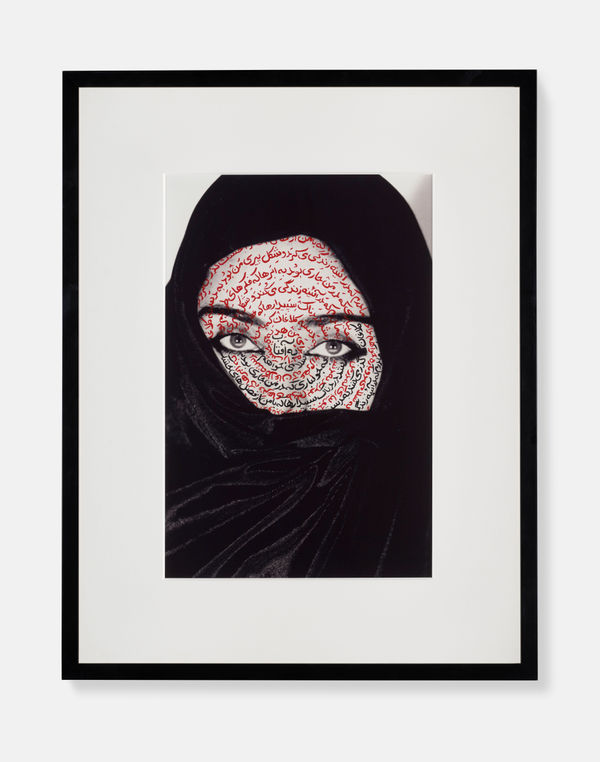
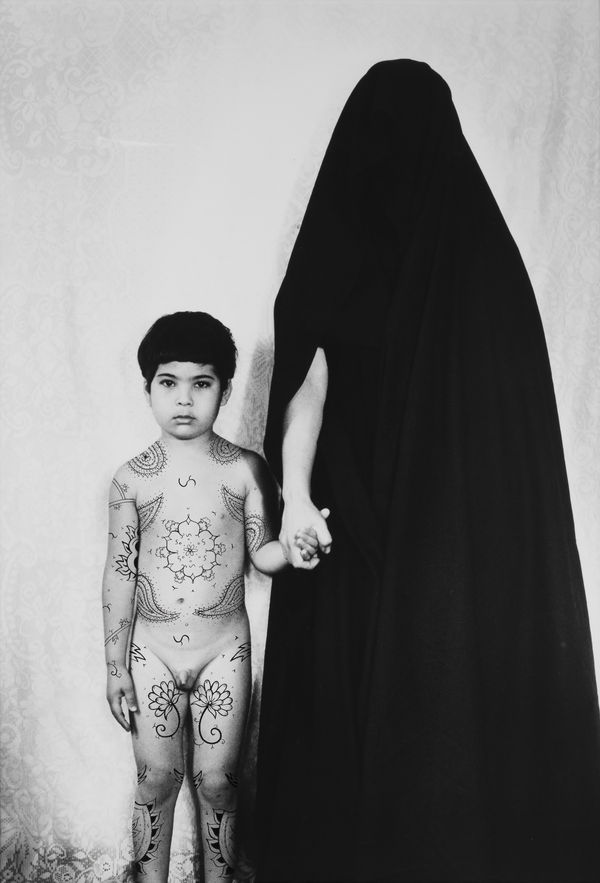
Born in Qazvin, Neshat left Iran as a teenager in 1975 to study in the US, prior to the outbreak of the Iranian (or Islamic) Revolution in 1978. Separated from her family for over ten years, Neshat returned to Iran in 1990 where she was astounded to see the enormous impact of the revolution and Iran-Iraq war. Neshat was particularly shocked at how women’s role in society had been completely transformed and how much their autonomy had been removed through the state’s total control over their body and appearance. Having taken a decade-long hiatus from art after her MFA, Neshat found creative inspiration through this shocking experience of travelling to Iran, a visit which continued to haunt her after she returned to the US.
Created from 1993-1997, the Women of Allah series responds especially to the 1978-1979 Iranian revolution and seeks to uncover the everyday lives of women living in extreme orthodox Muslim communities. It is the second series Neshat created in response to modern-day Iran and is considered her breakthrough body of work. A large series, it has covered several themes, including shahadat or martyrdom, femininity and violence and the juxtaposition between Eastern and Western femininity. In many of these images, the artist casts herself as the subject. A practical choice given her physical exile from Iran, Neshat also perhaps evokes her alter-ego in a parallel universe where she remained in Iran and was subject to such limitations. Given the series’ often controversial content, Neshat’s art has since been banned in her native country.
In this image Untitled (also referred to as Mother & Son) we suspect it is Neshat behind the veil, clutching the hand of her son Cyrus, whom she has inked from head to toe with floral patterns. The juxtaposition of the completely covered adult woman and the nude male child provides the emblematic contrast between different gender expectations in Iranian Islamic society, as well as the abiding rule that a lone woman cannot appear in public without a male guardian. Similar to German photographer Sophie Thun, Neshat aims to reimagine traditional facets of female self-portraiture and uses elements of performance and symbolism to examine a demographic group where visibility is ideologically and culturally hidden. At the heart of the series is the women’s own gaze and a sense of their integral power, despite society’s restrictions upon their freedom. Like Zanele Muholi, who investigates portraiture of the LGBTQ+ community in conservative South African society, Women of Allah is drawn from the artist’s personal struggles with their identity and attempts to reconnect with their native culture. Explaining her motivations, Neshat has said, “you can study the culture by studying the women: the way they dress, the way their own society changes.”
While the Women of Allah series is nearly twenty years old it has continued to be politically and socially relevant. In September 2022, the series received renewed recognition with the death of Mahsa Amini and subsequent protests. A young woman who died of wounds sustained in police custody for ‘improper’ dress, it sparked civil unrest across Iran, with women cutting their hair and removing their coverings in outrage. As such, Neshat’s work and its focus on the correlation between women’s bodies and strict religious policies, continues to be significant.
Shirin Neshat is an Iranian visual artist who is recognised for her work in photography, video and film. While Neshat originally trained as a painter, she was increasingly inspired by photojournalism, which became especially prevalent from the late 1970s with the outbreak of the Iranian Revolution and subsequent Iran-Iraq War in the 1980s. Claiming she approaches “photography as one would approach sculpting…constructing images, carving monuments,” Neshat believes it is the ideal medium for the content she deals with, valuing both its immediacy and simplicity. As with artists Anna Park and Belkis Ayón, Neshat chooses to work in monochrome which she claims conveys the greatest sense of realism and drama and also highlights the juxtapositions of society and gender dynamics she investigates.
Neshat has no formal film education and instead directly works with the concept and content while an assistant acts as cameraman. In the editing process, Neshat often adds hand-drawn details in ink to her prints, incorporating abstract designs and Persian calligraphy to cover those parts of the body (face, hands, feet) subject to regulation under Iranian Islamic law. The presence of pattern harks back to a tradition of tattooing in many Indian and Middle Eastern cultures, with Neshat seeing the ‘inscribing’ of the body of the Muslim woman in her images as a form of poetry. Indeed, on occasion Neshat will write poems related to the content in question, often by acclaimed Iranian female writers such as Tahereh Saffarzadeh or Forugh Farrokhzad. The use of self-portraiture and performance, with the artist often dressing herself as the anonymous Iranian women, has led to critical comparisons to American photographic artist Cindy Sherman.