Chris Ofili United Kingdom, b. 1968
-
 The Judgement of Paris - Actaeon, 2011 - 2023
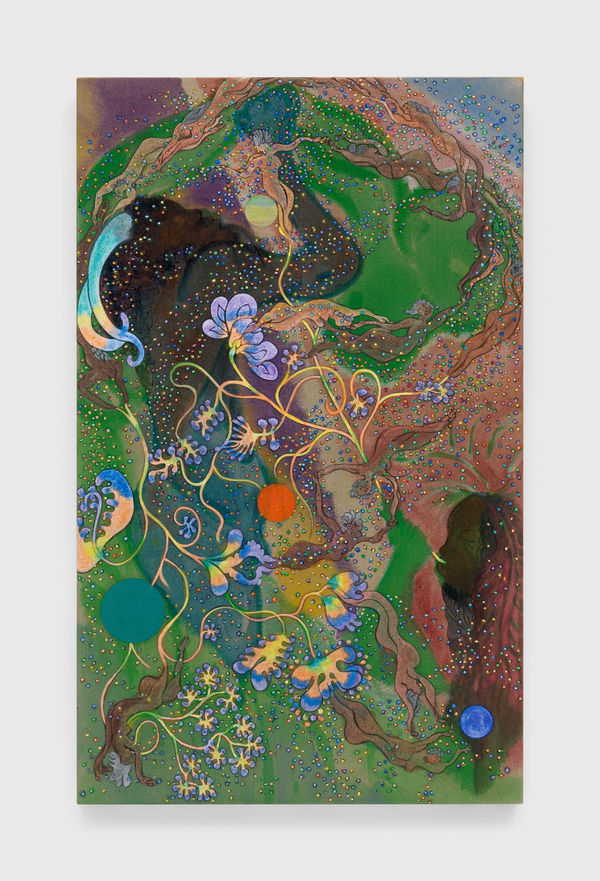
The present work, The Myth of Paris – Actaeon (2011 – 2023), shows two coloured figures, one to the top left and one to the bottom right, immersed in green, red, yellow, and blue fields. Organic forms or plants cover the composition like tentacles and differently sized ovals in green, orange, and blue are immersed across, recalling precious pearls and stardust, perhaps in their luminosity reminiscent of Jean Chardin’s masterpiece Soap Bubbles (1773 – 1734), now in the Metropolitan Museum of Art in New York. Finally, we see small brown figures in contorted positions, dancing across the far-reaching expanse of colour. Despite many elements of the composition recalling an arcadia – particularly in terms of the freedom and bright colours – there is also darkness. The main protagonists seem lost in a mysterious and foreign jungle, with the left figure looking upward, hands clasped together for prayer, and blue otherworldly horns protruding from its forehead in a way recalling a satyr, a popular subject in the artist’s recent oeuvre. The right figure, by contrast, is passive, calmly watching the spectacle of the other’s metamorphosis.
Throughout his career, Ofili was drawn to the foreign and mystical, with the artist’s portrayal of the black virgin Madonna in the late 1990s controversial but also providing a non-Western contemporary perspective on classical Christian themes. While the early 1990s works typically featured Pop-culture references and clichés surrounding beauty and the body and are thus political in outlook – similar to YBA contemporaries, such as Grayson Perry and Tracey Emin – Ofili’s recent works are introspective, perhaps reflecting the artist’s hermetic existence during the Covid-19 pandemic in Trinidad. Escapism and arcadia have a well-extended history in the canon of Western art, with many Surrealist artists, such as René Magritte, escaping the status quo through paintings that distort ordinary conceptions of reality.
The Judgement of Paris is a myth from Greek mythology where Paris, a prince of Troy, is asked to decide who among the three goddesses – Hera, Athena, and Aphrodite – is the fairest. Each goddess offers him a bribe: Hera promises power, Athena offers wisdom and skill in battle, and Aphrodite pledges the love of the most beautiful woman in the world, Helen of Sparta. Paris awards the golden apple to Aphrodite, leading to Helen's abduction from her husband, Menelaus, king of Sparta. This act sparks the Trojan War as the Greeks launch a massive expedition to retrieve Helen. Aside from The Judgement of Paris, the present work’s title is also connected to the myth of Actaeon and Diana from Ovid’s Roman epic The Metamorphoses (8 CE). This story tells of Actaeon, a skilled hunter, who accidentally encounters the goddess Diana while she is bathing. Furious at being seen naked, Diana transforms Actaeon into a stag. Actaeon, now unable to speak and retain his human identity is chased and ultimately killed by his hunting dogs. In the present work, the figure to the right can be seen as embodying Paris, the small brown figures in the ether are the three goddesses, while the big pearls may be emblematic of the golden apple Paris eventually gives Aphrodite. For the story of Actaeon and Diana, the horns of the left protagonist may suggest Actaeon’s transformation, while the figure to the right is Diana, calmly witnessing his downfall. Both myths recount the tragic downfalls of unconstrained erotic desires, with the Judgement of Paris resulting in war and Actaeon’s lustful glimpse leading to his demise. As such, the present work can be seen as an allegory against gluttony and sexual excesses. Other artists from the collection who have reflected on the pitfalls of unconstrained sexual desire include Robert Crumb, with the artist often depicting himself as the slave of overpowering sexual desires.
What significance do both the Judgement of Paris and Diana and Actaeon have for Ofili? The former has been a recurring theme throughout Ofili’s oeuvre of the last three years, with various paintings named after The Judgement of Paris and a recent show in 2023 at Victoria Miro exploring the seven deadly sins. Ofili, having grown up Roman Catholic in Manchester, has throughout his adolescence been interested in questions of right and wrong, with the Judgement of Paris an allegory of a hard and intractable choice to make. The myth of Diana and Actaeon – and Ovid’s The Metamorphoses more generally – has had a more extensive history in Ofili’s career, with the artist first having been tasked, alongside Conrad Shawcross and Mark Wallinger, to make the stage design for 2012’s British Royal Ballet performance Titian: Metamorphosis, exploring the myth of Diana and Actaeon. Corresponding to the ballet in 2012, Ofili presented a selection of works in the National Gallery on this myth alongside paintings by Titian. The present work is of acute significance within this context, with the rendering of the left figure exactly recalls Ofili’s stage design for the ballet. Furthermore, the present work was among the paintings Ofili had planned to include in the National Gallery show in 2012, only to decide to revisit it in 2023. There are striking similarities between the present work and Titian’s The Death of Actaeon (1559 – 1575), one of the central paintings in the National Gallery show. In Titian’s masterpiece, Actaeon is rendered with raised arms and horns in the right and Diana watching from the left. The case can be made that, compositionally, The Judgement of Paris – Actaeon (2011 – 2023) is the mirror image of Titian’s masterpiece.
Chris Ofili CBE is one of the most celebrated painters of the Young British Artists (YBA) generation. Ofili’s artworks have often been classified as punk art, blending popular culture and high art, the sacred and the profane, tackling socio-political issues around race and ethnicity. He has experimented with a wide range of techniques and materials, from bronze statues and watercolours on paper to monumental installations on canvas and linen layered with paint, resin, cut-outs from pornographic magazines, glitter, and elephant dung, which he brought back from Zimbabwe - a unique artistic touch for which he is mostly well-known. Ofili has garnered acclaim from the international art scene since the 1990s for his large-scale, vibrant, colourful, and intricately ornamented artworks. His participation in Charles Saatchi’s exhibitions, notably Sensation in 1997, contributed to his establishment as a member of the YBA group, of which he is remarkably one of the only few British artists of African or Caribbean descent. A few highlights of his career include his winning the Turner Prize in 1998 and representing Great Britain at the 50th Venice Biennale in 2003 in collaboration with architect David Adjaye. In 2017, he was appointed Commander of the Order of the British Empire (CBE) for his service to the arts; in 2019, he was included in the annual Power list, a list of the hundred most influential people of African or African Caribbean heritage in the United Kingdom.
Chris Ofili CBE was born in Manchester in 1968 to two Nigerian parents who had moved to the UK from Lagos only a few years before, in 1965. Ofili has a rich and varied cultural background and heritage, which he proudly reflects through his art. His childhood was marked by his experience as a young black boy in Manchester, whose family had freshly immigrated to the UK from Lagos. In 2000, Ofili was invited by an international art trust to attend a painting workshop in Port of Spain, Trinidad. This was his first time in Trinidad and having loved it during his visit, he decided to permanently move there in 2005. He has also lived in London, Brooklyn, Berlin and Tobago. The contemporary hybrid culture that he has surrounded himself with and his exposure to new languages and influences have been a great source of inspiration for his art.