Paula Rego Portugal, 1935-2022
-
 Painting Him Out, 2011
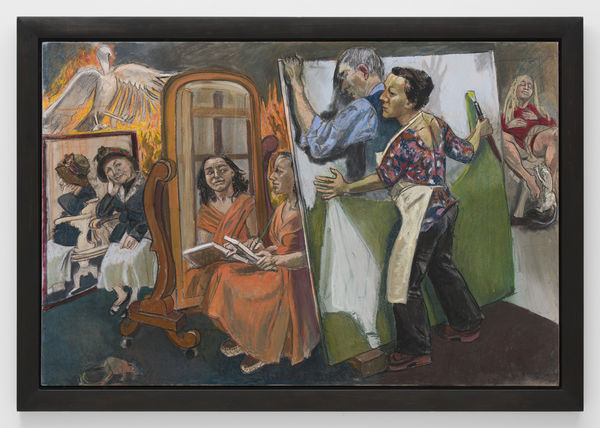
Paula Rego maintained an association with London painters while charging compositions with a distinctive character reflective of her Portuguese heritage and role as a female artist.
Painting Him Out, 2011, is one of Rego’s later works executed in the last ten years of her life. It is charged with a rich and puzzling narrative; in the centre of the composition, a painting man is half submerged in a painting, while a woman, presumably the artist herself, is carrying the painting, thus sidelining the man from the composition. To the right a young woman experiencing the agony of birth; to the left, we see two women, one young and one old, in front of the mirror submerged in flames. In sidelining the painting man in the composition, the present work is a metaphor for Rego’s passion to re-write art history, placing herself among the artists in the art historical canon.
Other artists from the collection who appropriate male art-historical tropes as a way of challenging male hegemony include Rebecca Warren, whose series of Fascia sculptures, for instance, directly reference and use the form of Pablo Picasso’s La Femme Enceinte (‘Pregnant Woman’) from 1959. The young woman giving birth in the right corner, on the other hand, is a reference to her vocal commitment against the criminalisation of abortion, a theme the artist also explores in her series of Abortion Pastels from the late 1990s.
Rego studied fine art at the Slade School of Art in the 1950s and initially adopted a style blending the influence of Joan Miro’s gestural surrealist work, with imagery, particularly of animals and mystical creatures. From the 1980s onwards, however, Rego adopted the politically charged figurative style she is most famous for today, recalling painters such as Chaïm Soutine who, particularly in portraits, portrayed the working class of early 20th Century Paris. The themes Rego discusses in her work include Christian traditional family values, gender roles, abortion, and the corporatist conservative Salazar regime in Portugal that, particularly in the Post-War years, severely restricted the liberties of the Portuguese population. Artists from the collection who use figurative painting as a socially transgressive way of critiquing and commenting on the status quo include Georg Grosz, who in works such as Nach dem Verhör, 1935, comments on sham trials and the demise of the judicial process in Nazi Germany.
Typically choosing pastel on paper as her medium, Rego’s works have a slightly rough touch, conveying a certain spontaneity and movement in the compositions. Speaking of her technique Rego says “Sketches always have more vitality than paintings because you’re finding things out through doing them”. Other artists from the collection who have avoided oil or even acrylic paint include Stuart Middleton, whose disturbingly sterile and delicately hatched compositions of animals in slaughterhouses have us question how we relate to the animal world. While there are stylistic motives for this choice of media in Rego, there is an argument that Rego’s choice was also partially political. Using pastel starkly separates Rego from the dominant male artists of the 20th Century, such as the Abstract Expressionists, including Jackson Pollock and Willem de Kooning, who were known to fill large expanses of canvas with oil paint in bold gestural strokes or drips.
Paula Rego is considered among the most important figurative painters of the last fifty years, with her work having received significant institutional and commercial interest since her passing in 2022, with museums such as Tate Britain and the National Portrait Gallery in London showcasing Rego. Born in Portugal to an affluent family, Rego studied in England, thus gaining exposure to the libertarian mindset of 1960s London and the rigid Catholic conservativism of the Estado Novo regime in Portugal. While Rego’s early works recall the automatistic processes of Surrealist artists, such as Joan Miro, this political contrast she experienced in her two homes gave her artistic practice a fervently political outlook from a young age.
Having become a member of the London Group of Painters in 1963, alongside Frank Auerbach and Michael Andrews, Rego first took part in an Institute of Contemporary Art show in London in 1965 and represented Portugal and the 1969 Sao Paulo Art Biennial. From the 1980s, Rego adopted her characteristic figurative style and gained significant attention with an exhibition at the Serpentine Gallery in London in 1988 and, in 1989, becoming the artist-in-residence at the National Gallery in London. In 2010, Rego became Dame of the British Empire and, in 2019, was awarded the Portuguese government’s Medal of Cultural Merit.