Auguste Rodin France, 1840-1917
-
 Main crispée droite, agrandissement dit aussi "grand modèle", Conceived before 1898, enlarged by Henri Lebossé in 1905 and cast in 1926
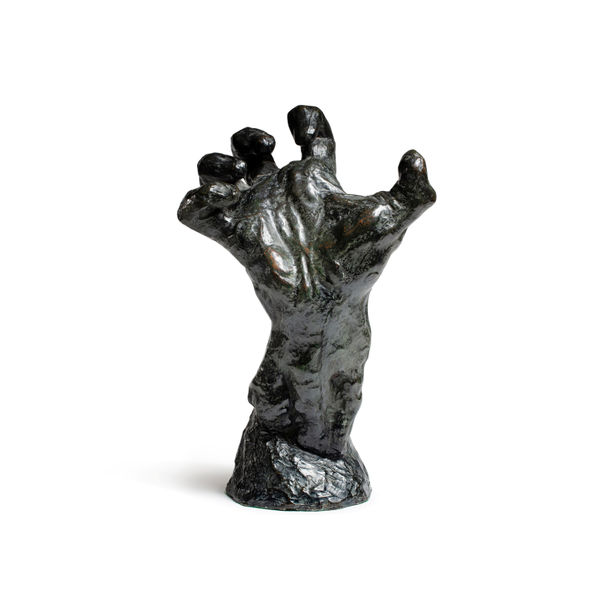
In the 1880s and 1980s Rodin worked on a series of hand sculptures that served as studies for his monumental public commission The Burghers of Calais (1884-1889/1895), showing six Calais citizens who surrendered themselves to England’s King Edward III. The present work is among the studies Rodin was particularly fascinated by and treated as an independent artwork. Main crispée droite, agrandissement dit aussi "grand modèle" is perhaps the most strained and impassioned of the series of hands; the gripping fingers suggest an emotional intensity and a feeling of despair and depravity reminiscent of Hieronymus Bosch’s depiction of hell in The Garden of Earthly Delights (1490-1510) from the Prado in Madrid as well as Tracey Emin, who imbues her work with a candid and self-reflective emotional intensity. Seven casts, including the present work, were made by Alexis Rudier between 1926 and 1945 based on an enlargement of Rodin’s original model of a hand. The present work was in the collection of Jules and Etta Mastbaum, the founders of the Rodin Museum in Philadelphia, in whose family collection the work has remained for nearly one-hundred years. While no longer a lifetime cast, Main crispée droite, agrandissement dit aussi "grand modèle" was commissioned by Musée Rodin and predates the later cast of eleven made between 1962 and 1965 by Georges Rudier. Given its casting date, provenance, and context within Rodin’s oeuvre, the present work can be deemed highly significant.
Auguste Rodin’s practice is deeply modern yet embedded in the history of sculpture dating back to the Italian Renaissance. During his lifetime he passionately collected ancient sculptures and was particularly drawn to damaged fragments that rendered persons incompletely. Arguably, this fascination with fragments was an impetus for Rodin to make sculptures focusing on partial representations of the body, such as hands, heads, and legs. The focus on singular body-parts was, perhaps, sculpture’s first foray into modernism, epitomised by abstracting from the human form and rejecting narrative subject-matter. Many generations of artists following Rodin, including Alberto Giacometti, Pablo Picasso, Bruce Nauman, and Kiki Smith, were also drawn to modelling hands as these are technically challenging and imbued with expression and social meaning. Speaking of Rodin’s sculptures, the Austrian writer and poet Reiner Maria Rilke has said “[t]here are among the works of Rodin’s hands, single small hands, which without belonging to a body, are alive. Hands that rise, irritated and in wrath; hands whose five bristling fingers seem to bark like the five jaws of a dog of Hell.” (MET, 2023).
Aside from focusing on body-parts as complete sculptures in themselves, Rodin was modern for rejecting the dictum or ideal that sculpture should emulate nature. In the case of Main crispée droite, agrandissement dit aussi "grand modèle", measuring 42 cm in height, Rodin purposely exceeded human dimensions. Furthermore, Rodin would mould body-parts together systematically to create large sculptures of the human body, thereby having great control with the details. What was unusual about Rodin’s practice is that he often left the moulding marks exposed on the final sculptures, thereby rejecting the illusion of naturalism. A contemporary sculptor who treads a fine line between depicting the human form while rejecting a natural portrayal of the human body is Antony Gormley. Sculptures, such as Drawn Apart (2000), render the human form yet make no attempt at naturalism with the moulding marks exposed and individuating bodily details left undefined.
Auguste Rodin (1840-1917) is widely considered one of the most important and innovative sculptors of the 19th and 20th Century. His influence can be felt among many modernist sculptors including Pablo Picasso, Constantin Brancusi, Alberto Giacometti, and Henry Moore. The hallmarks of Rodin’s style – his affinity for the partial figure, his focus on formal qualities and relationships rather than on narrative structure – were revolutionary in his time and set the foundation for modernism and abstraction in sculpture.
Born into a humble family in Paris, Rodin only achieved artistic success later in life after having been rejected from the École des Beaux-Arts in Paris three times and having worked various jobs as decorator. He earned a reputation for his talent of moulding clay surfaces. His most famous works are public commissions, including The Burghers of Calais (1884-1889/1895), The Thinker (1881/1904), The Kiss (1882), and The Gates of Hell (1880-1917). Two years after his passing a museum was set up in his honour in Paris.