Thomas Schütte Germany, b. 1954
-
 Bronzefrau Nr. 11 (Bronze Woman No. 11), 2002
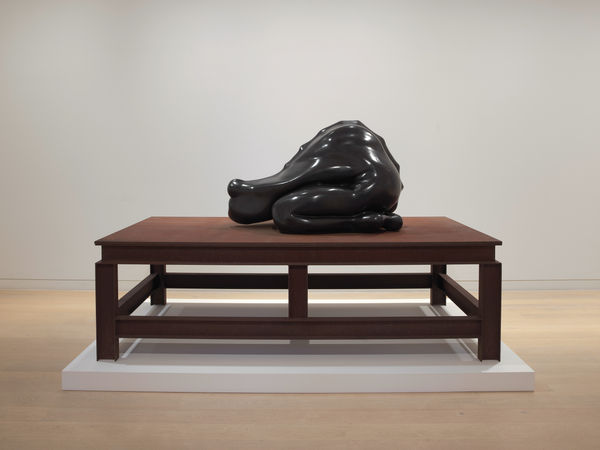
Bronzefrau Nr. 11 (2002) is a monumental sculpture from Thomas Schütte’s famed series of eighteen bronze, Cor-Ten steel, and aluminium Frauen (‘Women’), made between 1998 and 2006. This series is among the artist’s most ambitious, reflecting on the legacy of 20th-century sculpture and the possibilities of artistic innovation within an art historical canon celebrating progress and 'The New'. With names systematically given by number and medium, works from the series lack emotional associations and fail to reveal the identity of the artist or woman rendered. Other sculptures from this series are in important collections worldwide, including Folkwang Museum, Hamburger Kunsthalle, Kaiser Wilhelm Museum Krefeld, Kunsthalle Bielefeld, and Sammlung Goetz in Germany; The Art Institute of Chicago, The Museum of Modern Art, The Walker Arts Center in The United States; and Kunsthalle Winterthur and the De Pont Museum in Switzerland and The Netherlands respectively. The steel version of Bronzefrau Nr. 11 is in the collection of Folkwang Museum, Essen.
Spread across a Cor-Ten steel pedestal – reminiscent of an operating table rather than a sculptural plinth – we find a black polished bronze woman sitting. Her back is warped, and she is leaning forward, exposing a stiff and almost reptilian spine. The face is missing, with a lip-shaped stump protruding from the torso. The female figure’s identity is undefined and the form lacks a sense of human touch and intimacy. Unlike artists, such as Tracey Emin and Louise Bourgeois, whose works revolve around sharing human intimacy and vulnerability through a representation of the body, Schütte falls into a tradition, alongside Gerhard Richter, of questioning art historical narratives through recycling and adaptation of artistic imagery. Bronzefrau Nr. 11 is perhaps among the most abstract works from the series, with the human body whimsically adapted into an alien-like form reminiscent of H. R. Giger. Other examples, such as Stahlfrau Nr. 16, draw comparison to the smooth geometric forms of Henry Moore. Yet others, such as Bronzefrau Nr. 7 and Bronzefrau Nr. 13, recall the Neo-Classicism of Astride Maillol. Schütte engages with the sculptural canon of the 20th Century on his metaphorical operating table, freely adopting and engaging with different styles. Other sculptors from the collection who have employed appropriation to reflect on the historical canon include Rebecca Warren. Warren, unlike Schütte, is partially driven by a remedial concern to rectify the gender-based marginalisation of women in the historical canon.
Anecdotally, Schütte began his series of women from small clay forms between 1997 and 1999. Rapidly and spontaneously executed, these works capture an uninhibited gesture. By 1999, Schütte had made 120 fired ceramic maquettes, from which he selected prototypes for large sculptures, such as the present work. The process of enlarging the prototypes began in a foundry in the dockland of Düsseldorf, with a larger-than-life polyester replica of the maquettes created. In the process of enlarging, the rawness of the initial clay was transformed into a refined and sleek form. Schütte’s spontaneous method recalls the series of Clamdigger sculptures by Willem de Kooning; these were also spontaneously hand-moulded by the artist, first in Rome and later in Long Island, with the translation of the spontaneous gesture to a monumental scale, among the most acute challenges. Enlargement has perhaps been one of the defining characteristics of Modernist sculpture. Auguste Rodin enlarged many works, such as Main crispée droite, agrandissement dit aussi "grand modèle" (1895/1926), stripping sculpture from a pure concern for human likeness and scale.
Thomas Schütte is among the most significant artists of the late 20th and 21st Century, with his work particularly famed for his eclectic range of artistic techniques and visual languages. From architectural models to lithography, bronze, watercolour, ceramics, installations, and public art sculptures, his works are atemporal and impersonal, concealing an indexical relationship to himself or his surroundings. Schütte studied under Gerhard Richter at the Düsseldorf Art Academy. Anecdotally, he started sculpture as this was a medium less explored by his teacher. Like Richter, Schütte's practice is guided by an extensive borrowing of visual languages and images.