Ida Applebroog United States, 1929-2023
-
 Untitled (woman lying in bed), 1982
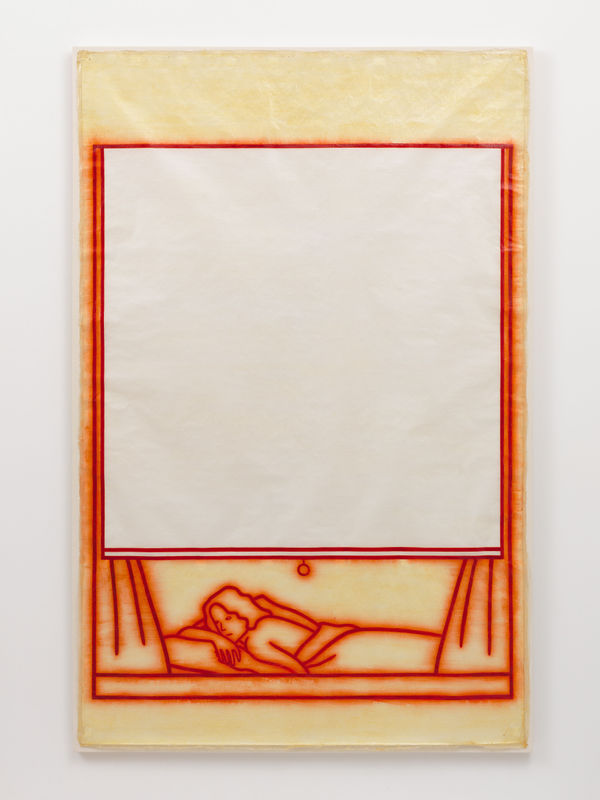
Applebroog began making her storyboard style paintings in the 1970s, painting vignettes on Rhoplex, a skin-like material which is akin in texture to vellum. Made in a comic strip format and style, they were almost certainly influenced by the graphic design work Applebroog did during her time at a New York advertisement agency in the 1950s, a very similar pathway to fellow New York artist Richard Estes, who has been quoted saying he learnt far more from his career in advertising than at the Art Institute of Chicago, where Applebroog also studied. This series of paintings also developed out of Applebroog’s Performances, a group of self-published, monochrome books which displayed repetitive cartoon-like images and short quotes or phrases, reminiscent of flip books or film stills. They were printed in runs of 400-500 and mailed out en masse to friends, acquaintances and other artists. The response to her artist books was mixed, some recipients replied with hate mail while others requested to be sent more regular content.
Applebroog has often cited her love of the theatre and the plays of Samuel Beckett in particular, with her vignette images sharing much of the same kind of tragicomedy. The very composition of her works has been described as a kind of ‘theatre’ with each image framed on their ‘stage’ by strip margins, a technique which critics have called “predellalike,” comparing the arrangement of Applebroog’s pictures to medieval and early Renaissance narrative altarpieces. Like photographer Sophie Thun, who experiments with collage and traditions of self-portraiture, the presentation and framing of Applebroog’s works is integral to their overall effect and message. The bands which surround the central image, and Applebroog’s regular inclusion of sash curtains or blinds, provide a ‘window’ into the intimate scenes she depicts, making the viewer into a true voyeur. The artist creates what has been described as a kind of iconography of modern life, which is particularly centred around the female experience. Breaking onto the art scene in New York during the feminist art movement in the mid-1970s, Applebroog joined the Heresies Collective, a group of feminist artists whose members also included Miriam Schapiro, Pat Steir, Amy Stilman and Cecilia Vicuña. Applebroog’s art has remained centred around female gender roles and issues of twentieth and twenty-first century feminism, tackling topics such as body image, abortion, sexual violence, female sexuality and mental health.
Untitled (woman lying in bed) (1982) was made at an important time in Applebroog’s career, painted just one year after her first exhibition with Ronald Feldman Fine Arts in New York, her long time dealer with whom she would exhibit for over twenty years before joining Hauser & Wirth. Untitled holds a special kind of poignancy in its depiction of a lonely, seemingly introspective woman. Applebroog has herself described an abiding childhood memory of her mother, who was almost certainly depressed throughout much of her life, staring wistfully out of the window during unhappy days spent with Applebroog’s abusive father. Decades later, the artist would herself experience severe depression as a mother and homemaker, describing endless days spent stuck inside with her apartment bathtub her sole place of respite. Such a work could be compared to Zanele Muholi’s Somnyama Ngonyama portrait series, which depicts its unsuspecting subjects with an intense vulnerability and intimacy of gaze.
With a career stretching over half a century, Ida Applebroog’s (b. 1929) pictures range from the quirky and familiar to the sinister, aiming to encompass all the joy and tragedy of everyday domestic life. She has a highly recognisable, cartoonish style which depicts generic ‘everyman’ and ‘everywoman’ figures, often in intimate, quiet moments of reflection. The artist’s trademark dark humour also sees her figures engaged in sometimes more shocking acts of sex or violence.
Applebroog broke onto the art market late in life, as her professional career did not begin until middle age. Professionally trained as a graphic designer, her first major creative series was 150 bodily self-portraits entitled Vagina Drawings, made while Ida was raising her family in New York, and which were not publicly displayed until 2010. In her mid-forties in 1969, following a mental health collapse, Ida Horowitz (as she was then known) checked herself into Mercy Hospital and changed her name to Applebroog, taking up sketching in place of occupational therapy. This proved to be a professional as well as a mental breakthrough and shortly after being discharged Applebroog’s art career accelerated. The 109 small-scale works she created at Mercy Hospital were misplaced for forty years, discovered only in 2009 by the artist and her studio assistants. They were subsequently displayed in the 2016 solo exhibition Mercy Hospital at the Institute of Contemporary Art Miami, her first US institutional show in more than two decades. That same year, Ida’s daughter Beth made the film Call Her Applebroog which brings together fifteen years worth of archival footage of Applebroog’s life and career.
Collected and exhibited internationally, Applebroog’s last major museum show was Ida Applebroog: Marginalia at Reina Sofia in Madrid (June – September 2021). The largest and most complex retrospective of the artist to date, the show spanned more than fifty years of Applebroog’s oeuvre and included paintings, artist books and archival footage of the small group of sculptures she made from 1969-1973.
Similar vignette ink and Rhoplex paintings from the 1980s are held in the prominent private collections of David and Indrė Roberts and Marguerite Steed Hoffman.