Belkis Ayón Cuba, 1967-1999
-
 ¿Arrepentida? (Repentant?), 1993
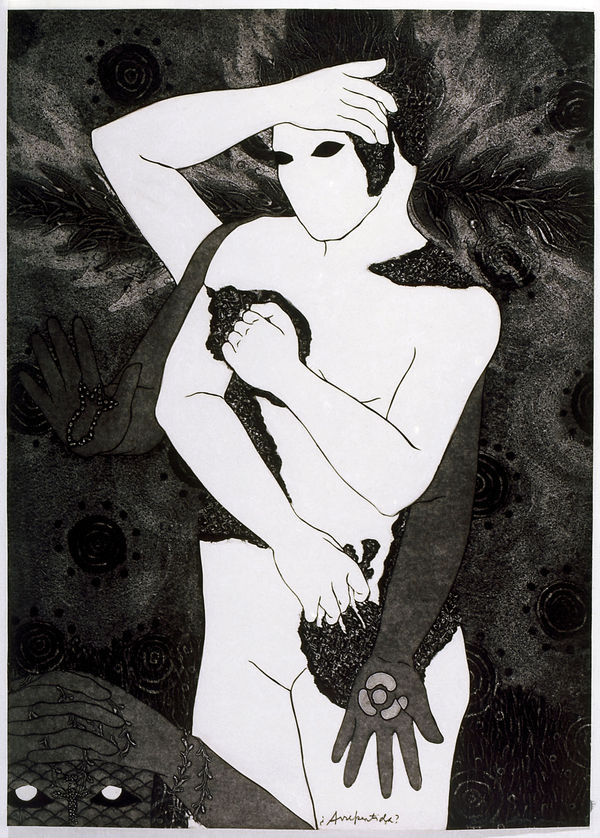
Ayón first became intrigued by Abakuá culture while studying at the San Alejandro Academy of Fine Arts. Recognised nowadays as a standalone religion in Cuba, it was first brought to the country by enslaved Nigerians in the early nineteenth century. An all-male secret society, it has been compared to Freemasonry and is notable for its exclusion of women members and female iconography. Intrigued by this exclusive mythology, Ayón was drawn to the Princess Sikán, the only female character in the Abakuá legends. Growing up in a staunchly patriarchal Cuban society, Ayón would call Sikán her ‘alter-ego’ and repeatedly feature the princess as the central figure in her prints. According to the legend, Sikán was granted sacred, forbidden knowledge when she heard the voice of Abakuá, whose wisdom was only meant to be given to men. When she shared that knowledge with her lover, who was from a neighbouring enemy community, Sikán was branded traitor and killed by her own people.
One of the few artists who has explored this secret society, Ayón’s work is important as it visualises a mythology that is traditionally only passed on orally. Although she was a self-declared atheist, many of Ayón’s later depictions of the princess are distinctly Christian in nature with Sikán embodying the role of a martyred saint. For instance, she is depicted as the central Christ figure in a rendition of the Last Supper in the 1991 work La Cena, and in other works is depicted encircled by a halo, cradling a lamb or pierced with branches like Saint Sebastian. We can draw comparisons here to Kiki Smith’s sculptures of the Virgin Mary and Mary Magdalene, which highlight the female saints’ spiritual enlightenment and divinity through graphic bodily suffering.
Sikán is an instantly recognisable figure in Ayón’s prints. She is always depicted in pure white, in contrast to the grey or black surrounding figures and background and is featureless apart from large almond eyes which allow one to project any number of ideas or personalities unto her. Sikán is also shown mouthless and thus voiceless, perhaps symbolic of the lack of a female presence within the Abakuá religion. Like the Zanele Muholi portrait series Somnyama Ngonyama, which aims to bring a voice to the Black African LGBTQIA+ community, there is a sense of introspection and reflection upon the viewer.Reflecting on the universal relevance of Sikán to oppressed individuals, especially women, Ayón said “Sikán is a transgressor, and as such I see her, and I see myself.”
There is an intimacy and sensuality to many of her depictions of Sikán, including ¿Arrepentida? which shows the princess seemingly clawing (or caressing) at her own body, statuesque in a compositional arrangement that has been likened to ancient portrayals of the Venus de Milo. There is a subtle Renaissance quality and Classical influence throughout. Much like painter Caitlin Keogh, who assembles multiple visual sources in a frieze-like arrangement, Ayón’s story of the princess Sikán stretches far beyond Abakuá myth and draws on tales of female disempowerment and sacrifice throughout art history.
The influence of the Communist, male-dominated Cuban society in which Ayón was living and working cannot be understated. Although scholarships and grants allowed her to travel outside of the country from time to time, for her whole life Ayón was based in Cuba during a period where the population suffered the severe economic effects of the Soviet Union collapse. ¿Arrepentida? (1993) was made two years post-collapse during a particularly pivotal year in Ayón’s career when she was transgressing traditional gender boundaries in Cuban society. Made when the artist was just twenty-six, that same year she was elected a professor at her alma mater San Alejandro academy and was invited to take part in the 45th Venice Biennale. Limited in terms of transport and shipping, Ayón was left with few means but to cycle the twenty miles to the Havana airport, followed by her father who carried her exhibiting work strapped to his bike. Unable to keep pace, her father and Ayón’s work missed the plane. Miraculously, Ayón’s friend Cristina Vives found an Italian woman who was travelling from Cuba to Milan that very day to transport the work, which made it to the Biennale just before opening. Over twenty years later, Vives would curate Nkame, the first retrospective of Ayón’s work to be held in a US museum.
Considered one of the most important Cuban artists of the twentieth century, Belkis Ayón (1967-1999), had a short-lived, but highly successful career that has seen great resurgence in recent years. She began painting at a very young age, with her mother placing her in a painting workshop aged five to divert her high energy to something productive. Before long she was winning numerous national and international art competitions for children. Ayón first rose to prominence in the 1990s after the fall of the Soviet Union when her native Cuba was in a desperate state of economic hardship. Graduating from the prestigious Instituto Superior de Arte in Havana in 1991, by 1994 she had already exhibited widely, including participating in the 45th Venice Biennale and winning the international prize at the International Graphics Biennale in Maastricht. Ayón would also go on to act as head of the printmaking department of Instituto Superior de Arte and president of the Union of Artists and Writers. Ayón mysteriously took her own life in September 1999, aged just thirty-two.
Given Ayón’s premature death, her oeuvre is limited and therefore highly prized on the market, with a great number of works still in the possession of the artist’s estate. Ayón was highly prolific during her lifetime however, producing over 200 editions, with each print consisting of up to eighteen individually made panels. Graduating the same year the Soviet Union fell, poverty was rife and resources limited. As such Ayón experimented with what was available to her, using materials as wide ranging as vegetable peelings, cardboard, sandpaper and acrylic paint on the printing surface. After constructing the final composition, she would then play with the texture, painting over areas to create a relief and carving grooves to allow ink to flow. The plate (or matrix) and paper would then be run through a hand-cranked printing press.
The collograph method, which applied material to the plate rather than carved directly into it, was unusual and embraced firstly out of necessity. Over time however Ayón became an expert in this field of printmaking, working on an increasingly large scale so that some of her prints became mural-esque, with several of these monumental tableaus displayed at the most recent Venice Biennale in 2022. While some of her early works and prints feature vibrant colours, Ayón switched to using a dark ghostly palette in 1991, believing monochrome provided a greater sense of drama.
In 2016, the first US museum retrospective of Ayón’s work opened at the Fowler Museum, UCLA in Los Angeles. It thereafter travelled to other US institutions including El Museo del Barrio in New York. It featured forty-three prints, including many previously unseen works held by the artist’s estate, and was curated by art historian Cristina Vives, a close friend of the artist.