Caitlin Keogh United States, b. 1982
-
 Running Doggerel (Parts 9 - 11), 2022
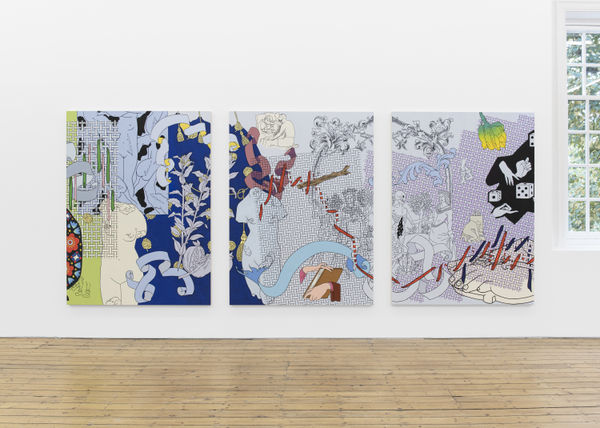
Running Doggerel is a reference to ‘doggerel,’ a trivial, often non-sensical form of poetry characterised by a monotonous rhythm and associated with nursey rhymes and colloquial phrases. A series of twelve paintings, they are made of one continuous narrative, creating a frieze-like arrangement where each work is integrally connected to the next.
Keogh’s use of motifs and imagery is fairly ambiguous in its origination and intent. Keogh’s source material for this particular project was comprised of thousands of phone photos, monograph reproductions, online search results and art museum postcards, sent from Keogh’s friend and former art history teacher M. Dorsch. The resulting collage is a loose maze of reference, with inspiration from Surrealist illustration, classical statuary, the nineteenth century aesthetic movement, medieval marginalia and the proto-pop collages of American artist Joe Brainard.
As with fellow New York artist Alexandria Smith, Keogh’s work comes out of multiple diverse sources, but is rooted in draughtsmanship, with both artists having initially worked as illustrators. After creating the initial drawing, Keogh will enlarge it onto the canvas using a grid, a very precise method known as the traditional Sign Painting Technique. The motifs she includes and imagery she creates speaks to Keogh’s wide variety of influences, ranging from botany, William Morris, medieval manuscripts and nineteenth-century illustrator Aubrey Beardsley. Much as Smith draws on the composition technique of assemblage artist Betye Saar, Keogh’s paintings become an assemblage of these artistic, historical and contemporary sources, which all combine for the artist as one abstract form of storytelling.
The artist’s paintings have been described as having a high level of “technical virtuosity.” The acrylic pigment is laid flat with shapes sharply outlined. The images are often intertwined with each other or layered, making the compositions dynamic and uncontained; a whole story is interwoven in the picture and is spread across multiple canvases. As with British artist Nick Goss, who paints melancholic, reflective scenes from fragments of memory and experience, Keogh uses multiple snippets from all areas of her life as inspiration or as a starting point for a painting. For example, the names for her individual works often come from works of literature which have resonated with her. Waxing Year (Keogh’s ongoing painting series which she exhibited at Bortolami in New York in 2021) for instance, was borrowed from Robert Graves’s book on paganism and the poetic myth, The White Goddess (1948).
Caitlin Keogh is primarily known for her surrealist, multi-image and literature-inspired paintings. Having worked as an illustrator early on in her career, the images and references in her works emerge from the many interests in her life, such as the writings of Piet Mondrian, fashion photography, paganism and feminist philosophy.