Clementine Keith-Roach United Kingdom, b. 1984
-
 Mourning Song, 2022
 -
Partition, 2022
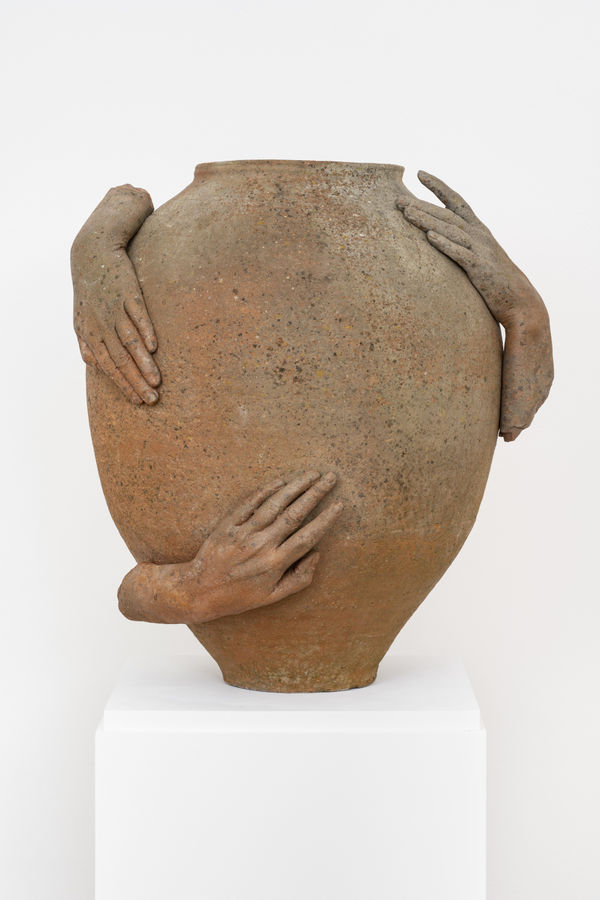
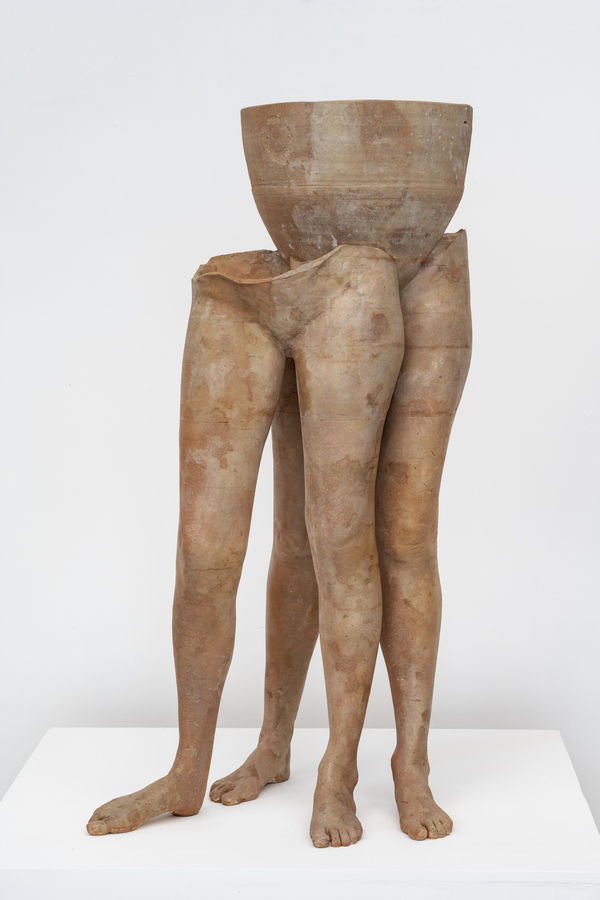
Keith-Roach first began making plaster casts of her own body when she was pregnant with her first child. Living in Athens at the time, she had discovered vessels in the city’s ancient ruins which were covered with nipple like pinches in the clay. Inspired by this find, Keith-Roach began to make casts of her own pregnant, changing body. To create works such as Libation I, Keith-Roach would cover her chest in seaweed gel, filling the mould cavity with plaster before transferring it onto terracotta vessels which she sources from countries such as Turkey or Greece. As such, her body and the vessel become one and the same.
In an interview with the Financial Times, Keith-Roach said that the discovery of these feminine vessels, and her own emulation “spoke to a very universal idea of the vessel representing the female body…There are untold histories on the skin of the vessels,” she continues. “I try to mimic that skin in the skin of the body parts.” There is also an aim to confuse the viewer visually, the combination of contemporary sculpture and ancient vessels means that one is left not quite sure of when the artwork was made. This is done by using paint and layering modelling pastes to build up a texture which makes the work appear far older than it actually is, using trompe l’oeil techniques as a kind of camouflage. By pushing and pulling paint over the vessel, Keith-Roach creates what she sees as a new ‘skin’ for the artefact. The clay itself is viewed by the artist as primarily natural in the way it is so easily moulded to the body, as well as its history as one of the earliest building and artmaking materials.
Keith-Roach’s more recent sculptures have included casts of her own or assistant’s hands. Thinking of the hands as one of the most important sense organs, she casts the hands and arms in different gestures to engage with themes of intimacy, labour, maternity, and protection. Keith-Roach gains inspiration for these specific gestures throughout art history, taking reference from such sources as Fra Angelico sacral paintings, statues of the Hindu Goddess Kali, contemporary media and her own personal photographs of her with her family. Citing Rodin’s Caryatid with Urn as an important visual influence, the action of the artist’s hands “holding up” these vessels also transforms them into caryatid-like creations, connecting them back to their ancient roots.
For Keith-Roach the body (and particularly the maternal body) is the ultimate primary object. Referencing such ancient influences as the Venus of Willendorf, one of the oldest Palaeolithic sculptures of a woman to be discovered, Keith-Roach’s humanoid vessels relate to some of the oldest artistic representations in history. Like the ancient objects she has visited in countless collections and sites in Greece and beyond, Keith-Roach sees her maternal body as both functional and symbolic; a productive, labouring vessel. Indeed, in several of her works, including Partition, the vessels are filled with a white resin as if a mother’s milk if ebbing from within, emphasising the continued productivity and changing nature of a pregnant or post-partum body. By building up a ‘collection’ of her, and her friends’ changing bodies throughout pregnancy and motherhood, Keith-Roach creates what she terms ‘anachronic’ art, works which evoke a timelessness and have the power to adapt and shift with the ages.