Lindsey Mendick United Kingdom, b. 1987
-
 Till Death Do Us Part, 2022
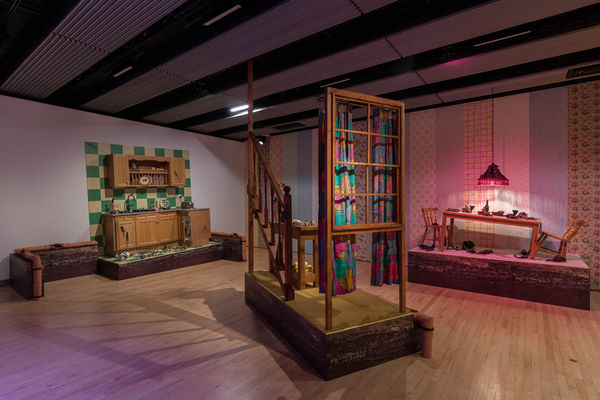
Lindsey Mendick’s Till Death Do Us Part, shows a domestic house in five parts (the hallway, the kitchen, the living room, the dining room and the bathroom). From a distance it may seem a perfectly ordinary set up of a traditional UK home, yet on closer view, one observes this home is overrun with rodents and insects. A large-scale installation that takes up a full gallery room, it was created specifically for the Strange Clay show at Hayward Gallery.
The scene is at once absurd, humorous and visually overwhelming. These ceramic rats, mice, slugs, cockroaches, wasps and moths take on an infestation like no other. In the living room, cockroaches slug it out in a miniscule boxing ring; mice go to war Spartacus-style with a giant cat-shaped Trojan ‘horse’; rats indulge in take-out food while mice and slugs battle in the kitchen, using Heinz tin cans as barricades. A sea-monster even erupts out of the toilet to shipwreck lifejacketed mice clinging to rafts. The complex scene is interspersed with art historical references to old masters: the decorative still life interiors peppered with insects looks to Dutch Vanitas genre paintings, the shipwrecked mice quote Géricault’s Raft of the Medusa. Simultaneously, Mendick, herself a millennial child of the 1990s, interweaves modern day references to Disney and Pixar movies such as A Bug’s Life or Ratatouille; in this world, insects and rodents (literally) rule the roost. A chunky old stereo is surrounded by faded CD cases of Take That and Alanis Morissette, whilst on the sofa lays a broken ceramic copy of the iconic (and politically dated) 1990’s book Men are from Mars, Women are from Venus.
At times the installation is a little disturbing or even shocking, designed to make the audience squirm. As sculptor Kiki Smith creates realist, unashamedly gory imitations of decapitated limbs to confront us with taboo ideas of death and decay, Mendick confronts the very human fear of vermin and infestation. As we walk into a home which may very well be our own, wasps, which already hold the power to hurt us, crawl over the telephone preventing outside contact; rats lie both sated and dead amongst the remains of our dinner; nightmarish tentacles crawl out of the toilet. It is purposefully grotesque, showcasing how some of our most irrational fears may come true in the safe space of a domestic home. Mendick’s high production quality and unique glazing provides direct contrast to the revulsion of the subject matter, which becomes apparent upon closer inspection, referencing the social veneer we use to cover our internal domestic spaces.
There is a strong performative aspect to the piece. Installed like a theatre production with real life-sized furniture, it is arranged in separate spaces (like the rooms of a house) so that viewers can move through. One enters the space to the sound of Madonna playing on a (ceramic) CD player, with dim lighting from living room lampshades lighting the way. Mendick’s close friend and fellow exhibitor at Strange Clay, Jonathan Baldock, also explores the potential for theatricality within ceramic, a medium perhaps least associated with ideas of performance. Both artists arrange their pieces like a stage set and incorporate sound to create a certain atmosphere and immersive experience for the viewer, turning their installation into a piece of theatre more than an institutional exhibition.
Mendick’s relationship with artist Guy Oliver is a frequent inspiration and feature in her art, with Till Death Do Us Part specifically referring to the trials of their long-term domestic relationship. The ‘micro-conflicts’ and battles which couples regularly encounter we see play out literally in miniature between these rodent characters. A now trademark aspect of Mendick’s ceramic installations, which she has included in previous exhibitions, is also the ceramic sticky note. Annotated with short, sharp phrases such as ‘you hate everything about me,’ or ‘do you think I find this fun,’ they reveal the passive-aggressive way many couples communicate and argue when living in close proximity, something which was ever more heightened during periods of quarantine over the last two years.
Mendick’s art is inherently ironic and humorous, directly influenced by her own personal experiences and immediate surroundings. Born in London in 1987, as a child, her initial interest in sculpture stemmed from her mother, who would create intricately decorated and personalised fondant-iced cakes for friends and family. Mendick’s own work takes the traditional ceramic and turns it on its head to provide the unexpected and laughable, with the artist often creating works which play on traditional ceramic forms, such as Toby jugs shaped like her severed head, or ornate vases which appear ripped apart from something hiding on the inside.
Since moving to Margate, where her representative gallery Carl Freedman is also based, Mendick has also befriended legendary Young British Artist, Tracey Emin, as well as fellow ceramic artist Jonathan Baldock, whose work is also featured in Hayward’s Strange Clay show. Mendick’s work has drawn multiple critical comparisons to Emin for its autobiographical focus and heavy themes of sexuality, relationships and mental health. In Mendick’s 2019 show The Ex Files, for instance, where she built an office as an ode to the corporate jobs she had held in the past, she included ceramic sticky notes sharing intimate details of past relationships, a feature one could compare to Tracey Emin’s ground-breaking 1995 work Everyone I Have Ever Slept With. Indeed, in Mendick’s summer show at Carl Freedman, she listed Emin in the credits for the exhibition at the entrance. The install of Till Death Do Us Part, with its disturbance of the domestic space is also similar in this thread to Emin’s My Bed. The domestic environment as a battleground for female experience (which Emin has frequently made use of) is consistent in Mendick’s work. Themes of fertility for instance (the artist has a polycystic ovary which she often references) are present in other installation pieces by Mendick, such as Can’t take my eyes off you, a work presented in 2021 for the Future Generation Art Prize at the Pinchuk Art Centre in Kyiv.
Mendick’s inspiration by other Young British Artists of the 1990s (with Carl Freedman himself an important curator of this movement) is paramount and clearly evident in her work. Aside from her inspiration from Tracey Emin, in The Ex Files Mendick also made a direct reference to sculptor Sarah Lucas with the inclusion of an office chair covered with draped leathery high-heeled legs. Noting Sarah Lucas as one of her artistic icons, this work is highly reminiscent of Lucas’ iconic Bunny Sculptures, where stuffed nylon tights were attached to chairs to create the impression of splayed limbs.
Much like Emin and Lucas, Mendick’s work is integrally unfiltered, autobiographical and socially relevant. Her latest solo show in the summer of 2022, and first with Carl Freedman, Off With Her Head, addressed the controversial, and highly political subject of the vilification of powerful women, with Mendick depicting and addressing historical and even fictional female figures ranging from Medusa to Anne Boleyn to Meghan Markle. Raw autobiographical themes are infiltrated throughout Mendick’s work. Collaborating with partner Guy Oliver, who is also a filmmaker, for this show the artist superimposed her own face onto a video of a kneeling Anne Boleyn within the exhibition, confessing her (very human) ‘sins,’ such as petty shop lifting and eating out-of-date food, a direct reference to the artist’s own obsessive thought disorder. Discussing the revealing nature of her work in an interview with The Guardian, Mendick said “I feel like the honesty is quite protective…If everyone feels you’re being honest about one thing then you can keep the real darkness at bay.”