Paloma Varga Weisz Germany, b. 1966
-
 Lying Man, 2016
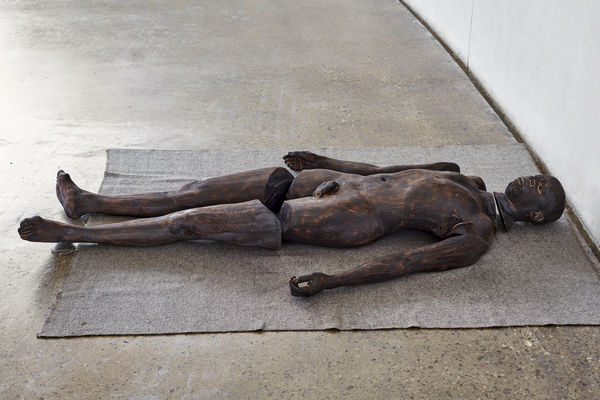
Lying Man appears to be sleeping but on closer inspection, however, the audience discovers to the figure is dismembered, burnt and blackened. The image becomes disturbing and morbid, conjuring thoughts of Christian iconography, crime scenes, historic executions, newspaper reports or forensic dissections where the viewer becomes the unsuspecting witness. The rough, medieval look of the work speaks to the metalwork sculptures made by Kira Freije, who uses medieval imagery and welding techniques to create foreboding, apocalyptic figures which speak to the doomsday Christian beliefs of the Middle-Ages.
A sculptural installation interrupting the serenity of a classic gallery space, Lying Man was made from the full body cast of a real human model. The model is Tindyebwa Agada; a former child soldier from Rwanda who was adopted by British actress and screenwriter Emma Thompson in 2003. Agada has since worked as a human rights activist. The cast model is thereafter replicated in limewood with a mechanical wood-copying lathe. Instead of putting the pieces together, like with a traditional cast, Varga Weisz has chosen to keep them separate, using a blowtorch to burn the wood of the head and limbs to imitate the dark skin of the original model. Commenting on the work, Varga Weisz has said: “I get more distance, I feel that it's more about a destructed soul than about a dissected body.”
Included in 2015/2016 group exhibition The Problem with God, which assessed the prevalence of Christian imagery in contemporary art and the concept of God, Varga Weisz’s art is strongly inspired by elements of religion. In an interview with Gladstone Gallery, the artist comments that she tends to visit churches whenever she goes to another country, seeing them now only as sanctuaries of calm but also as exhibition spaces in how the ornamentation, congregational seating and items of worship are curated. Varga Weisz tends to work with limewood, a classical material which has been used for centuries in carving and was especially pivotal as a medium during the late Gothic period and Early Renaissance. The famed medium of choice for fifteenth and sixteenth century German sculptors including Tilman Riemenschneider, Varga Weisz appreciates its neutral texture and colour which allows it to be adapted in whatever way she chooses.
Lying Man could be considered the aftermath of a saint’s beautification through execution, with Varga Weisz creating other sculptural figures with saint-like wounds and afflictions, such as covered with boil like nodules or hair. The ‘hair suit,’ something used to depict angels in Medieval times, is also associated with Mary Magdalene. This exploration of such imagery is comparable to Kiki Smith, an American sculptor, who creates figures centred around saintly characters such as Virgin Mary or Magdalene. Smith has also depicted her characters in such tortuous forms, covered in hair or flayed, working primarily in bronze but also taking great inspiration from the wooden sculptures of Riemenschneider.
As well as tied to this medieval style of saintly, apocalyptic imagery, the work draws upon relevant themes in our current political climate. Lying Man, modelled on the body of a former child soldier, recalls the image of a drowned migrant or disaster victim, an eerily familiar image in today’s news with frequent refugee drownings in the English Channel and the ongoing war in Ukraine. Indeed, Varga Weisz’s works have been compared to those of fellow German sculptor Thomas Schütte in how they resemble victims of trauma. However, while Lying Man is clearly a disturbing image, there is a serenity in the faces Varga Weisz carves, from a distance one could believe the Lying Man was dreaming rather than disembodied.
Discussing this tendency, Varga Weisz has said she notices that the faces and images of the characters she creates often end up resembling sculptures of this late Gothic and early Renaissance period, and that she can’t seem to carve a face of extreme emotion. This look of peace upon the face of such a disturbing form can invite both intrigue and confusion from the viewer and allows them to develop their own interpretation of the work as desired by the artist. This draws comparisons to artist David Zink Yi, who exhibits enormous realistically cast ceramic dead squids to create a juxtaposition with the disassociated gallery space and allow the audience to experience a complex mixture of emotions to this grotesque, yet strangely morose sight.
Paloma Varga Weisz (b. 1966) is a German artist, based in Düsseldorf. Creating figurative works that explore elements of disguise, uncovered histories and narratives, she works in both sculpture and drawing. Coming from an artist family (her father Feri Varga was a Hungarian painter), Varga Weisz was named after Picasso’s daughter, jewellery designer and artist Paloma Picasso. Having fled Nazi-occupied Paris because of his Jewish heritage, her father settled in the South of France where he mixed in similar circles to Picasso, becoming a close friend of poet Jean Cocteau, Henri Matisse and Françoise Gilot, Paloma’s mother.
Varga Weisz was classically trained in traditional methods of woodcarving, modelling and casting in Bavaria in the 1980s before formally studying for her fine art degree. Completing her studies in 1998, she gained her first solo exhibition that year, exhibiting at Galerie Bochynek in her native Düsseldorf. Her work in wood fully developed after her formal education, as she realised that as a woodcarver she had the ability to work anywhere. Beginning by making very small, delicate figurines, Varga Weisz has continued to work directly with a knife and chisel as well as using more industrial tools such as a wood-copying lathe. Usually working alone in her studio, unless when she works with ceramic or bronze and will collaborate with a workshop or foundry, Varga Weisz’s work is very contemplative, with the artist describing herself as a ‘storyteller’ and ‘painter’ in how she narrates through sculpture, rather than as a craftsman. Believing it is up to the audience to interpret the work itself, she will tend to first model an idea in clay before transferring it to wood.