Katsura Funakoshi Japan, 1951-2024
-
 Hands Scooping Up Water, 1994
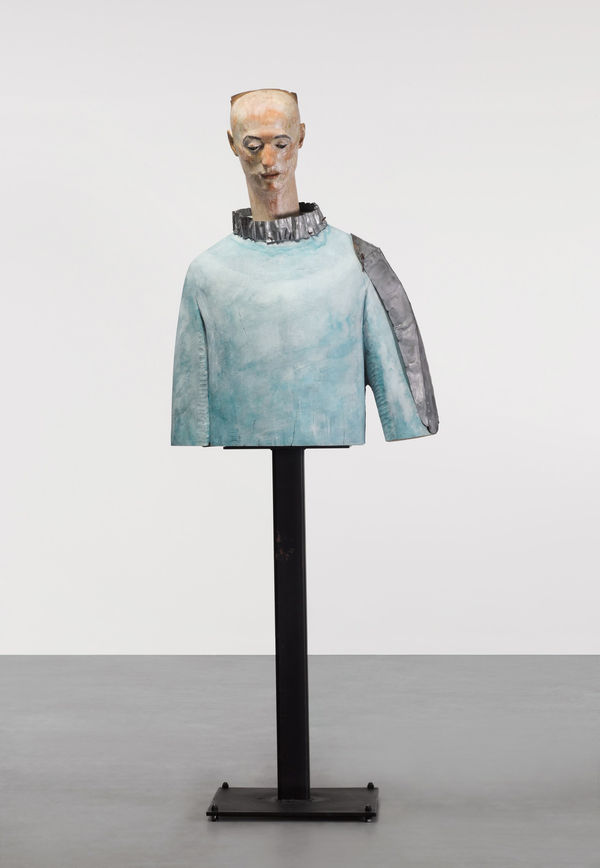
Funakoshi’s bust sculptures are some of his best known. Having worked on the human torso in wood since the 1980s, he has continued to experiment with these depictions into the present day. They are considered important contemporary interpretations of the traditional portrait bust, a depiction that spans Western and Eastern art history, and which can be found in ancient Greek and Roman sculpture, Japanese temples and Byzantine iconography.
Funakoshi has stated he wants his sculptures to express “quietude and spirituality along with power and energy.” His figures typically convey a calm and imperceptible expression, however, their depiction from the waist up also portrays a sense of solidity and strength. Carved from the malleable but heavy material of camphor wood, the torso is thick and impassable, with Funakoshi working on his busts from the waist up rather than from the shoulders down (as is the norm). There is a definite sense of tactility to his works, with Funakoshi purposefully leaving visible carving marks and natural grain and flaws in the wood, while applying pigment to other areas for extra detail. While they are sculpted with a realist approach, Funakoshi’s figures can stray into the realms of Surrealism. At times the crown of the head may be left unpainted, strange features such as handless arms or extra heads may be added, turning his busts into characters from a proverbial tale or dream. This serves to create a unique blend of abstract realism and absorbing, yet uncomfortable tranquillity that is intrinsic to Funakoshi’s sculpture.
The figures are often sculpted with downcast eyes, inviting one to step forward and engage. They are imbued with poetic, philosophical titles which speak to the character’s nuance, with the audience left questioning what grand ideas they may be pondering. The gentle stillness of the faces can be compared to the sculptures by German artist Paloma Varga Weisz, who often works with limewood, the typical medium of early Renaissance German sculptors. Varga Weisz has discussed her inability to carve a face of extreme emotion, which, like the faces of Funakoshi’s busts, prompts intrigue as the viewer attempts to interpret the figure’s expression.
Funakoshi’s own bid to capture both a physical strength and tranquillity has drawn critical comparisons to German limewood sculpture by acclaimed masters such as Tilman Riemenschneider or Viet Stoss. American sculptor Kiki Smith, while working primarily in bronze or plaster, has frequently also sought inspiration from early Renaissance wooden sculpture, seeking to convey a sense of spiritual stillness amidst physical deterioration in her hagiographic statues of Virgin Mary and Mary Magdalene. Continuing these traditions of art historical sculpture, Funakoshi also uses inlaid marble for eyes, following the practice of Japanese wood carvers of the Kamakura period and stone carvers of Ancient Egypt. This is the final application in the artist’s intensive month-long period of carving one bust. It is possibly also symbolic of Funakoshi’s reference to religious iconography, given many cultures, such as the Ancient Greeks and Egyptians, would lay painted stones upon a corpse’s eyes in the final stages of burial. A sense of ceremony and ritualism is thus instilled within the busts, further emphasised by the fact that Funakoshi is also directly influenced by Unkei Busshi, a twelfth century Japanese artist who was acclaimed for the realism he brought to his temple sculptures of Buddha. Fascinated by the sensory experience of ancient ritual, British sculptor Jonathan Baldock also includes elements of historic burial and spiritualism within his work. He regularly uses funeral herbs such as sage and lavender to fill casts of his own body or stitch into the fabric of textile pieces, reiterating saintly reliquaries and rites of paganism. For both artists, a connection to the materiality of the past is vital to both the conception and execution of their sculptures.
Today one of Japan’s most celebrated artists, Katsura Funakoshi (b. 1951) was born in Iwate, Japan to painter and sculptor Yasutake Funakoshi. Following in his father’s footsteps, in the 1970s he studied at the Tokyo University of the Arts where his father was a professor. Since 1980 Funakoshi has worked in wood after he received a commission to create a depiction of the Madonna and Child from a Trappist monastery in Hakodate. He sculpts predominantly in camphor wood from a laurel tree which mirrors a light skin tone and will typically paint and polish the surface before adding in marble stones as eyes. The distant, passive expression of Funakoshi’s characters, characterised by thin noses, arched eyebrows, elongated necks and tall foreheads, is often critically compared to the portraiture of Italian painter Amedeo Modigliani. Working in the bust format for the last thirty years, since 2005 Funakoshi has worked on his Sphinx series, a group of classical nudes that are adorned with bestial features such as elongated ears and tails.
While most of his busts are anonymous, Funakoshi occasionally sculpts portraits. A 1991 bust of the English sculptor Anthony Caro, entitled Number of Words Unarrived, is housed in the Metropolitan Museum of Art, New York. A draughtsman and printer as well as a sculptor, Funakoshi has exhibited internationally for over forty years, notably representing Japan at the 1988 Venice Biennale and 1989 São Paulo Biennale.