George Grosz Germany, 1893-1959
-
 Schlangenhaut und Pantinen, 1927
 -
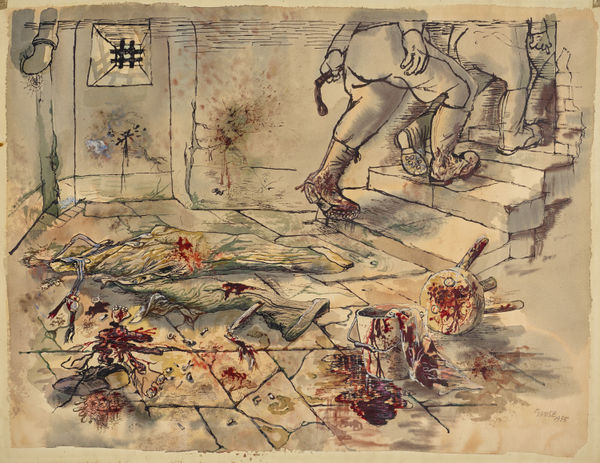
Nach dem Verhör, 1935
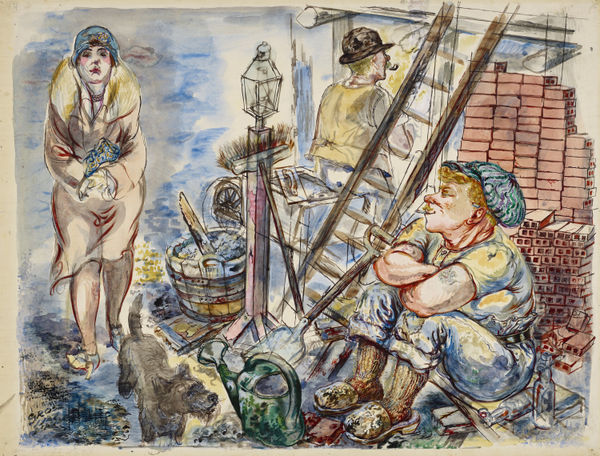
Schlangenhaut und Pantinen (Snakeskin and Clogs) (1927)was made during the Weimar Republic period when Grosz was living in Berlin. During World War I Grosz had volunteered briefly but was discharged several times with ill health, finally suffering a nervous breakdown in 1917. It was when Grosz was recovering in a military mental asylum, where he spent the rest of the war, that he began a series of rapid sketches featuring “the beastly faces of comrades, arrogant officers and lecherous nurses.” Opposed to German nationalism, the artist changed his name from Georg Groß to George Grosz in 1916. The addition of the ‘e’ and removal of the German letter ß from his surname meant it appeared less German overall while still the same phonetically. Staunchly opposed to the values of his home government, Grosz joined the Communist party in 1918, although he left in 1923 after a visit to Soviet Russia and an unsatisfactory meeting with revolutionary leader Vladimir Lenin.
Residing in his native city after the end of World War I, Grosz became a leading member of Berlin’s Dada movement from 1918, taking part in the First International Dada Fair in 1920 in Berlin alongside other artists including Otto Dix, Hannah Höch and Kurt Schwitters. Born out of the violence and loss of war, Dadaism was highly politicised and satirical, overturning traditional societal values and beliefs. Grosz’s series of works on paper depicting the bitter realities of urban German life was born out of these values. Caricatured, and at times absurdist, these works depict the abject poverty, social depravity and greedy bourgeoisie of a city caught between the desecration of war, and the rise of modern Capitalism.
Schlangenhaut und Pantinen depicts a well-dressed and bourgeois young woman with her lapdog, likely one of the many prostitutes of Grosz’s oeuvre, walking alongside a building site while she is watched leeringly by a construction worker. Grosz’s obsession, bordering on fetish, with Berlin’s grimy socio-economic landscape could be compared to American cartoonist R. Crumb, who creates illustrations which satirise the male gaze and mock male desire. The title Snakeskin and Clogs seemingly refers to the woman’s handbag and the worker’s shoes, a metaphor perhaps for Germany’s rampant class divides, and the contrast between the characters’ professions, from which they are both taking a break in the moment of capture.
Harbouring an underworld of heavy drug use, sex work and crime, Berlin was considered one of the most immoral cities in Europe. Reflecting on his cityscape cartoons, Grosz said in his 1946 autobiography: "Barbarism prevailed... The times were certainly mad! Morality as such no longer existed. A wave of prostitution and obscenity swept the land.” These satirical works which mocked leading politicians, the military, middle and working classes are some of Grosz’s most famous and have drawn critical comparisons to nineteenth century British satirist William Hogarth. They were immensely controversial at the time of execution, and Grosz encountered frequent censorship and lawsuits. The most famous of which was his illustrated book Ecce Homo (1923) which included 84 lithographs and sixteen watercolour reproductions, many pornographic images of prostitutes and their pimps. Banned by the German government the year of its publication, Grosz was subsequently charged with public offence and put on trial. It has since become a legendary document in the history of German Expressionism. The excessive sexuality and gestural style of this movement are comparable to many artists in today’s market including Ella Kruglyanskaya, whose dynamic, colourful paintings exude the same bold sexuality and bawdiness, but with a feminist twist. Indeed, Grosz’s most blatant images of sex and nudity have become emblematic of his classic style and some of his most popular works. The depiction of women by Grosz in the Weimar era are almost always erotically charged and raise many questions about the ‘male gaze’ in art. Such debates have been examined by contemporary female artists such as Sophie Thun, who infuses her photographic-collage works with historic elements of female self-portraiture as a way to disrupt the traditional trajectory of the female nude.
The public condemnation of Grosz and his politicised cartoons throughout the 1920s did much to boost his popularity internationally. In 1924 he was granted a solo exhibition at the Galerie Billiet in Paris, with renowned collector Alfred Flechtheim becoming his dealer in 1925. Flechtheim would be pivotal to the evolution of Grosz’s career and placed many of his works in state museums, although the Nazis would confiscate most of them several years later. Grosz would eventually flee to New York in 1933 to evade Hitler’s election. He would remain in America for over twenty years, during which time he would exhibit in institutions across the states, opening up his market to prominent American collectors including financier Joseph H. Hishhorn. Hishhorn’s extensive collection of more than 6,000 works was eventually donated to the US government, resulting in the founding of the Hishhorn Museum and Sculpture Garden in Washington D.C. in 1966, the institution which housed Schlangenhaut und Pantinen until 1992.
Nach dem Verhör (The Interrogation) was made just two years after Grosz relocated to America with his family after fleeing political persecution in Germany. Briefly a member of the Communist party in the late 1910s and early 1920s, Grosz was staunchly and openly critical of the Fascist Nazi party. In 1932 he had taken a brief teaching position at the Arts Students League in New York and decided to move permanently to the city a year later. Hitler would be elected German Chancellor just a week after Grosz’s departure. After his self-imposed exile, the Nazis labelled him ‘Cultural Bolshevist Number One,’ removing and destroying many of his works in German public museum collections and exhibiting the rest in the Entartete Kunst show of ‘degenerate art’ in Munich in 1937. In 1938 the Nazi government took away Grosz’s citizenship and he legally became an American citizen.
Able to freely express his political opinions in America, during the 1930s Grosz created hundreds of works which openly criticised Nazi rule. Living between Manhattan and Cape Cod, when working in New York he would spend hours roaming the streets with his sketchbook, making finished versions of his preparatory drawings at night. Nach dem Verhör was made during a darker stylistic period before Grosz’s style softened. In the last two decades of his life Grosz pursued an oeuvre of landscapes, nudes and still lifes, however in the years immediately following his exile he frequently drew apocalyptic compositions such as this one, which spoke to his criticisms of the German government. Like Sri Lankan artist Chandraguptha Thenuwara, who frequently includes references to contemporary military oppression and political violence within his work, Grosz’s 1930s caricatures comprise sobering, gruesome images of a war-ridden world.
Unhampered by censorship, which had plagued the artist during the Weimar Republic, Grosz’s politicalised cartoons are blatantly and unabashedly visceral, depicting practises of torture, mob violence, sexual assault, starvation and warfare. Grosz refuses to shy away from the realities of war and takes a similar, highly realist approach to American artist Kiki Smith, who throughout the 1980s and 1990s created series around controversial and taboo subjects such as the AIDS crisis, abortion and bodily deterioration. The 1930s caricatures would eventually evolve into Grosz’s last major body of socio-critical work The Stick Men, a late 1940s series of emaciated, Giacometti-esque figures who wander a desecrated landscape. As sculptor Kira Freije draws on medieval aesthetics to confront twenty-first century apocalyptic anxieties of climate crisis and an AI takeover, Grosz responds to 1930s society by depicting a bleak, satirised, and yet all too realist, existence.
Similar politicised works on paper by Grosz executed in the 1930s are held in multiple institutional collections including the Metropolitan Museum of Art, New York; Museum of Modern Art, New York and Art Institute of Chicago. A 1938 watercolour and ink drawing entitled The Interrogation is housed in the Ben Uri Gallery and Museum in London, bought with the assistance of the UK Art Fund. It is arguably the ‘before’ image to Nach dem Verhör (1935), as it depicts guards in the midst of whipping and torturing a prisoner (while Nach dem Verhör portrays the bloody aftermath). The Interrogation as a subject is believed to refer to the murder of Grosz's friend, writer, Communist and anarchist Erich Mühsam, and may also refer to the imprisonment of Grosz’s other friend Dr Hans Borchardt, who was imprisoned in camps at Dachau and Sachsenhausen before escaping. Jewish German-American philosopher Hannah Arendt, who fled Nazi rule herself after being briefly imprisoned by the Gestapo, commented that what made Grosz’s cartoons so disturbing is the actual truth behind them, they “seemed to us not satires but realistic reportage: we knew those types, they were all around us.”
Grosz is today considered one of Germany’s most important mid-century artists and satirists. A follower of Dadaism, he was also a leading member of Neue Sachlichkeit (New Objectivity), a German realist art movement of the 1920s and 1930s also associated with artists Otto Dix, Christian Schad and Georg Schrimpf.
Born in Berlin in 1893, during World War I Grosz volunteered briefly but was later discharged from military service in 1917 after suffering a nervous breakdown. It was during this period recovering in a military mental asylum that he began a series of rapid sketches featuring “the beastly faces of comrades, arrogant officers and lecherous nurses.” Joining the Communist party in 1918, he became one of the leading members of Berlin’s Dada movement. Born out of the violence and loss of World War I, Dadaism was highly politicised and satirical, overturning traditional societal values and beliefs.
In the inter-war Weimar period, Grosz made thousands of drawings and paintings of Berlin’s increasingly wild nightlife, cabaret-scene and underworld of drugs and prostitution. His work was frequently censored, with Grosz’s portfolio of Ecce Homo drawings (largely pornographic images of pimps and sex workers) confiscated in 1923. Following the rise of the Nazis in the 1920s, Grosz’s work became increasingly darker and critical of the German government, with his subject matter covering sex crimes, corrupt Capitalist businessmen and wounded soldiers. Fleeing political persecution, he came with his family to New York in 1933, where he remained for the next two decades. While Grosz attempted to reinvent his art and depict softer subjects after leaving Germany, he continued to make several visceral, apocalyptic works attacking the Nazi government. Accepted into the American art community, in 1937 Grosz received a Guggenheim Fellowship and in 1941 was the subject of a major retrospective at the Museum of Modern Art in New York which later toured institutions around the United States. Exhibiting nationwide and teaching at art schools throughout the 1940s and 1950s, in 1959 Grosz returned to his native Berlin where he died shortly after.
The George Grosz in Berlin association was founded in 2015. In February 2022, the Grosz estate announced a privately funded museum of Grosz’s work, The Kleine Grosz Museum (Little Grosz Museum), would open in May 2022. Housed in a former petrol station, this is the first museum dedicated to his art in Berlin. The project was led by Ralph Jentsch, the managing director of the Grosz estate and editor of the artist’s catalogue raisonné.