R Crumb United States, b. 1943
-
 Untitled (Page from Art & Beauty Magazine, Number 2, 2003), 2002
 -
Untitled (Page from Art & Beauty Magazine, Number 3, 2016), 2013
-
Untitled (Page from Art & Beauty Magazine, Number 3, 2016), 2013
-
Untitled (Page from Art & Beauty Magazine, Number 3, 2016), 2015
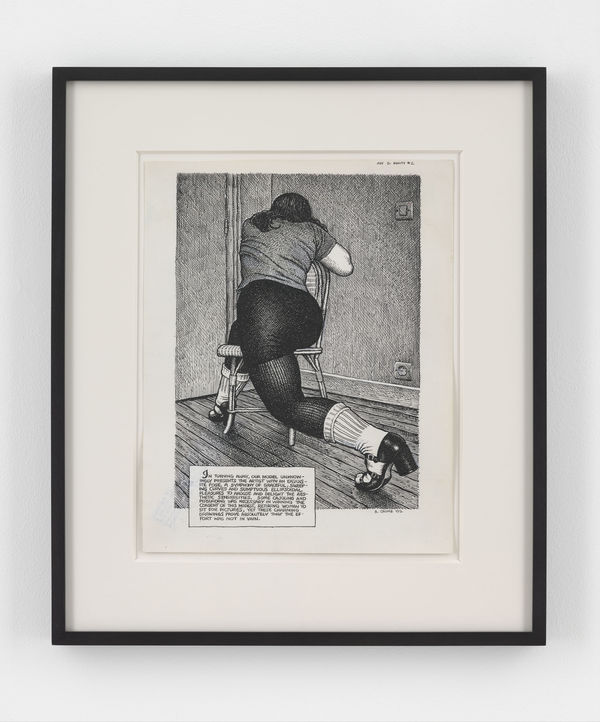
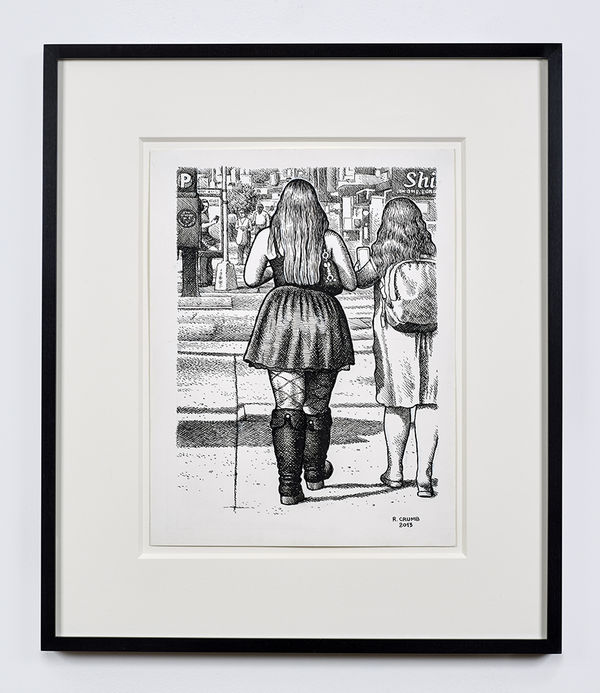
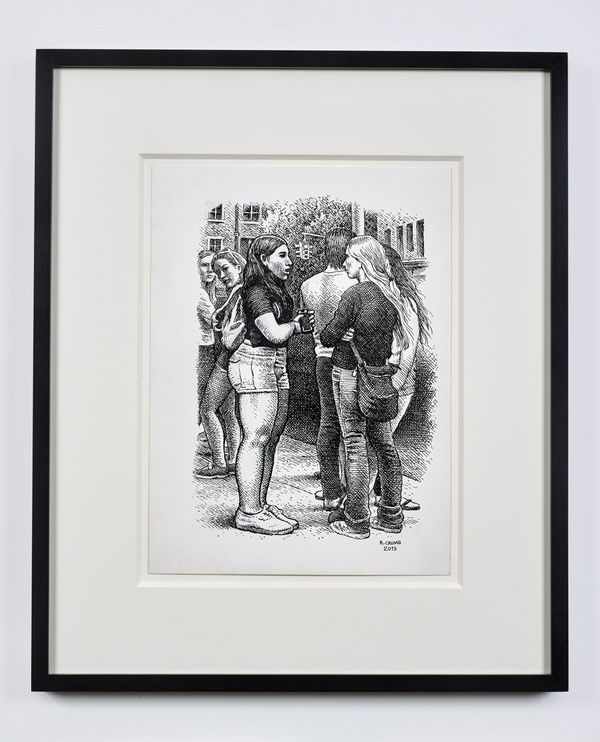
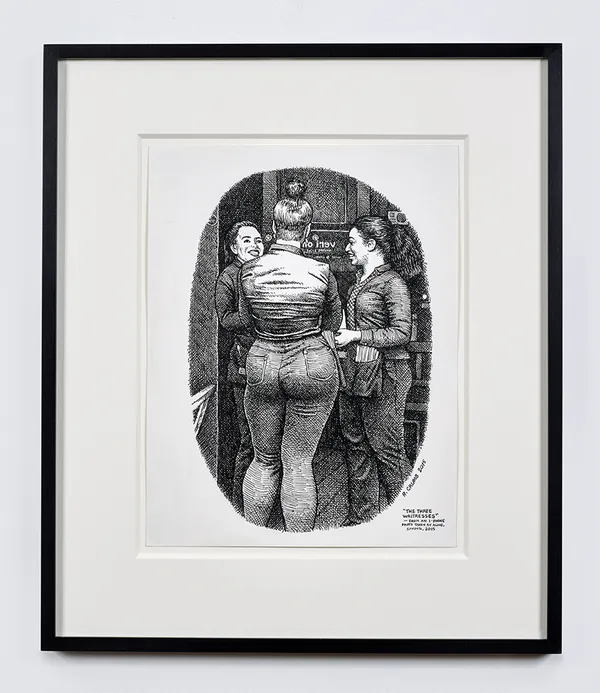
All four of these works come from Robert Crumb’s (or R. Crumb) Art & Beauty magazine, which was first published in 1996. A second volume followed in 2003, (in which the first 2002 work was featured), with the rest of the works featured in the third and most recent issue, published in 2016. Art & Beauty takes its name from a soft porn catalogue of the 1920s and 1930s, several copies of which are in the personal collection of Crumb. Published under the high-brow title Art & Beauty Magazine for Art Lovers and Art Students to evade censorship, the catalogue featured images of nude and semi-nude ‘life models’ and is considered one of the first ‘top-shelf’ magazines.
This catalogue provided the starting point for this series by Crumb, a lifelong collector of vintage art, with many of the works featuring images directly copied or traced from the original magazines. Crumb’s Art & Beauty also draws on symbolism and iconography from throughout art history and popular culture. Characters and motifs from tabloid news, reality television and social media populate the pages of the magazine, with each image accompanied by cartoon-esque or journalistic style commentaries. The tongue-in-cheek, satirical publication is intermingled with a thread of academic inspiration, with the accompanying text sometimes featuring real life quotations from artists including Leonardo da Vinci, Paul Cézanne, Salvador Dalí and Andy Warhol.
Three of these works come from the third volume of Art & Beauty Magazine, which was more digitally influenced than previous issues. Its characters were directly influenced by the rise of a ‘filtered’ or ‘re-touched’ beauty standard and social media, with Instagram founded just a few years previously in 2010. Selfies, and camera phone snapshots, several emailed directly to the artist by wannabe muses, provide the starting point for many of these works on paper compositions. In comparison to previous works by the artist, in many of these images Crumb is working from the women’s own portrayals of themselves. As well as including familiar faces from Crumb’s personal life – such as his wife and collaborator Aline Kominsky-Crumb, whose portrait adorns the first ever volume of Art & Beauty – celebrities such as tennis star Serena Williams or television personality Coco also feature.
The artist has been very open about his own fixations on women, even writing a comic book on the subject, My Troubles with Women in 1990. Sent to Catholic school as a child where he was rejected by girls and terrorised by his nun teachers, Crumb also had a difficult relationship with his mother, who frequently abused amphetamines and had a turbulent, sometimes violent relationship with Crumb’s father. Drawing women in an ultra-sexualised and often demeaning light has thus become a method of catharsis for the artist, as well as a way to satirise popular culture. While Crumb has faced great criticism from critics and Feminist writers for his depiction of women, others argue that he merely presents us with an up-close-and-personal exposé on how society conditions us to view women in the media and beyond. This could be compared to German mid-century satirist George Grosz and his overtly eroticised images of prostitutes in Weimar Berlin, a purposefully political choice which Grosz claimed spoke to the social degradation of post-war society.
Addressing the controversy over his approach to women Crumb has said “yes, I’m guilty of looking at women as ‘sex objects’, I’ve done it thousands of times over the course of my life. I could not help it. The sight of a woman with a large ass and strong legs instantly electrified me. It was not something I could stop myself from feeling. I could only stop myself from acting on it, and therein lies Freud’s Civilizations and its Discontents.” Crumb’s blatant fetishisation of the traditional “feminine” body (curves, large hips and breasts) is rooted in artistic representations of the female body dating back centuries, ranging from the voluptuous Renaissance nudes of Titian and Rubens to the evolution of the pin-up girl and page-three model. While many may still take issue with Crumb’s interpretation, contemporary female artists are also engaging with a historical obsession with the female body. Latvian painter Ella Kruglyanskaya for instance, paints vibrant, bawdy portraits of curvaceous women, but with a distinct feminist twist and appreciation from the ‘female gaze.’
At the heart of Crumb’s work is a sense of the uncanny. Much as American artist Kiki Smith creates visceral, sometimes grotesque sculptures of the human body and its deterioration to confront taboo issues of AIDs, abortion and death, Crumb’s images confront the viewer with the uncomfortable reality of our society’s own obsession with sex and the female body. Discussing the appeal of Crumb’s work in a 2016 interview with The Guardian, Lucas Zwirner remarked “There’s something irreconcilable at the heart of the work that doesn’t resolve towards a single vision of beauty, and which is at odds with much contemporary art. It’s about seduction and repulsion. You are drawn into the work and you are judging yourself as you look at it.” Ironically, in the last few years following the third publication of Art & Beauty, Crumb has turned away from erotic images towards political satire, explaining that now he is in his mid-70s his libido is failing and he is no longer so interested in depicting women in such a sexualised light.
All of these works were included in R. Crumb: Art & Beauty (April – June 2016) at David Zwirner, London. The largest presentation of the project to date at the time (it included more than 50 works), it followed the publication of Crumb’s third volume of Art & Beauty. The show also marked his first solo exhibition in Britain following Crumb’s 2005 retrospective at the Whitechapel Gallery.
Robert Crumb, known in the illustration and comic world as R. Crumb, is one of America’s most celebrated graphic artists. He first rose to prominence for his work in San Francisco’s 1960s underground comic movement, where he created a number of popular characters such as Mr Natural, Snoid and Fritz the Cat, many of whom he developed under the influence of psychedelic drugs. From the 1970s and into the 1980s Crumb’s work became darker, containing themes of sexual violence, racism, deviancy and incest, which drew considerable public criticism from members of the third-wave Feminist movement and rising conservative Christian groups under President Reagan.
In the 1990s, Crumb’s work entered the fine art sphere. The 1994 documentary Crumb by his friend and band-mate Terry Zwigoff won the grand jury prize at the 1995 Sundance film festival, delving into the mental health history of Crumb’s family and his career and gaining significant critical praise. New York art dealer Paul Morris, who continues to support and comment on Crumb’s career to this day, began working with the artist in 1997, with Crumb’s work entering the secondary public market two years later.
Crumb’s absurdist grotesque scenes have been critically compared to the compositions of Bruegel and William Hogarth, as well as the German Expressionist images of Weimar-era Germany which regularly featured eroticised and violent depictions of women and sex. Late legendary art critic Robert Hughes declared in 2005 that Crumb was “the one and only genius the 1960s underground produced in visual art, either in America or Europe.” A prominent pop culture figure that is now synonymous with the American comics genre, Crumb is collected by many notable private collectors and celebrities including Leonardo DiCaprio. In 2015 the original copy of Crumb’s Book of Genesis was bought by Star Wars creator George Lucas for 2.9 million USD. One of the most successful graphic books of all time, with over 200,000 copies sold worldwide, it was ranked number one on The New York Times Graphic Books bestsellers list upon its publication in 2009. Also exhibited at the 55th Venice Biennale in 2013, the original Book of Genesis is now housed in the Lucas Museum of Narrative Art in Los Angeles, which is set to open in 2025. Crumb’s notebooks, which he has kept throughout his career, are now reported to sell for close to a million each on the private market.
Since 1991 Crumb has lived as a relative recluse in the South of France with his wife and daughter, both of whom are also cartoonists. Disconnected from much of the outside world (he reportedly doesn’t even own a cellphone), and now in his mid-70s, Crumb makes few public appearances. Most recently, his illustrations have focused around family life, with Crumb depicting his own paranoia and conspiracy theories around Covid in comparison to his vaccinated, wellness-loving wife Aline (also a prominent cartoonist). His partner and frequent collaborator for over forty years, Aline died of cancer in November 2022.
Institutionally and privately collected in both America and Europe, particularly France where he has exhibited regularly since the early 1990s, Crumb has had several major international retrospectives, including touring shows R. Crumb’s Underground (2007-2009), and The Bible Illuminated: R. Crumb’s Book of Genesis (2009-2011), both of which toured institutions on the West and East Coast of America. Crumb’s most recent show with David Zwirner, whom he joined in 2006, was a group show which displayed work by all three family members together for the first time and which opened in Paris, February – March 2022.