Ella Kruglyanskaya Latvia, b. 1978
-
 Menu, 2012
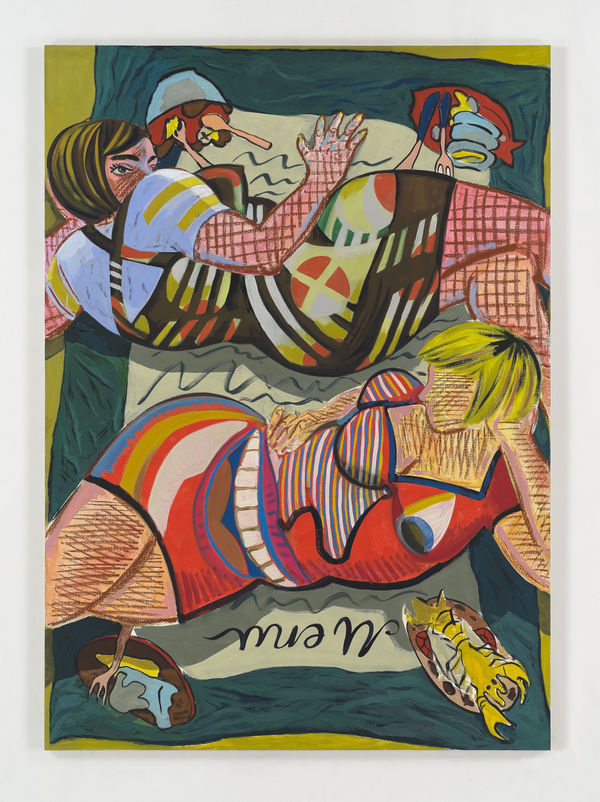
In Menu (2012) Kruglyanskaya clearly addresses the old-fashioned phrase (typically directed at women) of looking “good enough to eat.” Reclined provocatively on a picnic blanket amid half-discarded plates of food, Kruglyanskaya’s women are seen from the perspective of the presumed lustful male who is reflected visually winking and guffawing on the apparel of the frontmost blonde woman. Interestingly, while the brunette figure is half turned towards the frame with a flirtatious batting eye, the blonde character is faceless; the viewer thus embodies the admirer who sees her entirely objectively and only as a ‘piece of meat.’ This take on an ‘objective’ view of women can be seen in the context of Kruglyanskaya’s early career, she first trained as an artist by painting still lifes, a genre she continues to explore.
At the core of Kruglyanskaya’s work is the essence of ‘looking’ and an effort to turn the traditional ‘male’ gaze on its head. Her notion of reflecting the male gaze is a stance dating back to such famous works as Édouard Manet’s 1882 masterpiece A Bar at the Folies-Bergère, where we as the viewer become the male patron, reflected in the mirror talking to the barmaid who faces us. In Kruglyanskaya’s modern interpretation, the typical role of the male voyeur is reversed and the female subject looks defiantly back at you. A style that has been described as ‘cartoonist’ and more akin to illustration than fine art, some critics have noted that Kruglyanskaya’s characters and humorous, tongue-in-cheek scenarios would look more at home in The New Yorker or Punch cartoons. Sherman Sam, writing a piece on Kruglyanskaya for Artforum in 2015 noted the possible influence of Robert Crumb, an American cartoonist known for his fetishisation of curvaceous women, within the bawdy energy of Kruglyanskaya’s paintings. Indeed, when discussing the motives for her 2006 work Bathers, which was one of the star pieces in her 2016 Tate Liverpool retrospective, Kruglyanskaya said, “well, I’m just gonna do the most obvious thing, which is tits and ass. Humour is really important in my work. Also humour is a very modern feature of art.”
The sexuality and glamour Kruglyanskaya projects is consistently comical and even farcical. Women are shown aghast in ‘compromising positions’ such as covered in paint spills, entangled in ropes, draped over settees or sunbathing on the beach. The images are eerily nostalgic and could easily be lifted from the pages of 1950s sexist ads or women’s magazines. By poking fun, Kruglyanskaya gains the upper hand. Recognising the humour in sexuality is a trope also used by Young British Artist Sarah Lucas. Known primarily for her provocative soft sculptures and use of banal materials to represent genitalia, like Kruglyanskaya, Lucas mocks society’s sexualisation of women by finding hilarity in the sexual form.
Sensuality in material is also a key component of Kruglyanskaya’s practice. Drawing comparisons to Matisse in her use of vibrant pattern, Kruglyanskaya works with oil, oilstick and egg tempera on canvas and panel, taking great delight in the tactile pleasures of the paint with erotic, suggestive euphemisms dotted throughout her paintings. The women she depicts are constantly in control, taking ownership of the viewer’s gaze rather than falling into submission, embracing their sexuality rather than losing agency. Even the way the women’s forms are painted, with strong muscular legs, large breasts and hourglass figures, gives them substance and power upon the canvas. Closely cropped, they fill the entire frame on a cinematic scale as if to spill out into our consciousness. There are no shrinking violets in Kruglyanskaya’s paintings. Men are rarely seen, with their presence only hinted through the visual impression of a grimace or shadowy outline.
Similar to German photographic artist Sophie Thun, who frequently engages with traditions of female self-portraiture and depictions of female subjects, Kruglyanskaya rejects gender boundaries when it comes to typical motifs of art history. She does this through irony and humour, embodying sexist stereotypes and assumptions as a way to refute them and point out their absurdity. In her 2018 painting Painter, Discontented, a female artist is depicted brush in hand and dynamically contorted in a pose of frustration beside a painted abstract work, an overall image which could easily be compared to studio photographs of Abstract Expressionist artists such as Jackson Pollock or Willem de Kooning. The ‘tortured genius artist,’ a stereotype almost exclusively applied to men, has been depicted in numerous works by male artists such as Lucian Freud’s Painter Working, Reflection (1993) which depicts the artist full-frontal and brandishing his paintbrush aloft. In Kruglyanskaya’s own version, Art Wench (2018), a busty blonde woman bears two mugs of paintbrushes aloft like pints of beer in front of her cleavage, an image Kruglyanskaya has stated is “my own crisis represented.”
Kruglyanskaya’s work itself holds a great deal of reference, ranging from German Expressionism and ancient Etruscan wall painting to mid-century cinematography and advertisement. Women are usually shown in pairs, emphasising the theme of female friendship that runs throughout Kruglyanskaya’s work. Inspired by the work of Italian author Elena Ferrante, whose Neapolitan Novels famously celebrate the complexes and intensity of female companionship, Kruglyanskaya’s characters are both friends and ‘frenemies,’ shown gossiping, arguing or lounging together. In a commission series for Studio Voltaire in 2014, the artist’s first solo show in a public gallery outside the US, Kruglyanskaya created a series of large-scale oil paintings which depicted the women in vigorous, sometimes male-dominated labour, “grooming, brooming and brick-laying.”
Drawing is a crucial stage throughout Kruglyanskaya’s work. Viewing her sketches as stand-alone pieces where she can experiment free of restrictions, they will often feed into her finished painted works or be copied directly in paint as finished compositions. The artist often also utilises the ancient technique of egg tempera in her work. A medium usually associated with religious iconography of the medieval and early Renaissance period, it allows long-lasting vibrancy and a lush texture.