Denzil Forrester Grenada, b. 1956
-
 In Homenow, 2022 - 23
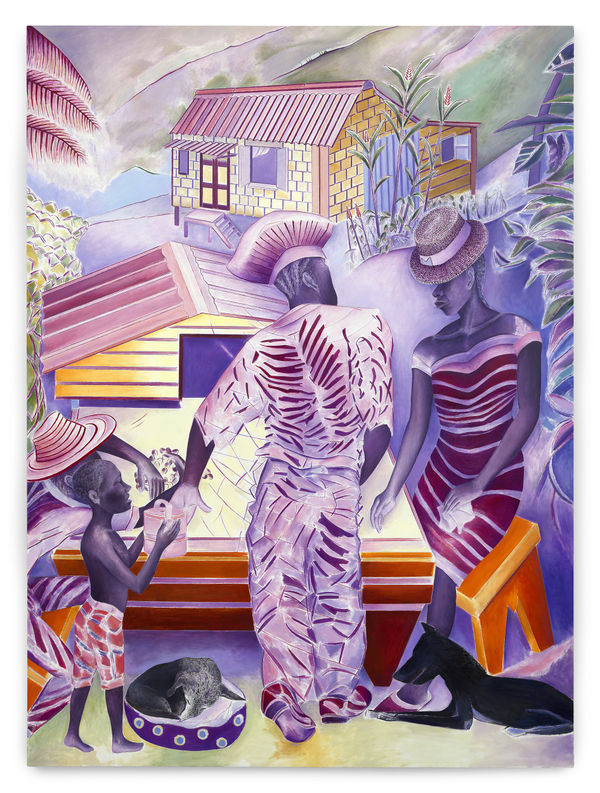
Living in London for many decades, Forrester moved to Cornwall in 2016, a transition which has appeared to have had a nostalgic impact upon his oeuvre. Discussing Forrester’s more recent work, artist Peter Doig has stated that Forrester’s new paintings “emerge as much from his imagination as from his studies of real life,” possessing “a subtlety and form that has perhaps come about because he is reflecting upon his past." In this work, Forrester reimagines a scene from his childhood growing up in a farmhouse in the West Indies. The two adult figures depicted are Ma Pets, a local schoolteacher, and Pa Clame, the couple who housed and cared for Forester for seven years after his mother emigrated to Britain. On the left-hand side, a young Forrester holds aloft a small pail, while behind him, head farmhand Godwin clasps a handful of fruit which he has picked from the nutmeg trees around the farm. Every character is turned away from the viewer and all faces apart from Forrester’s are obscured. As such one is made aware they are merely a voyeur, intruding upon a tender memory to which only Forrester is truly party. While the image itself is not realist in style, like John Hoyland, who attempts to replicate the abstract essence of the Caribbean in his work, Forrester seeks to infuse his pictures with the vibrant reggae energy which has become vital to his practice, rather than paint true to nature.
In Homenow displays its scene like a photo snapshot, its vibrant colour palette and illusory sense of depth and perception evoking a dreamlike quality. Similar to British artist Nick Goss, who infuses his oil on linen paintings with elements of personal memory, fragments from across Forrester’s life are pieced together in this image. For instance, Ma Pets dons a traditional 1960s Grenadian hat while Pa Clame wears what appears to be a classic Rastafarian ‘tam.’ Godwin wears a replica of a boater that Forrester was gifted by a friend in the 1980s. The small, sleeping dog, lying in a bed at Forrester’s feet is a touching tribute to the artist’s own pet dog, who passed away shortly before this was painted. The composition of In Homenow is quieter and more enclosed than Forrester’s signature pulsating nightclub scenes which often feature seething crowds of frantic dancers. There is however a use of pattern and fluid line which projects the work out of the frame, with the electric, almost neon purple palette serving to bring the scene to life.
While it is Forrester’s nightclub paintings that he is most well-known for, the influence of reggae music and rave culture dates back to his childhood in Grenada. Forrester has discussed memories of Carnival week as a child - “Carnival of course is all over the West Indies, it’s part of your DNA if you’re from there” - describing it as a “week of rave” with every village organising their own Carnival group of dancers and musicians. Forrester has emphasised how London’s club scene hence provided a sense of escape and familiarity for the city’s Afro-Caribbean community in the post-Windrush years, with reggae music originating in Jamaica in the 1960s and coming to the UK around the same time as Forrester himself. While the artist has continued to make nightclub works, in recent years Forrester’s paintings have become increasingly autobiographical, evoking scenes from his childhood, both in Grenada, and Stoke Newington, London, where he moved to live with his mother in 1967.
Denzil Forrester (b. 1956) grew up in Grenada, the West Indies, moving to London aged eleven in 1967. Studying at the Central School of Art, he responded particularly to the artists Van Gogh, Matisse and Picasso, as well as German Expressionists Otto Dix and Max Beckmann.
A keen participant in the reggae and dub nightclub scene of the 1980s in London, it was during this time that Forrester first developed his signature artistic practice. Bringing a sketchbook to nightclubs he would make drawings in pastel and charcoal of the dancing crowd, the time dedicated to each sketch dictated by the length of the soundtrack. Thousands of these quick preparatory drawings would feed into subsequent paintings. Aside from his nightclub paintings and autobiographical works, much of Forrester’s early work references police brutality against the British Black community. Similar to Sri Lankan artist Chandraguptha Thenuwara, who inserts military motifs referring to contemporary conflict, Forrester often includes sinister references to police violence in his work. Several of his most famous paintings, such as Death Walk (1983) address the arrest of Forrester’s friend Winston Rose in 1981 (the year of the Brixton riots), who died in a police van after being restrained and beaten by eleven police officers. Forrester has continued to address current police violence against the Black community, such as in recent painting Q (2022) which addresses the case of ‘Child Q’ where a fifteen-year-old Black girl was illegally stripped searched.
Familiar figures reappear throughout Forrester’s oeuvre, with the artist sometimes repeating previous paintings to create an alternate composition, a process he has likened to dub music and remix culture. Many works are also titled for dub tracks. A key example is Three Wicked Men (1982), which has been ‘remixed’ multiple times by Forrester into pieces including Brixton Blue (2018) a commission for Brixton tube station in London. The original Wicked Men was donated to the Tate Collection in 2017 by Scottish artist Peter Doig.