Hew Locke United Kingdom, b. 1959
-
 The Procession: Group K, 2022
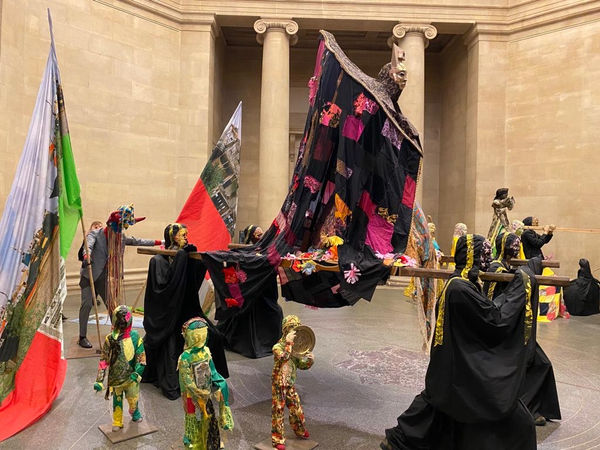
The Procession, Locke’s most ambitious project to date, was the 2022 annual commission for Tate Britain’s Duveen Hall. The whole project took over a year between Locke and eight assistants and consists of almost 150 life-sized individually decorated figures and five horses. Highly immersive and unsettling it draws the viewer in, encouraging them to walk alongside and immerse themselves as a follower of the mysterious procession. One is left wondering as to its purpose and its eccentric characters - is it a protest, a march to war, a carnival, a Día de los Muertos celebration? All these options seem plausible in its visually kaleidoscopic composition.
Installed throughout two neo-classical colonnaded halls, this was the twenty second commission for the space by the Tate museum group, with previous installations by artists including Fiona Banner, Phyllida Barlow, Mike Nelson, Pablo Bronstein and Cerith Wyn Evans. The effect is overwhelming, awe-inspiring and distinctly eerie with each figure heavily individualised and dynamic in its movement. Some brandish banners, balance on stilts, ride on horses or sit in wheelchairs, beating drums or dancing with hands outstretched. Their faces are concealed by animalistic or ghostly masks, flowers or headdresses, with the addition of elaborate, colourful costumes making them appear like fantastical creatures or characters in some psychedelic fairy tale. The composition is like that of a work by Alexandria Smith who takes inspiration from Surrealism, experimental science fiction and the dream state to create otherworldly assemblages and paintings which are simultaneously vivacious and disquieting. While the effect of The Procession is carnivalesque, there is a multi-layered atmosphere, with New York Times critic Elizabeth Fullerton describing the installation as “part religious pageant, part carnival, part danse macabre.”
Like Denzil Forrester, whose vibrant palettes are often inspired by the Carnival culture of his native Jamaica, Locke’s style is highly influenced by the Caribbean aesthetic of masquerade and ideas of magic realism. However, The Procession is purposefully ambiguous and multi-cultural in reference, emblematic of the artist’s own background growing up in Guyana during a period of South American expansion and territory dispute. Part of the Windrush Generation, Locke lived in Guyana for most of his childhood, born thirteen years before the country became a Republic and gained full independence from the British Empire. Frequently engaging with themes of nationalism and secretive, often forgotten colonial history, Locke has said that if he had not been an artist, he would have become a historian or worked for the United Nations. For over ten years he has collected certificates for company shares for now defunct firms such as the West India Improvement Company or Black Star Line, the latter a shipping company set up by early twentieth century Black nationalist Marcus Garvey. In an interview published in Tate Etc., curator Elena Crippa stated that Locke had been inspired to create The Procession after hearing the press briefing for Tate Britain’s 2015 show Artist and Empire, which the artist found uncomfortably dismissive of the collection’s dark heritage. Henry Tate, the founder of the museum and collection, was a sugar refinery merchant whose wealth was largely created through the Transatlantic slave trade, a fact which adds an unsettling tone to Locke’s installation.
Intensely informed by these themes of a shadowy colonial past, visual references are subtly interwoven within The Procession. The 1788 illustration of the Brooks Slave Ship, which shows the horrendous conditions in which Africans were transported, is printed onto the costumes of one of the figures carrying a banner. Two figures bear the death mask of an English general on a pole while another dressed in black crepe is eerily reminiscent of Queen Victoria, the monarch who oversaw the brutal, military led expansion of the British Empire during the nineteenth century.
There is also an important link to contemporary conflict, specifically the climate crisis. Alongside custom printed fabric, second-hand materials of tartan, batik, sari silk and embroidered cloth are compiled to create the elaborate characters. They themselves carry images which not only remind us of our colonial past, but also our detrimental impact on the planet, with banners showing rising sea levels and crumbling architecture as well as sail boats, a hint perhaps to the escalating refugee crisis in Europe. Speaking on the concept behind The Procession and how it is relevant today, Locke says: “There are lots of messy nuances in history, so my commission is like a spider’s web, with one thing linking to another. You may think, this doesn’t link to that, but for me, even if it’s not necessarily literal, there’s a poetic link. You’re talking about a global situation and that’s even more relevant now because of climate change and how that connects us all.”
Hew Locke is a Scottish sculptor and installation artist. Born in Edinburgh to a Guyanese father and British mother, both of whom were artists, Locke lived in Guyana from the ages of five to twenty, moving to the UK to study art at Falmouth University and the Royal College of Art in London. Frequently engaging with themes of British nationalism and colonialism, Locke’s works often include relevant recurrent motifs such as boats, heraldry, coats of arms, public statuary and royal regalia. Locke has received several important public commissions over his career, including being shortlisted for an installation on the Fourth Plinth in Trafalgar Square in 2010, and installation The Jurors, which was commissioned in 2015 by the Prince of Wales (then Duke of Cambridge) to mark 800 years since the signing of the Magna Carta.