Josh Kline United States, b. 1979
-
 In Stock (Walmart Worker’s Arms), 2018
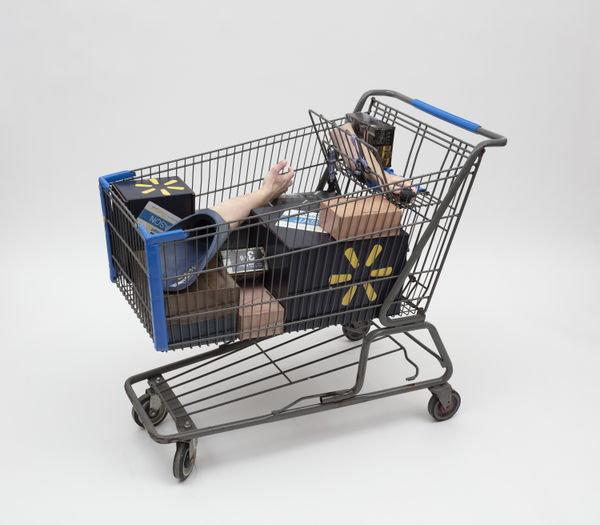
For the last fourteen years Kline has made artworks in three separate groups: Creative Labor (2009–2014), Blue Collars (2014–2020), and an ongoing cycle of installations. In Stock (Walmart Worker’s Arms) (2018) is part of Blue Collars, a series where Kline addresses the identities and struggles of essential workers in modern day America. The series is essentially an exercise in portraiture, with Kline using photogrammetry to create 3D scans and printed models of the bodies of real blue-collar workers, such as waitresses, deliverymen and hotel staff, with whom he also conducts videotaped interviews. In works such as In Stock, Kline arranges the dismembered body parts of these workers amidst the tools of their day-to-day work. A FedEx worker’s head, still wearing a baseball cap, rests on top of his open delivery box. A waitress’s arm, clutching her orders pad, sits atop a lunch table amidst the burgers and fries she has just served. Through this disturbing composition Kline purposefully dehumanises this sector of society to the extreme; they have not only ‘sold their soul’ to the company machine but now their bodies as well. Like Nicole Wermers and her Reclining Figures series, everyday labour and the instruments of this labour have become embedded within the very bodies of the individuals who operate them. They have become no more than commodities, traded, instrumentalised, exchanged and misused in a highly transactional consumer society and unable to separate themselves from the roles in which they function.
The working population and its struggles have been a key focus of Kline’s work since very early on in his career. In 2009 Kline helped organised the first group exhibition for artist-run space 179 Canal (which later evolved into commercial gallery 47 Canal). Entitled Nobodies New York, it brought together work by emerging, ‘nobody’ artists, including Alisa Baremboym, Antoine Catala, Devon Costello, Tatiana Kronberg, Anicka Yi, and Kline himself. It opened on May Day, the national holiday dedicated to workers, with the press release addressing the realities and difficulties of working life during the early financial crisis. Another group of early work by Kline included installations of IV drips for ‘rest’ and ‘work’ which were labelled with typical ingredients people ingest every day, such as expresso, ambien and ritalin, to cope with the demands of working life. This provided another commentary by Kline on how our bodies have become mere working tools which we seek to control to meet increasingly unrealistic demands.
The titles Kline uses for his art pieces are similarly emblematic of his view of America’s blue collar work populace. Titles such as 20% Gratuity, Packing for Peanuts and No Sick Days demonstrates the grim reality of many zero-hour contracts and minimum wage working conditions. The series also directly informs Kline’s subsequent group, Unemployment, where he addresses the possibility that emerging AI technologies replace most middle-class office workers. Once again human bodies are scanned and 3D printed, although this time they are bagged up disturbingly like rubbish or new products, providing a highly unsubtle message of how Kline suspects these massive, faceless corporations will treat their workers in the future. Reflecting on his Whitney retrospective, New York Times reporter Emma Goldberg stated “he [Kline] blurs the relationships between present and future, reality and dystopia.” Unlike artists such as Kira Freije, who employ art historical, antiquated references to address apocalyptical themes in their art, Kline finds the apocalyptic potential right within our capitalist contemporary society, blatantly confronting us with uncomfortable, even terrifying truths.
Working in sculpture and installation, Kline’s largest body of work to date is his multi-media installations where he combines design, video, sculpture and photography to make an immersive experience. An encompassing theme of his work and artistic focus is contemporary crisis within Modern American society. Speaking on the subject, Kline observed how the entirety of his adult life spent in America has been chaptered by various crises, beginning with the election of George W. Bush when he was twenty-one, followed shortly after by 9/11, the invasion and occupation of Iraq and the 2008 Recession. In an interview by the Whitney, Kline has said “My art is about this larger crisis you see when you zoom out…My work right now is about the future, but it’s also directly influenced by and about current events.” In recent work, he has experimented with new technologies and AI such as deepfakes, making disturbing and thought-provoking video pieces such as Forever 48 and Forever 27 (both 2013) where actors are deep-faked to resemble Kurt Cobain and Whitney Houston. Also influenced by the drastic progression of climate change, Kline’s short-film, ADAPTATION (2019-2022), a sci-fi interpretation of a futuristic flooded city, was recently exhibited at LAXART (February – April 2022).