Anne Collier United States, b. 1970
-
 Photographer, 2021
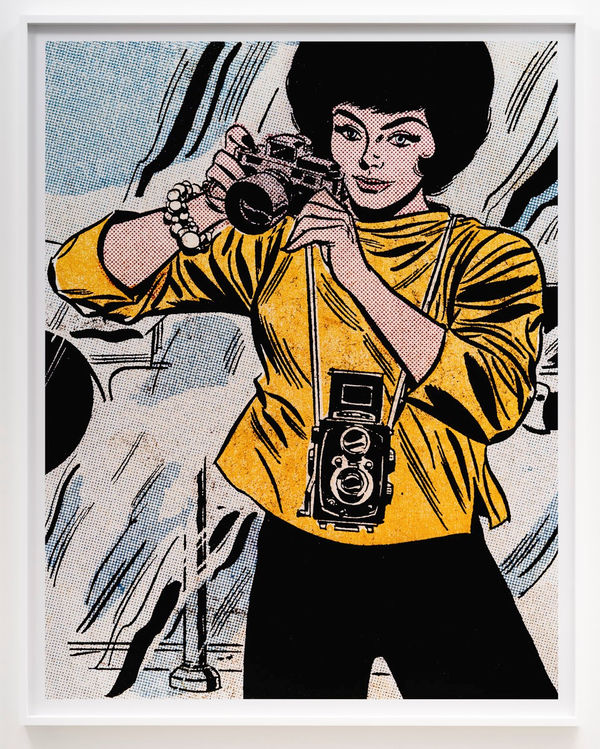
Throughout her career Collier has remained fascinated with what curator Michael Darling has termed a “self-perpetuating ocular system,” in other words, the act of looking and being looked at. Collier has developed several series tackling this theme in the last twenty years, most notably Filter, Woman Crying and Woman Crying (Comic). While Woman Crying is largely based on monochrome images taken from 1960s, 70s and 80s album covers, Filter and Woman Crying (Comic) explore imagery taken from American romance comic books which were published from the 1950s and which first entered the fine art world through the work of Pop artist Roy Lichtenstein. Often marketed towards a certain demographic of adolescent teenage girls, the comics frequently featured characters who fulfilled cliched stereotypes about forlorn or heartbroken women on the brink of collapse. Like contemporary painter Ella Kruglyanskaya, who paints voluptuous women highly reminiscent of 1950s pin-up culture, by re-photographing this archival material Collier offers a new interpretation, where the sexist undertones in these comic depictions of women may be drawn out and examined in a twenty-first century light.
Interestingly, Photographer (2021) draws from both Collier’s recent comic series and her earlier 2000s series Woman with a Camera in which she rephotographs stills from the 1970s to the early 2000s of female subjects with a camera in hand. An important series which was published as an artist’s monograph, it resulted in 80 35mm slides, with each of the original re-photographed images pre-digital ‘relics’ which had been abandoned by the former owner, and which Collier had found through various means. The theme of abandonment is crucial to the act of photography itself, which is so often used to preserve something or someone who is then forgotten or lost to time. In exhibitions at Anton Korn and Gladstone, editions of Photographer have been exhibited alongside Collier’s other recent series Filter, a group of photographic triptychs in which different Kodak colour viewing filters are placed onto an image of a crying comic woman, making them appear like rolls of film in some dramatic Hollywood blockbuster finale.
An unusual image which bridges all three of Collier’s most recent series, we could consider Photographer a kind of artist self-portrait. Collier not only immerses herself visually in the comic book aesthetic but actively breaks the fourth wall, making the viewer into one of her subjects and one of the many crying women that she captures. This unique kind of portraiture is similar in method to Sophie Thun. Thun reappropriates age-old traditions of female self-portraiture in her collage style photography referencing Renaissance and Dutch Golden Age artists such as Artemisia Gentileschi and Clara Peeters in the same way that Collier places her work in the path of Roy Lichtenstein and classic comic book artists such as Tony Abruzzo, whom Lichtenstein sought to imitate. Indeed, Collier has described her work as “deflected self-portraiture,” stating that she aims to “find objects or artefacts that could somehow operate as ‘surrogates’ for aspects of my own identity and personality.”
Born in Los Angeles, Anne Collier (b. 1970) moved to New York in the early 2000s upon graduation from the California Institute of Arts. Her first important series involved shooting found objects she discovered in junk shops, flea markets and on the internet. From then onwards she began a process of rephotographing stills, with her first major work an image of a 1976 disc of Marilyn Monroe’s records titled Double Marilyn (2007), a clear nod to Warhol’s iconic silkscreen portraits. Since 2006 Collier has built up a large archive of material from which to photograph, having collected photo manuals, film stills, comics, album covers and magazines. Her most recent ventures include photographing images from 1950s romance comic books, building on the tradition of Roy Lichtenstein in her re-interpretation of how female vulnerability is objectified.