Ewa Pachucka Poland, 1936-2020
-
 The Open Man, 1969
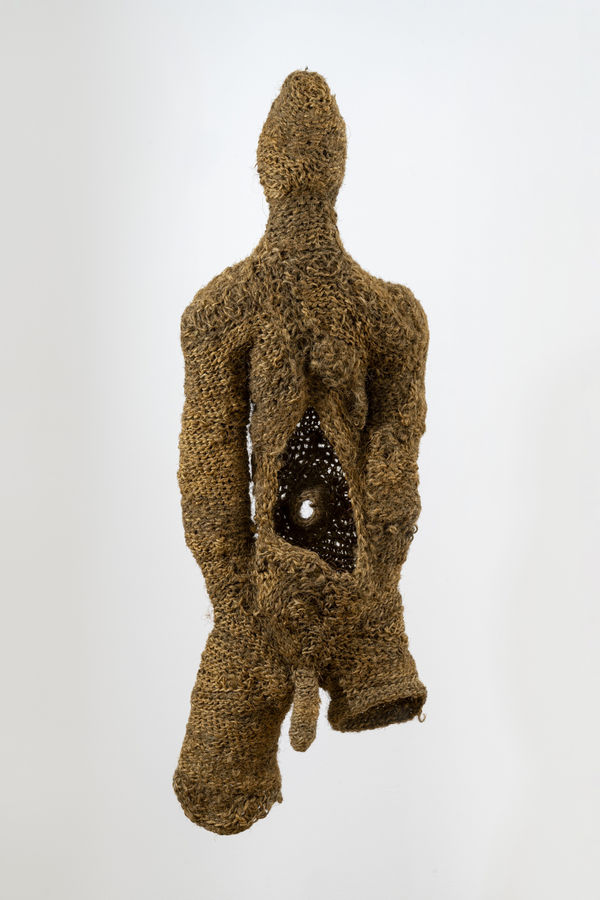
Having begun working in fibre art some eight years after graduating from art school, Pachucka rejected traditional methods of weaving, instead using a crochet hook which she could work at high speed to create spontaneous, fast patterns. Similar to contemporary British sculptor Jonathan Baldock, who frequently engages with non-traditional fine art methods related to his working-class roots, from the beginning Pachucka’s art materials were practical and basic, incorporating Bahama sisal, hemp strings and jute rope which she would purchase from a fisherman supply shop. Driven partly out of necessity, given tapestry materials were limited in Poland at the time, the resultant woven fibre was both resilient and soft, three dimensional but malleable, qualities the artist herself likened to clothing and also to human skin.
A pivotal move away from the traditional categorisation of textile art as ‘decorative’ or ‘feminine,’ Pachucka preferred to emphasise form and matter over ornamentation. She was heavily inspired in her early oeuvre by fellow Polish textile artist Jolanta Owidzka, who worked experimentally with hand-spun wool, metallic fibres and leather. Pachucka’s earliest body of woven work, such as her cocoons, drew inspiration from the natural world, echoing organic forms which she had previously explored through her early prints and paintings. Emerging as part of a group of 1960s textile artists that also included Sheila Hicks, Olga de Amaral and fellow Polish artist Magdalena Abakanowicz, critic and art historian Danuta Wróblewska has described Pachucka’s early crochet work as closer to organic abstraction than figuration. Writing on Pachucka’s work, Wróblewska said: “Their vividness resembled sections of a lunar landscape or distant patterns of a zoomorphic form: cocoons, abandoned insect shells, swallows' nests. These things had a warmth that was somehow familiar, bringing them closer.”
From the late 1960s Pachucka moved further towards representation, creating crocheted clothing and human forms, of which The Open Man is an early example. This series of woven, half formed figures appear somewhat primitive and otherworldly, enveloping negative space they appear like the shed skins of some long-lost civilisation. These themes follow much of Pachucka’s work, with her figures’ unsettling stillness and anonymity often compared to the forms of mummified corpses or preserved Pompeii victims. Like the wooden bodies carved by German sculptor Paloma Varga Weisz, there is a distinct morbidity and emotional confusion around Pachucka’s figures, which has led to critics associating them more with abstraction than figuration. Displayed for the first time at a 1970 solo exhibition at Grabowski Gallery in London, they were formed by padding the crochet shell out with filling, and later with a metal structure to hold the figure apart. Upon completion, the metal rods were removed and the figure suspended so that it appeared both materially substantial and apparition like, floating within the gallery space.
Born in Lubin, Poland, Ewa Pachucka (1936 – 2020) studied at the Lyceum of Plastic Arts, Warsaw, and at the Academy of Fine Arts in Łódź, a historic site for textile industry within Poland. During her studies she was particularly attracted to abstraction, rebelling against the pro-Soviet communist government who enforced socrealism (socialist realism) as a socio-political and aesthetic doctrine after World War II. Beginning her fine art career as a painter and printmaker, it was only in 1965 that Pachucka began working with fibre art after an experimentation with hemp yarn and a crochet hook revealed she could make organic forms of concave and convex shapes. It was this new venture which propelled Pachucka onto the world stage as shortly after beginning work in this medium, textile artist Jolanta Owidzka introduced Pachucka to curator Mildred Constatine, who subsequently included two of Pachucka’s works in 1969 group show Wall Hangings at the Museum of Modern Art, New York.
After a brief period living in Denmark, in 1971 Pachucka and her husband emigrated to Sydney, Australia aided by dealer Rudy Komon. This move proved hugely creatively stimulating and resulted in some of Pachucka’s most complex and celebrated work. Inspired by the peaceful, utopian landscape of New South Wales, Pachucka’s work increasingly focused around nature, creating works such as hemp and linen wall hanging Landscape (1974), a topographical composition inspired by the Manly beach in Sydney. Her woven figures also became more detailed and human like, with the artist creating multi-figure woven ‘environments’ in theatrical settings which were then dramatically lit. A key example is Arcadia: Landscape and Figures, a monumental installation of five life sized figures, two animals and fifteen landscape pieces, which took the artist five years to complete over 1972-1977. It is now housed in the Art Gallery of New South Wales.
For the next twenty-five years Pachucka continued to work and exhibit in Australia as part of the craft movement, also creating a number of public art commissions including sandstone sculpture The Sun Calendar or Fossilized Architectural Landscape (1988)for the Outdoor Sculpture Garden at the new Parliament House in Canberra. Living in Australia for almost thirty years, in 2000 Pachucka and her husband returned to Europe, settling in the South of France where she resided until her death in 2020.