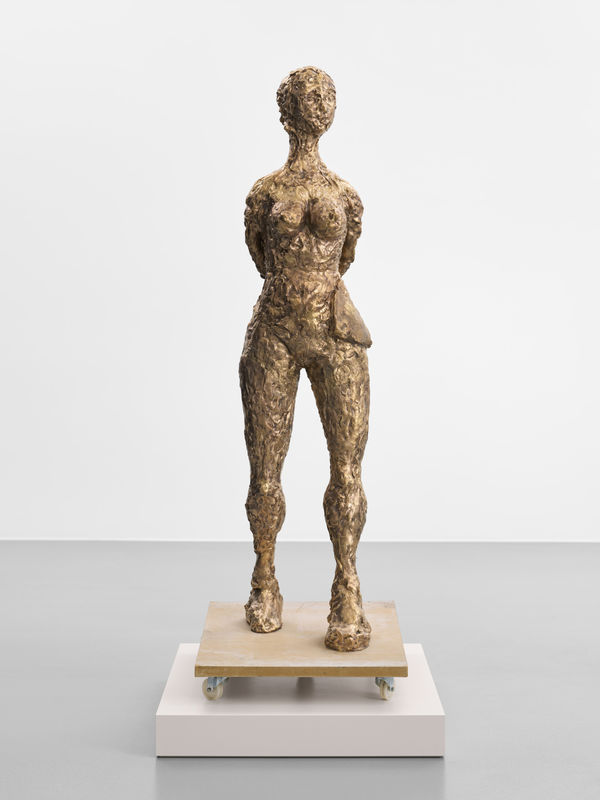
Rebecca Warren United Kingdom, b. 1965
Rebecca Warren is a British sculptor who works across multiple materials, most commonly bronze, steel and clay. Her sculptures move between abstraction and figuration, with certain features often magnified for erotic or comic effect.
Croccioni is characteristic of her practice, referencing and appropriating other art historically significant artworks for the purpose of feminist critique and art historical analysis. Appreciative of Robert Crumb’s comics that self-ironically expose and comment on the artist’s sexual fantasies of female domination and sexual indecency, Warren’s oeuvre engages with Crumb’s pictorial language of enlarged hips and curves, with the artist titling the series Homage to R. Crumb my Father (2003) in his honour.
The title “Croccioni”, is a portmanteau word combining “Crumb” and “Boccioni”; as such, the present work is a homage to both Robert Crumb and the sculpture of Umberto Boccioni, particularly Boccioni’s Synthèse du dynamisme humain (1913). Boccioni, alongside Filippo Marinetti, Giacomo Balla, and Gino Severini, was among the main protagonists of the Italian Futurists, who, inspired by the Cubist concern for capturing different object perspectives on a two-dimensional plane, sought to render the movement and dynamic of the industrial age in static paintings and sculptures. Synthèse du dynamisme humain (1913) is considered Boccioni’s masterpiece, capturing the generic concept of human movement itself, rather than a particular person in the act of running or walking. Boccioni died prematurely in 1916 when he fell from a horse, with Synthèse du dynamisme humain only cast posthumously in 1931 and with various photographic documents from the 1910s suggesting that the bronze cast was altered and differed in significant respects to the original plaster cast.
Compared to Boccioni’s sculpture, Croccioni is distinctly feminine. While Boccioni’s concept of movement consists of a masculine-looking figure tilting forward and characterised by hard geometric edges and a smooth bronze surface, Croccioni is distinctly soft, with the pair of legs portrayed voluptuous and curved, wearing plateau shoes, and the gold-painted bronze characterised by a rough imperfect texture, reminiscent of stretch marks. As such, the present work can be seen as re-writing or interpreting the concept of movement, with it capturing the movement of non-idealised women in daily life, rather than an exclusionary masculine concept.
The other Warren sculpture in the collection, Bon Voyager (2023), references Degas’s masterpiece Petite danseuse de quatorze ans (1879-1881), which was also cast in bronze posthumously and with different versions wearing different skirts and hair ribbons, depending on the tastes of successive curators and restorers. As such both works appropriate artworks with a rich history of posthumous alterations, thus reflecting on the life of artworks and how they may undergo changes through successive generations.
Bon Voyager (2023) was also included in the landmark exhibition, ASensitiv: GIACOMETTI / WARREN at the Giacometti Institute in Paris. It was commissioned specially for the show, with Warren invited to create and display several new works which respond to Giacometti’s sculptures in the Institute’s collection. With Bon Voyager a particularly figurative example, Warren’s painted bronze forms tend to be abstracted, undulating presences, sometimes combining different body parts or emphasising others. The painted, luminous bronze surface eerily evokes flesh with its rough, pock-marked texture and reflection of light. Similar in concept to Sarah Lucas and her bronze cast series I SCREAM DADDIO, these bronze bodily amalgamations are frequently comic, with Warren drawing on the material’s traditionally elitist history to evoke humorous responses to works which often feature blown-up anatomical features such as toes, breasts or heads. Warren’s full-scale bronze figures, including Bon Voyager, are taken further, and are highly reminiscent of primitive religious idols.
Throughout her oeuvre, Warren has remained fascinated with artists who fetishise the female body to the extreme, such as Willem de Kooning or cartoonist Robert Crumb. Warren instead seeks to reinvent the masculine gaze and perception when it comes to sculpting the female figure, especially given male artists often idolise or diminish it. By roughly hewing the bronze surface or emphasising certain feminine features to the extreme, Warren disrupts the viewer’s traditional interpretation of the feminine form, creating her own representation of the ‘female gaze.’ This is a theme which is continuing to be explored by contemporary artists such as Sophie Thun, who uses her own body to re-examine stereotypes and self-portraiture of the female artist throughout history. Discussing these ideas, Warren says: “I think interrupting the surface is a way of interrupting other things that are in place and taken for granted. If these interruptions are provocative, then they play on the permission that I as a woman or as artist am supposed to have been given from elsewhere. Well from where? From whatever things have already been made, and whatever ways in which women and artists are supposed to have been organised.”