Sara Cwynar Canada, b. 1985
-
 Doll Index, 1811-1950, 2023
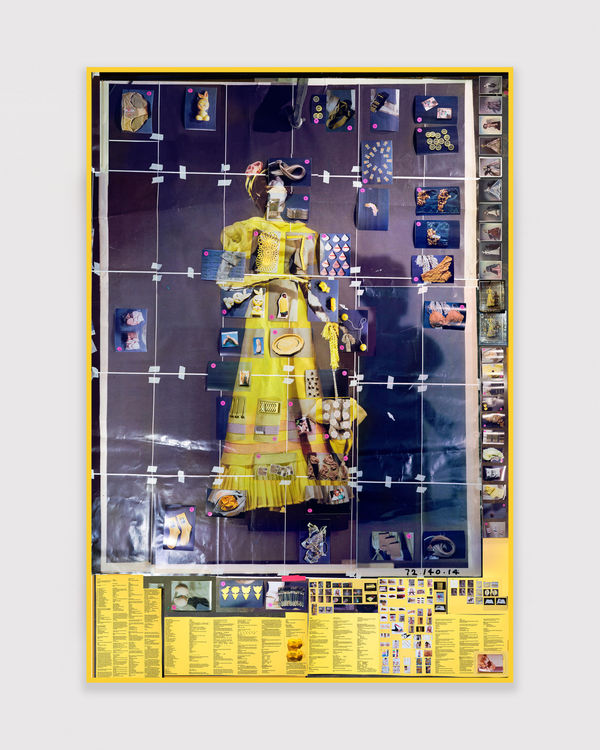
Sara Cwynar is a Canadian New-York based artist, known for a critical practice that dismantles the male gaze and gender expectations, particularly through hyperbole, appropriation, and archival collage. Her practice is in dialogue with older generations of feminist artists, particularly Cindy Sherman and Barbara Kruger, both of whom have also employed hyperbole to expose structures of gender-based oppression.
Doll Index, 1811-1950, a large-scale print mounted on aluminium, shows slim doll from the early 19th century in front of a black well-lit background, like a photo studio. The doll is taken from an image of an 1811 House of Paquin doll, taken on the occasion of a French doll exhibition at the Brooklyn Museum in New York, between 1949 – 1950. The photo appears crinkled and stuck together with tape. Surrounding the doll are small, archival collages – some circled, some crossed-out – of underwear, push-up pads, kitchenware, food, and sexual accessories, such as a gag, alongside cryptic writing. Doll Index, 1811-1950 demonstrates through hyperbole how women are fetishized for their appearances “like dolls”; the cacophony of collaged references, some contemporary and some dating from the 19th century, epitomises how the standards imposed on women are indecipherable and in constant flux. Aside from purely criticising gender norms, Doll Index 1811-1950 is biographical of the artist’s life. Cwynar was a professional figure skater herself and witnessed first-hand the pressures of embodying inconsistent feminine ideals, such as passivity and athletic excellence. Other artists to explore the male gaze in their work include Robert Crumb and Sophie Thun, with Thun being a particularly noteworthy comparison as she is from the same generation and utilises photographic imagery. Thun is known to use analogue methods of photography, such as photograms, to provide an outside commentary on female sexual imagery.
Having been trained as a graphic designer and employed by The New York Times for three years, Cwynar has witnessed the power of photo-editing and post-production first-hand. Accordingly, aside from purely exploring gender-norms, her work is also concerned with questioning the verisimilitude of what we see, particularly in a day and age when visual imagery is digitally distributed. Doll Index, 1811-1950 is extraordinary as many details in the original archival image were changed by Cwynar. While the original doll’s clothes are in a warm lime or emerald tone, Cwynar’s doll is rendered in a piercing neon-yellow and the background lighting and shadowing is far more heightened than in the original archival image. Awareness of the highly illusionistic post-produced character of social media portrayals, the artist contends, is a way of being more resilient. Other artists from the collection to question digital images include Thomas Ruff, whose JPG works take pixilated jpgs found on the internet and prints them on a large scale, thus exposing their inherent vagueness and pixelation.