Grayson Perry United Kingdom, b. 1960
-
 Expulsion from Number 8 Eden Close , 2012
 -
#Lamentation, 2012
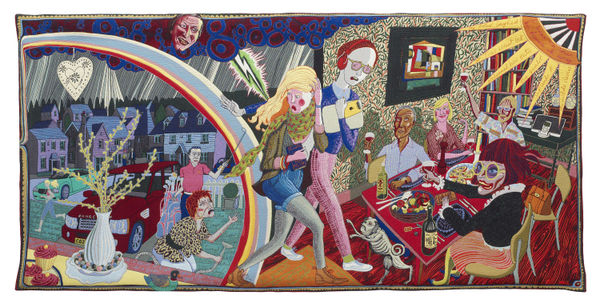

In 2012 the artist hosted a Channel 4 TV series titled All in the Best Possible Taste with Grayson Perry, in which the artist explored taste and class divisions across British society through visits to Sunderland, Tunbridge Wells, and The Cotswolds.
The present work is one of the six tapestries from Perry’s 2012 series The Vanity of Small Differences, a series that distilled Perry’s experience of British culture from the show. Loosely based around Hogarth’s classic A Rake’s Progress (1735), the series tells the story of Tim Rakewell, who, born into a working-class family, gradually ascends social hierarchies because of his computing skills. The body of work reflects on how different status symbols, whether football club t-shirts or expensive handbags, change very little about the fundamental human condition. As such, there is a certain “vanity” in identifying too strongly with markers of status.
In Expulsion from Number 8 Eden Close, we are halfway through Tim Rakewell’s ‘progress’. Depicting a scene where Tim brings his girlfriend home from university, the text within the tapestry reads from her point of view: “I met Tim at College; he was such a ‘geek.’ He took me back to meet his mother and stepfather. Their house was so clean and tidy, not a speck of dust... or a book, apart from her god, Jamie [celebrity chef Jamie Oliver, shown top left]. She says I have turned Tim into a snob. His parents don’t appreciate how bright he is. My father laughed at Tim’s accent but welcomed him onto the sunlit uplands of the middle classes. I hope Tim loses his obsession with money.” The 2015 Vanity of Small Differences touring exhibition describes the scene, where Tim and his girlfriend are shown fleeing his parents after an argument – “They pass through a rainbow, while Jamie Oliver, the god of social mobility, looks down. They are guilty of a sin, just like Adam and Eve in Masaccio’s The Expulsion from the Garden of Eden (c.1425).”
#Lamentation (2012), is the last tapestry from the cycle of six by the artist. It shows Tim Rakewell after a car accident at the intersection near a retail park. Tim lies dead next to his glamorous wife and destroyed Ferrari, alongside a cover of Hello magazine celebrating him and his wife. In the background, onlookers take photos while, to the right, paramedics prepare to remove the body. Below, it says: “[w]e were walking home, from a night out, these two cars, racing each other, speed past. Middle aged men showing off, the red one lost control. The driver wasn’t wearing a seatbelt. He didn’t stand a chance. The female passenger was okay but catatonic with shock. I’m a nurse. I tried to save the man but he died in my arms. It was only afterwards I found out that he was that famous computer guy, Rakewell. All he said to me was ‘Mother’. All that money and he dies in the gutter.” #Lamentation (2012) forcefully epitomises the moral of the series that wealth and status do not guarantee a happy and fulfilled life. Perry has said that Roger van der Weyden’s Lamentation of Christ (1441) was a significant compositional influence, with the artist drawn to biblical allegorical scenes for inspiration for each cycle in the series. Other artists from the collection known for allegorically charged paintings include Paula Rego, who is concerned with women’s rights in her oeuvre rather than class.
Grayson Perry is known to blend boundaries between high and low culture throughout his oeuvre, with the artist’s 2017 Serpentine Gallery exhibition titled The Most Popular Art Exhibition Ever! and the artist concerned about making his works accessible to wide audiences. Throughout Perry’s practice, this open attitude toward low culture is reflected in the artist’s use of traditionally more decorative media, such as pottery and tapestry. While the artist began experimenting with pottery in the 1980s, Perry only utilised tapestry from the 2000s, with the Vanity of Small Differences series perhaps his most ambitious cycle of works. Other artists from the collection who use tapestry include Kiki Smith, with the artist employing the jacquard method and drawn to topics surrounding contemporary environmental instability and the climate crisis.
Using the ancient method of tapestry making to display contemporary imagery, each of the six images from this series pay homage to a historic religious work, including Matthias Grünewald's Isenheim Altarpiece, Rogier Van de Weyden's Lamentation and three different paintings of The Annunciation by Carlo Crivelli, Grünewald and Robert Campin. Engaging with the archaic theme of class divides, the images also reference the pictorial display of wealth and status in The Arnolfini Portrait by Jan Van Eyck and Mr & Mrs Andrews by Thomas Gainsborough. A similar approach is taken by American artist Kiki Smith in her recent jacquard tapestry series. While her style is highly reminiscent of medieval iconography, taking particular inspiration from the fourteenth century French The Apocalypse Tapestry, Smith brings her tapestries up to date by interpreting the imagery from the viewpoint of contemporary environmental instability and the climate crisis.
A complete set of all six Vanity of Small Differences tapestries is jointly owned by the Arts Council Collection and the British Council. The series began a national and international touring exhibition in Sunderland in 2013 and was last on display at Wentworth Woodhouse in Rotherham (June – September 2023).
Born in Chelmsford, Essex, Grayson Perry (b. 1960) lives and works in London, United Kingdom. Winner of the 2003 Turner Prize, Perry was elected a Royal Academician in 2012. In June 2023, he was knighted for services to the arts. Having studied in Portsmouth and Essex, Perry first decided to pursue an artistic career in 1982 when his work was featured in the group exhibition Young Contemporaries at the Institute of Contemporary Art, London. While early examples by Perry typically offer laconic re-interpretations of other artist’s works, as well as an angry take on contemporary culture, artworks produced since the early 2000s are more whimsical, offering sharp political criticism hidden under a veneer of humour. Following the Brexit referendum in 2016 Perry’s work has gained significance, with his art deemed an important commentary on current British events.
Aside from his career as an artist, Perry has in recent years gained a reputation as an influential public figure. Since 2000, Perry has been outspoken about genderfluidity, often appearing at public appointments as his female alias ‘Claire’. He has hosted and produced various Channel 4 television series about art, gender, and social divisions, including Grayson Perry’s Full English (2023), Divided Britain (2017), and the especially popular pandemic hit-series, Grayson’s Art Club (2020-2022).