Oliver Laric Austria, b. 1981
-
 Oceanus, 2023
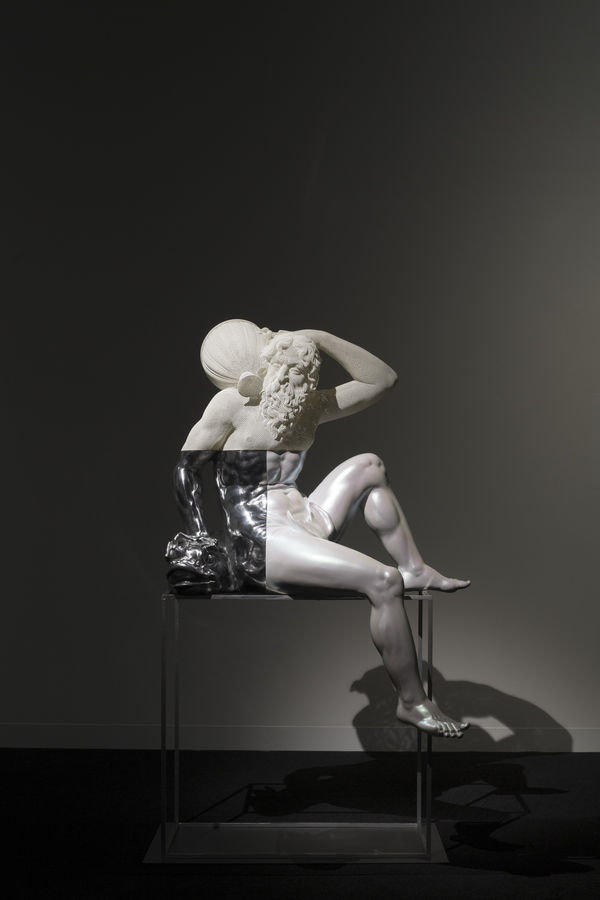
The present work shows Oceanus, the god of the oceans and a popular motif in Greek and Roman mythology, sitting in a relaxed pose and looking toward the viewer. In his left hand, he is holding an urn or vessel; on his right, he is leaning on a sea creature wrapped around his leg. The present work is not a historical artifact, as the motif might suggest; it is a contemporary sculpture by Oliver Laric, made for an exhibition at the Musée de la Romanité in Nîmes, where several of his works respond to Roman artifacts from the museum collection. Oliver Laric is an Austrian multi-media artist working across video, sculpture, and installation and is known for exploring how copies and bootlegs shape our view of the past and the present. What makes the present work, Oceanus, unusual is its use of three differently textured materials. While the lower body is in an off-white tone, emulating the colour of marble, the right half of the torso and arm is dark, like bronze. Finally, and most disconcertingly, the chest, head, and left arm misleadingly appear like clay and are systematically incised by holes. Other artists who combine ancient iconography with modern materiality include Damien Hirst and Clementine Keith-Roach, with the former known for his maritime-inspired sculptures shown at Palazzo Grassi in Venice in 2016 and the latter significant for terracotta sculptures that feign a feminist pre-historic narrative of their creation.
Oceanus' production involved 3D printing and photogrammetry - the technology of digitally modelling 3D shapes based on 2D images. The first step in the process was to scan the artwork or object to be copied. Subsequently, the artist digitally distorted and altered the model and provided his open-access blueprint to 3D sculptors, such as lustinian Funie and Samuel Poirer, who would print the work in aluminium, adding special effects and colour. Laric’s sculptures are novel for their technologically informed design and production process, as few sculptors today have harnessed the full possibilities of 3D printing. Laric does not merely use the 3D printer to make casts for sculptures – as some artists, such as the female sculptor Leiko Ikemura, have done – but goes on to print the sculptures directly. In doing so, he questions the significance of uniqueness, as his sculptures can, in principle, be printed iteratively. Other artists from the collection, who have questioned the role of the artist as ‘genius-creator’, include Michael Craig-Martin who throughout his artistic practice tries to remove elements of the artist’s touch at the stage of execution.
The Greek god Oceanus was a popular motif in Greek and Renaissance art and is known to decorate the 200 BC Pergamon Altarpiece, now in the Pergamon Museum in Berlin, and the 19th Century Trevi Fountain in Rome. The original purpose of depictions of Oceanus, we may speculate, was to appease the gods to ensure sufficient rainfall and safe maritime voyages. The sculpture Laric used as a blueprint for Oceanus is part of the now dismantled Neo-Classical Leopold Fountain in Innsbruck, Austria, which was meant as monument to Archduke Leopold V. With the Leopold Fountain no longer present in public, the only reconstructed and altered evidence of the Innsbruck sculpture – a copy and appropriation of a Greek motif itself – is Laric’s digitally modelled Oceanus. In choosing a Greek subject that has several times been historically re-purposed, Laric draws attention to how symbols can change in meaning through time. Other artists to have explored the temporal life of images include Sara Cwynar, who, using Photoshop, recontextualises images of clothes and women from historical archives for a feminist social critique.
Oliver Laric is an Austrian-born multi-media artist known for works that explore the themes of authorship and authenticity. Working across video, 3D-printed sculpture, and installation, Laric’s work demonstrates how imagery has been re-used and exploited over time and how it remains available for the future.