Alexandra Bircken Germany, b. 1967
-
 Deflated Figures, 2022
 -
Eva, 2024
Originally trained at Central Saint Martins as a fashion designer, Alexandra Bircken's work explores the appearances people maintain socially – or, as she might say, our “social skins” – by drawing on a wide selection of ready-made everyday objects from deconstructed motorbikes to sportswear. Her uncompromising and extended sculptural practice can be compared to Fluxus artists, such as Robert Filliou and Daniel Spoerri, who similarly use everyday items as integral sculptural elements, as well as contemporary artists like Sarah Lucas and Helen Marten.
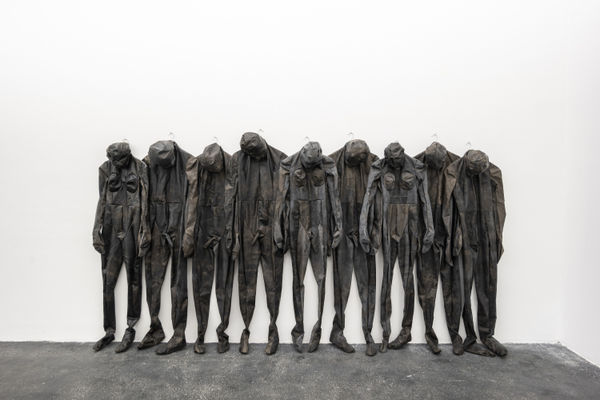
Deflated Figures consists of nine crinkly discoloured latex figures aligned to a wall and hung on clothes hangers. Three ‘female’ figures have breasts sewn to their chests, while the remaining six ‘males’ are characterised by their deflated penises. Despite latex being a sadomasochistic cliché and reminiscent of dominant-submissive sexual relationships, these figures are off-putting and lack sex appeal, recalling the full-body protective gear worn in chemical facilities or sites of contamination. By juxtaposing sex and lifeless and deflated forms, the present work can serve as a metaphor for the current status quo in society, particularly in Europe, where systemic challenges, such as inequality, the possibility of war, and global warming, have been received with fatigue and impotence, despite being deemed existentially crucial. Speaking of despair as a catalyst for her work, Bircken says: “[c]onsumption, cars, climate protection, (...) When I observe things, I often think: How can it be that no other decision is made or that nothing happens!”
Having studied fashion and worked as a designer until 2003, it is unsurprising that deconstructed clothes play a central part in Bircken's oeuvre. There are the deflated figures, such as the present work, and figures, such as The Tourist (2022) characterised by a cacophony of accessories ranging from wool jumpers to American football shoulder pads. Fabric is a medium of choice for Bircken as clothes are something many can empathetically connect to and central social norms and appearances, which is one of Bircken’s central preoccupations in her practice. Repurposed textiles have an entrenched history, particularly among female artists, with Sarah Lucas, again, noteworthy for her series of humorous Bunny sculptures that involved the artist stuffing and sewing together tights to create feminine, though faceless, figures. Bircken began her series of latex figures in 2014 for her Hepworth Wakefield retrospective that featured twenty latex figures lying on the floor or mounted on ladders. For the 58th Venice Biennale in 2019, the artist continued her deflated figures series, with a dozen figures hanging from room beams and cranes, thus site-specifically intervening in the exhibition space. Other artists from the collection who site-specifically respond to exhibition spaces include Jonathan Baldock, whose jocular ceramic works are to be shown collectively and often respond to and engage with the rooms they inhabit.
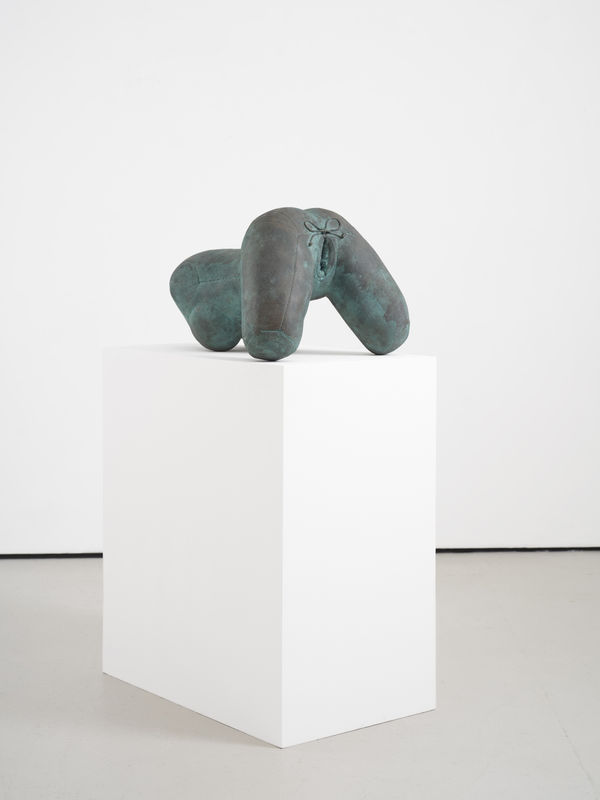
Eva (2024), a bronze sculpture by Alexandra Bircken, shows a life-sized woman’s torso with hips. The torso is not a copy of a Hellenistic marble torso of Aphrodite, capturing the ideal of perfect proportions and beauty. It is also not a free sculptural concoction by the artist herself, with the bodily curves and contours reflecting her sense of proportions and style. Instead, following Bircken’s longstanding practice of re-appropriating unordinary objects for sculpture, it is a bronze sculpture cast from a Japanese sex doll, with the doll’s faux genitalia and sewing lines intact. Typically, in the history of art, female torsos are portrayed in an upright position to draw attention to the proportions and demonstrate the sculptor’s artistic mastery. In Bircken’s sculpture, we are unambiguously looking at a sexual object, with the chest facing the floor and the backside and genitalia confrontationally meeting the viewer’s eye. The viewer might be forgiven for thinking that Evastill performs the function of a sex doll when, in fact, it is a sculpture made for the museum display and contemplation of contemporary culture.
It should be noted at this point that Eva is richly patinated, with a surface reminiscent of oxidised copper, similar to historical and neglected public sculptures that, for many years, have withstood the onslaught of time and rain. Oxidised copper is not the colour of lust or sexual gratification but instead a symbol of decay. Perhaps Eva’s use of materials nods to the decay of contemporary society, with real human-to-human interaction and intimacy gradually replaced by surrogates that mimic the materiality and form of the human body in ever greater sophistication. Throughout her oeuvre, Bircken has curiously looked at contemporary objects that epitomise decay. A prominent example of this is her sculptures made from re-purposed sports motorbikes; these works poke fun at the male-dominated machismo world of bikes and question to what extent these male toys improve society or provide answers to any urgent questions. What is particularly striking about the series of sex doll sculptures is that it involves Bircken focusing on our sexual practices, private topics that we rarely speak about publicly or in the open. Other artists who have sought to blur the boundaries between public and private include Man Ray, with his photograph La Prière (1930/1960) a relevant comparison as it obsessively draws attention to the backside of Lee Miller, Ray's partner at the time.
Eva is from a series of works Bircken has been working on since at least 2013, with a golden spray-painted bronze sex doll sculpture first exhibited at BQ in Berlin in 2013 and later at the 58th Venice Biennale in 2019. The present work appears to be the first one with an oxidized copper finish and can be seen to imaginatively reflect on what a polished sex doll from 2013 may conceivably look like more than a decade later. In its casting of stitched surfaces, Eva recalls Surah Lucas’ series of Bunny sculptures, with Lucas moving from utilising fragile nylon stockings in her sculptures in the 1990s to casting her figures in bronze and concrete, thus giving them permanence. Having studied fashion and worked as a designer until 2003, it is unsurprising that deconstructed clothes or knitted objects play a central part in Bircken's oeuvre, as can also be seen in Deflated Figures (2022), the other work by Bircken from the collection. Bircken is often drawn to fabrics as these connect to how we present ourselves publicly.