Sylvie Fleury Switzerland, b. 1961
-
 You Got the Silver, 2023
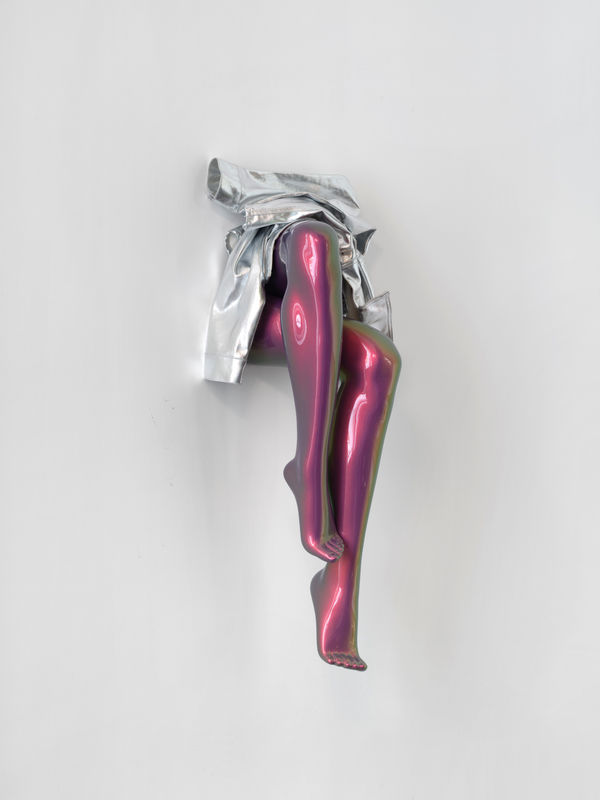
Sylvie Fleury is a significant post-Pop artist known for irreverently commenting on Consumerism and Feminism through her multi-media practice, combining installation, sculpture, and painting. Due to the critical self-reflective nature of her practice, she can be compared to other artists from the collection, including Linder, Cindy Sherman, and Sara Cwynar, all of whom interrogate the male gaze and the objectification of bodies in capitalism.
The present work, You Got the Silver, is a pair of crossed women’s legs in shiny car paint protruding from a wall, with a shiny chrome jacket on the woman’s lap. One of Fleury’s key artistic signatures, much explored in the exhibition Sylvie Fleury: S.F. at Sprüth Magers in London, is appropriation as an artistic tool and the referencing of other artists' works. The present work’s title is a direct reference to the 1969 Rolling Stones song You Got the Silver concerned with female infatuation, while the sculpture is a direct reference to the series of 1972 Secretary Sculptures by Allen Jones, showing the legs of secretaries in pastel colours. Jones has an ambiguous relationship to feminism, with his portrayal of women occasionally criticised as too 'sexed-up' and objectifying; the present work accentuates this criticism to the point of ridicule by covering the lady's legs in shiny car paint, thus comparing women to cars, arguably the most prized toy of consumerism and machoism.
Other works in the exhibition at Sprüth Magers take less aim at consumerism, or rather women within the context of consumerism, and instead ridicule minimalist artists such as Frank Stella and Carl Andre for their exclusion of emotion and human touch to their geometrical abstract paintings and minimalist installations defined by a stringent logic. Consumerism is, of course, one of the main concerns of Pop artists, going back to Andy Warhol and Roy Lichtenstein. Other artists to reflect on consumerism throughout the collection include American Photo-Realist painters, such as Richard Estes and John Salt, who are both famed for their portrayals of cars and the US streamlined culture of the 1960s as well as Sara Cwynar, who explores female self-perception and self-esteem through the digital environments that shape us and the expectations that guide us. Through the constant entrenching of stereotypes around female beauty in society, it is apt to compare the female body to shiny cars the way of Fleury - not because this is something one believes or normatively strives for but because it is reflective of the habits and expectations many women have internalised.
Commenting on her artistic practice, Fleury says that irreverence characterises herself even irreverence "toward herself”. She further adds that she finds freedom through her practice of art-making. While Fleury is making fun of Jones in her work, she is also making fun of herself as - just like Jones - she is associated with Pop art and rendering sexualised female legs. Irreverence toward oneself certainly has a cathartic effect as it means that one is held less responsible for what one says and does as an artist. Other artists from the collection who are irreverent toward themselves to achieve artistic freedom include Robert Crumb. In making fun of his own eccentric sexual desires and female infatuation in his cartoons, Crumb manages to explore sexual fantasies, yet pre-empts any criticism of being 'off' through his own acknowledgement of his sexual eccentricities.
Sylvie Fleury is a contemporary Swiss artist whose installation, sculpture, and mixed media work deals with our sentimental and aesthetic attachments to consumerist culture. Fleury’s early “shopping bag” installations laid the foundations for a body of work that became as provocative as it is playful. Fleury heralded a new artistic trend by subverting the codes of consumption, creating an interplay between fashion and art while interrogating the relationship between desire and fetishism. Fleury’s work exploits the ambiguity of superficiality, exploring subversions, paradoxes, truths, and values via materialistic components she deems symptomatic of our epoch – particularly luxury clothing and accessories, makeup, race cars, icons of modern and contemporary art, magazines, television and media and other objects drawn from everyday life.