Man Ray United States, 1890-1976
-
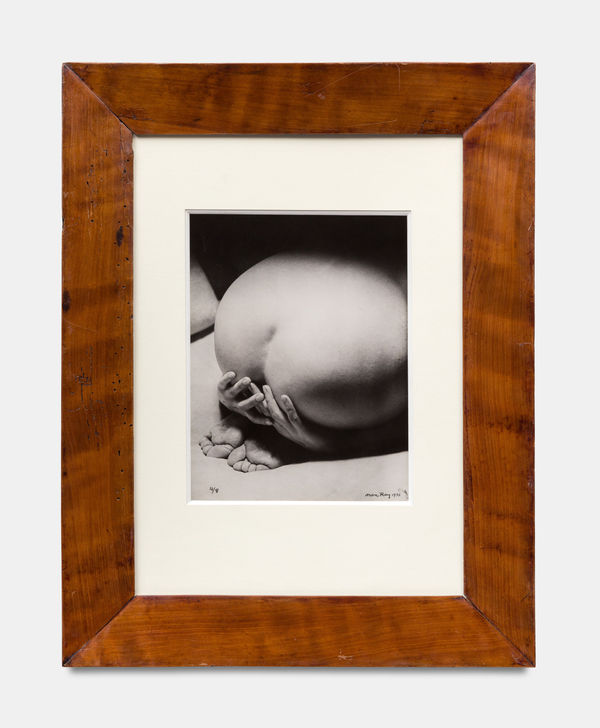
 La Prière, 1930 / 1960
Man Ray is today remembered as among the most prolific and experimental artists associated with Surrealism and Dada, famous for working across painting, readymade, photography, and film and expanding the medium and vocabulary of the various practices he engaged with. Man Ray had an aesthetic appreciation for the contours and forms of the human body and, a strong admirer of the Marquis de Sade, sought to shock viewers by portraying a sexually liberal lifestyle in many of his works. Other artists from the collection exploring sexual indecency throughout their oeuvre include Robert Crumb, who is particularly famed for cartoons portraying his fantasies of sexual intercourse.
La Prière (1930/1960) is among the most iconic works from Ray’s photographic oeuvre throughout the 1920s and 1930s. It shows the backside of the artist’s photographic assistant, lover, and muse, Lee Miller, who covers her modesty with her hands, somewhat recalling the gesture of prayer. The title demonstrates Ray’s love of ambiguity in imagery and in language as his fine appreciation for jargon and world play; a literal translation is 'The Prayer', but it also means 'The Invitation' – an old slang word for 'to reveal where the money is hidden'. La Prière was shot in 1930 and produced in various editions in the 1960s and 1970s. The present work is from an edition of nine numbered ‘0 – 8’ from the early 1960s, with another work from this edition held in the Paul G. Getty Centre in Los Angeles. In the early 1970s, Ray returned to La Prière, creating an enlarged edition of seven prints. Furthermore, the artist experimented with the photo negative of La Prière in the darkroom, creating several unique prints, some of which are held in the Centre Georges Pompidou in Paris.
Having met Lee Miller in 1929 in Paris, Ray immediately fell for Miller and had a tumultuous relationship until 1932, when she left Ray for Aziz Eloui Bey, an Egyptian filmmaker whom she married in 1935. Miller was to be a significant influence on Ray in the three years of their relationship, assisting him in discovering the solarization technique in photography, which involved briefly exposing a photograph in the darkroom to bright light, thus creating a tone reversal. Miller was also an inspiration for Ray's now famous readymade Object of Destruction – a metronome with a photograph of Miller’s eye attached to the swinging arm. Aside from La Prière, many photographs are devoted to Miller, including shots of Lee Miller’s legs in Lee Miller’s Legs with Circus Performer (1930) and lips in Observatory time (1936). Later in life, Miller would become a photojournalist, documenting the Second World War for Vogue Magazine; she married the important Art Historian Roland Penrose, the most vocal proponent of Surrealism in the United Kingdom, who would also champion Man Ray’s work.
Man Ray was among the first to argue for the artistic validity of photography as a medium separate from painting. Aside from choosing challenging subject matter at unusual angles, epitomised in the present work, Ray expanded the creative boundaries of photography through methods such as solarization and the photogram technique, with the latter involving placing objects on photographic paper prior to light exposure. Ray’s experimentation opened significant creative possibilities within the confines of a traditionally purely representational medium, allowing the creation of abstract photographic compositions. While artists including Laszlo Moholy-Nagy and Christian Schad also extensively worked with photograms from the early 1920s onwards, Ray’s method was distinctive for its merging of familiar everyday imagery, such as a woman, with abstract and surreal interferences. Other artists from the collection whose work utilises photograms include Sophie Thun, who combines analogue photography with the photogram technique to create images contemplating the male gaze and female objectification.
Man Ray (born Emmanuel Radnitzky; 1980 – 1976) was a significant contributor to the Dada and Surrealist movements and one of the first American artists to have shaped the avant-garde. The eldest son of Russian Jewish immigrants, Ray was born in Philadelphia and grew up in Brooklyn, where he sought to pursue a career as a painter. Having seen the 1913 Armory Show in New York, Ray befriended Marcel Duchamp, with Ray particularly intrigued by the futurist concern of rendering dynamic motion through painting. From the 1920s onwards, Ray lived in Paris, significantly advancing the possibilities and techniques of photography. With the onset of the Second World War, Ray settled in Los Angeles in the 1940s, where he befriended William Copley and maintained a close relationship with Max Ernst and Dorothea Tanning. Only in 1951 was Ray able to return to Paris, where he spent the remainder of his life focusing on painting, with his Natural Paintings, characterised by randomly determined abstract patterns of paint, one of the main artistic innovations of his post-war oeuvre.