Pablo Bronstein Argentina, b. 1977
-
 High Altar, 2020 - 2021
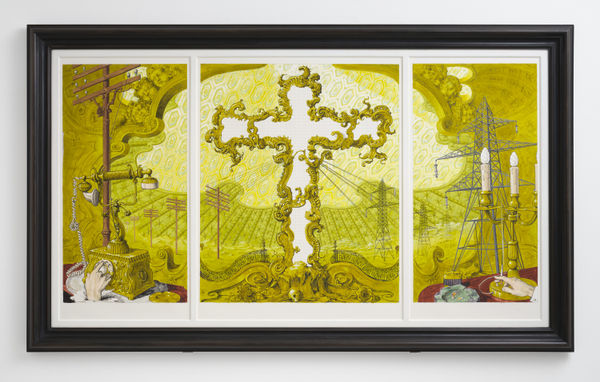
High Altar is a work on paper the artist Pablo Bronstein made for the occasion of the exhibition Hell in Its Heyday. Featuring symbols of commerce, dominance, and global trade, such as London’s monumental bank edifice, Albert Speer’s megalomaniacal Pantheon-inspired Volkshalle, and container ships, the show reflects on the way brute capitalism is perpetuated through a hidden veneer of architectural grandeur and tradition. The exhibition’s title suggests that despite the decorum of the scenes depicted, the commerce driven society we live in today is in fact “hell in its heyday”. Previously having written a critically lauded polemical book on Post-Modern architecture in London and having had a show at the Royal Institute of British Architects on “Pseudo-Georgian” 20th Century architecture in Britain, titled Conservativism, or the Long Reign of Pseudo-Georgian Architecture, Hell in its Heyday was presented at the John Soane’s Museum in Holborn, London; the former residence of John Soane, a famed architect who, among other achievements, built parts of the Neo-Classical Bank of England, the venue seems fitting to reflect on architecture and power. Other artists from the collection who reflect on the blinding effect of capitalism and social challenges, particularly in the United Kingdom, include Grayson Perry, whose tapestry Expulsion from Number 8 Eden Close (2012) portrays class divisions in the United Kingdom.
High Altar, a triptych, is the largest and most intricate work from the John Soane’s Museum exhibition. The left panel of the work consists of a highly ornate golden telephone, the right panel shows a golden lamp with the decorum of a candlestand. The middle panel depicts a baroque rendered Cross, prominently in the foreground, showing into a portal. The cross is connected to the telephone and lamp through cables and transmission towers. In the background we see a baroque rotunda, reminiscent of the architect Gian Lorenzo Bernini, while the bottom of the composition features signs of mortality, including cigarette buds, wilting flowers, and a skull. As the title and baroque design suggests, the work parodies the quasi-divine celebration of technology in society by utilising baroque architectonic exaggeration. The question High Altar ponders is: has technological innovation, epitomised through the internet, really just been a blessing? Other artists from the collection reflecting on technological innovation include Thomas Ruff, whose famous Jpegs, compressed digital images printed at large scale, bear testimony to the manipulative and misleading potential of digitally circulated images. Unlike Ruff, who ponders technology with a critical and analytical eye, Bronstein’s ambivalent attitude toward technology still recalls some of the nostalgic excitement and wonder of visions of a prosperous future epitomised in 19th Century science-fiction novels such as Jules Verne’s Journey to the Center of the Earth (1864).
Pablo Bronstein (b. 1977) is an Argentinian-born artist who, since completing his studies at Central Saint Martin’s, The Slade School of Fine Art, and Goldsmith’s College, has built up an oeuvre of architectural sketches and delicate gouaches commenting on power and architecture, predominantly in 20th and 21st century Britain. Known for a pictorial language that mixes parody, nostalgia, and kitsch exaggeration with the artist, for instance, framing many of his works in gilded baroque frames, Bronstein can helpfully be associated with Grayson Perry, who similarly resorts to parody and, at times, kitsch to comment on British culture.