Philip Pearlstein United States, 1924-2022
-
 Standing Male, Sitting Female Nudes, 1969
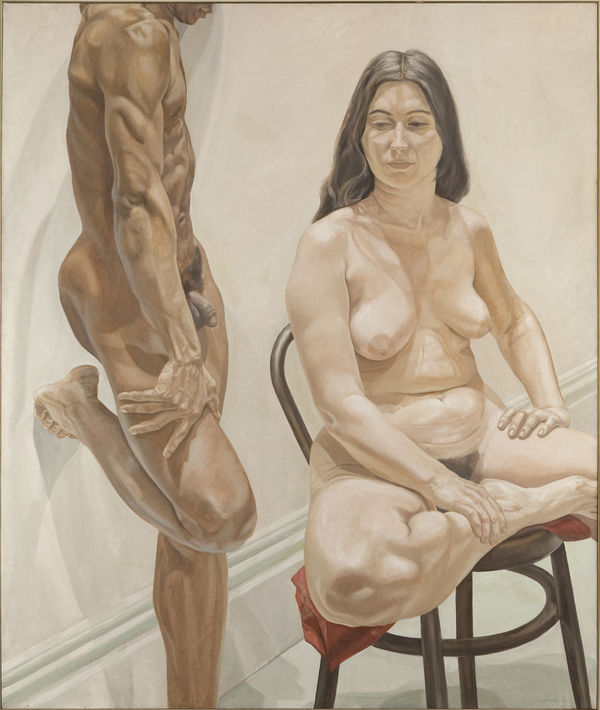
Renowned for his intimate paintings dwelling on the corporeality of the female body, Philip Pearlstein (1924–2022) was a pioneering figure of American contemporary realism. In the 1960s, his large-scale canvases challenged the prevailing taste for abstraction, taking a fresh approach to the traditional subject of the human form. In this painting, a nude man leans against a wall, his body turned towards a naked woman on a chair. Strong, overhead lighting reveals every contour of their flesh, which is painted with exacting detail. Like many of the artist’s compositions, the figures are radically cropped by the canvas edge and each one is devoid of emotion. When this painting was made, he was working directly from live models, an approach that many critics considered anachronistic. Pearlstein initially made abstract landscapes before turning to the human figure, and though his techniques evolved over the years, he remained dedicated to unflinching realism.
Initially having produced abstract landscapes, Pearlstein began attending live drawing classes from the late 1950s onwards. In 1961, he made paintings of nude couples based on his drawings; in 1962, he began painting directly from the model in a realistic style, honouring the presence and physicality of the human body. This method of painting was considered highly anachronistic at the time, with the illusionistic representation of space and people having been considered a style of the past. Pearlstein fundamentally rejected the Cubist concern of fractured space as well as the Greenbergian mantra that paintings should honour the flatness of the picture plane. Capturing the human body, with its contours and shades is an acute painterly challenge, worthy of engaging with even in the late 20th Century.
Philip Pearlstein is, alongside Alex Katz, perhaps the pioneering figure of American contemporary realism in painting, with the artist mainly remembered for intimate portrayals of the female body. Transitioning from Abstract Expressionist landscapes to lifelike nude compositions in the 1960s, Pearlstein defied artistic norms of the time by presenting his subjects devoid of emotion, depicted with icy lighting and cropped compositions. Critics initially viewed Pearlstein's shift as regressive, associating it with 19th-century academic art. However, he persisted, embracing a modern perspective that eschewed symbolism and narrative, focusing instead on the raw physicality of his models.
Born in 1924 in Pittsburgh, Pearlstein's early artistic endeavours garnered attention, leading him to pursue formal art education despite a hiatus for military service. Settling in Manhattan in the late 1940s, he immersed himself in the city's art scene, eventually gaining recognition for his distinct style. Pearlstein's commitment to realism extended beyond the human form, as he incorporated elements of everyday life into his compositions, from patterned rugs to mundane objects. Despite evolving his techniques over the years, he remained steadfast in his dedication to portraying the human figure with unflinching accuracy. Throughout his career, Pearlstein's work received critical acclaim and was exhibited in prestigious galleries, such as the Milwaukee Art Museum in Wisconsin and the Brooklyn Museum in New York. Despite attempts to attribute deeper meanings to his art, Pearlstein maintained that his paintings were simply depictions of models, devoid of metaphorical subtext.