Otto Dix Germany, 1981-1969
-
 Self-portrait, 1948
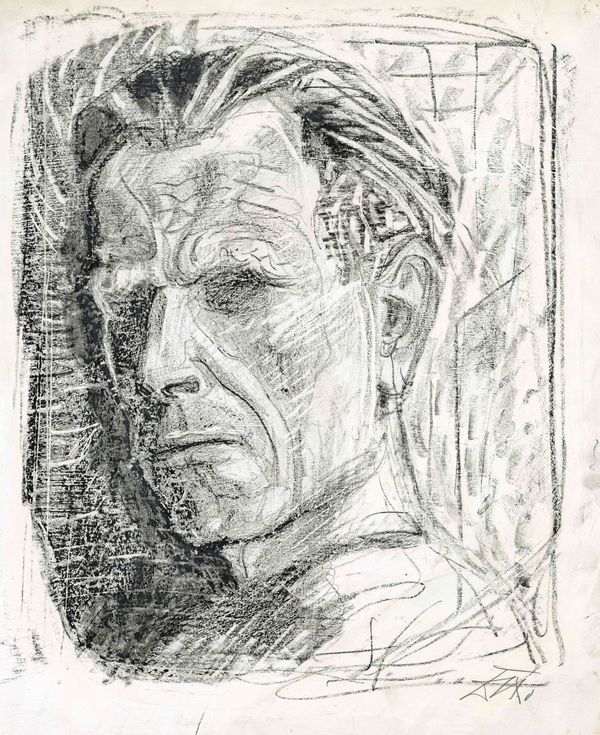
The present work shows Otto Dix at a side angle. He is in his late fifties; wrinkles, a receding hairline, and a sense of fatigue characterise his physiognomy. His eyes are black and lost, providing little insight into the humanity and thoughts brooding inside. To the left, a shadow is all-embracing; to the right, there is a hint of light and an open expanse. Having fought in the First and Second World Wars and deemed as a degenerate artist by the Nazis, the present work bears testimony to the tumultuous fate of Germany in the first half of the 20th Century. Other artists from the collection who reflect on the war include Georg Grosz, with Nach dem Verhör (1935) commenting on the sham trials of the Nazi regime. Unlike Grosz, who above all is a polemicist commentator of his time, Dix's work, especially his portraits, have an emotional intimacy and candidness.
Otto Dix is perhaps among the most famed portraitists of the 20th Century. He would typically make quick preparatory sketches – such as the present one – and then spend extensive time in the studio mastering and capturing the sitter’s aura. He made 160 self-portraits, often embedding himself in allegorical scenes to provide a socio-critical commentary on the war or the shallowness of the pleasure culture in the Weimar Republic. In his use of portraiture, Dix was at odds with his contemporaries in the 1920s, 1930s, and 1940s, with Cubism, Surrealism, and Abstraction, respectively, at the forefront of artistic innovation. Other artists from the collection who stuck to portraiture and a realist pictorial language, at the cost of being deemed old-fashioned, include Lucian Freud. His Self-Portrait: Reflection (1996) from the collection deserves mention; just like the present work, it depicts the artist in the late stages of life, with signs of age.
Dix chose not to add colour to the present work – as he did in many other works on paper – as it was a study for a lithograph in black and white. Dix made a total of seven lithographs of his face in 1948. There are no immediate paintings corresponding to the work. There are noteworthy self-portraits in oil from the late 1940s, however, such as Self-Portrait in Fur Cap against Winterlandscape (1947), which nods to Rembrandt’s famous Self-Portrait in a Heavy Fur Cap (1631). In late works, the lines are rough and coarse; a certain spontaneity is noticeable in the drawings and paintings.
Otto Dix is, alongside Georg Grosz and Max Beckmann, among the most significant German painters associated with Neue Sachlichkeit (‘New Objectivity’), a loose artistic tendency that saw the flourishing of a polemical and allegorical realist style in the years of the short-lived Weimar Republic (1918 – 1933).
Otto Dix was born in Untermhaus, a village near Gera and Dresden. His talent as a draughtsman was recongised from an early age. After an apprenticeship as a housepainter, he studied at the Grand Duxal Saxon School of Arts and Crafts in Dresden, where he strongly engaged with Renaissance painters, such as Botticelli and Rembrandt. When the First World War broke out, he enthusiastically became a conscript and fought on the Western Front in France and the Eastern Front in Russia. While the mortality, destruction, and grief were dreadful, Dix considered the war a significant experience, exposing the rawness of human nature. His first highly significant works are drawings of the horror in the trenches; these works loosely borrow from Expressionism, Cubism, and Futurism.
Following the war, Dix continued his portrayal of the destructiveness of war in depictions of trench warfare and of disfigured army veterans. Another subject matter that gained prominence was the portrayal of Berlin's shallow and lustful jazz and brothel culture. His works of the 1920s caused an outcry among conservative circles in society, especially for the non-idealised and caricatured depiction of nude women. Nonetheless, Dix gained public standing and notoriety, becoming a professor for painting in Dresden in 1927. His masterpiece from his period in Dresden was The War (1930), a war triptych that recalls Matthias Grünewald’s Isenheim Altarpiece (c. 1512 – 1516). In 1933, the Nazis came to power; Dix was relieved of his position as professor and stripped of his pension. During the war years, Dix tried to get by with landscape paintings that often recall those of golden age painters, such as Brueghel the Elder. Most works survived the war, as his work was mostly possessed by private individuals. After the war, Dix continued to paint, though his subjects tended to be less fierce and bold. With the rise of Art Informel in Europe, he also failed to gain a widespread following and approval.