Alina Szapocznikow Poland, 1926-1973
-
 Autoportret II, 1966 / 2012
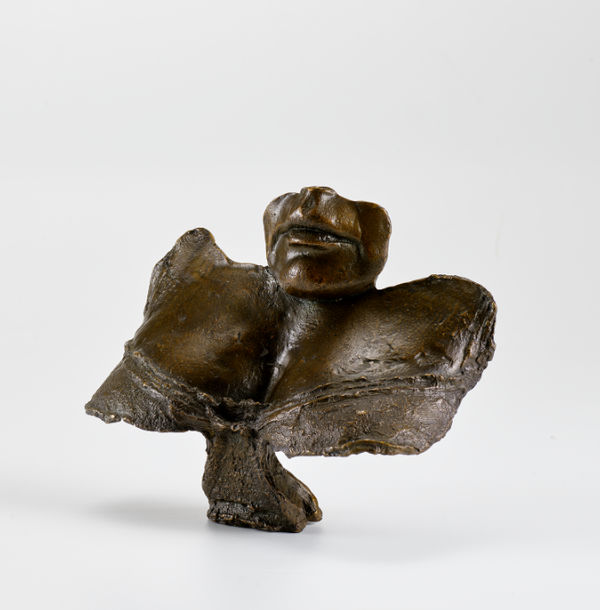
The present work shows a forward-kneeling figure with arms loosely reminiscent of wings. The front- and back-side feature the relief of two women’s lips. The lips are enlarged compared to the rest of the sculpture’s proportions and based on an imprint of the artist’s own. Lips have an extensive history in the canon of Western art, with these symbolic of femininity and sex. Willem de Kooning, in the Women paintings from the early 1950s, would reflect on the generic woman, portraying the female figure with enlarged breasts and a potent grin. Tom Wesselmann, the American Pop artist, dedicated the series of Mouths in 1965 to the idealised and eroticised portrayal of disembodied red lips. Executed in 1966, the heyday of Pop Art, the present work can be seen as engaging with the essentialising portrayal of female beauty in advertising contexts. Other artists from the collection who have reflected on how women can be essentialised to their erotic parts by Pop culture include Robert Crumb and Rebecca Warren, with Warren’s sculpture Croccioni (2009) particularly noteworthy for the exaggerated and unrealistic rendering of curved women’s legs.
The present work was hand-molded in clay and cast in bronze, with the lips an imprint of the artist’s own and the wings made from an imprint of her breasts. Two bronze casts were made during the artist’s lifetime and five posthumously with the assistance of the highly regarded Susse foundry in Paris. Aside from bronze, Szapocznikow was known to work with less durable materials, such as polyester resin. Notable works include lamps with the head in the shape of body parts, such as lips. One of the great appeals of polyester resin was its ability to capture the tactile quality of flesh. Other artists from the 1960s who would embrace unusual synthetic materials, like Szapocznikow, include Lynda Benglis, with her multi-coloured puddles of latex particularly noteworthy. Polish contemporaries of Alina Szapocznikow, such as Ewa Pachucka and Magdalena Abakanowicz, were also drawn to softer tactile qualities in sculpture, but would ultimately prefer coarse fabrics, such as sisal and burlap in their work.
Szapocznikow was born in Poland into a Jewish family. When the Second World War broke out, she was interned in the Warsaw Ghetto and later the concentration camp Bergen-Belsen, surviving by working in the camp hospital. Encounters with death must have inspired her choice of motifs, with enlarged and mutilated body parts central to her entire sculptural oeuvre. Arguably, sculpture had a therapeutic role for Szapocznikow, with the moulding of body parts, such as in the present work, a way of internalising the horrors witnessed in Bergen-Belsen. Once diagnosed with terminal cancer in 1969, the artist made her illness the subject of her work, naming biomorphic works in polyester and polyurethane after her cancer. Other artists from the collection who used sculpture to engage with trauma include Louise Bourgeois, with Bourgeois’ status as a woman and mother central to works, such as the series of Personnage sculptures.
Alina Szapocznikow is a Polish-born artist known for her avant-garde sculpture, experimenting with novel materials and soft humanoid forms. A holocaust survivor, she spent her adolescence between Prague and Paris, with the artist exposed to both the Socialist Realism of the East and Surrealist influences in France. While her practice cannot be associated with a single movement, her work does bear the influence of Pop art and Surrealism. Szapocznikow was diagnosed with cancer in 1969 and died four years later, at the age of 46.
During her lifetime, Szapocznikow achieved acclaim in Poland, with works exhibited at the Polish pavilion of the 1967 Venice Biennale. Since the early 2010s, international institutions have been interested in the artist, with The Museum of Modern Art in New York, Hammer Museum in Los Angeles, and Centre Pompidou in Paris organising retrospectives of her work. Most recently, she was in a group exhibition at Bourse de Commerce, Pinault Collection, in Paris (August – November 2023). Many situate her among a group of important female artists, including Louise Bourgeois and Eva Hesse, who transgressed the formal boundaries of post-war sculpture.