Rineke Dijkstra Netherlands, b. 1959
-
 The Krazyhouse, Liverpool, UK (Megan, Simon, Nicky Philip, Dee), 2009
 -
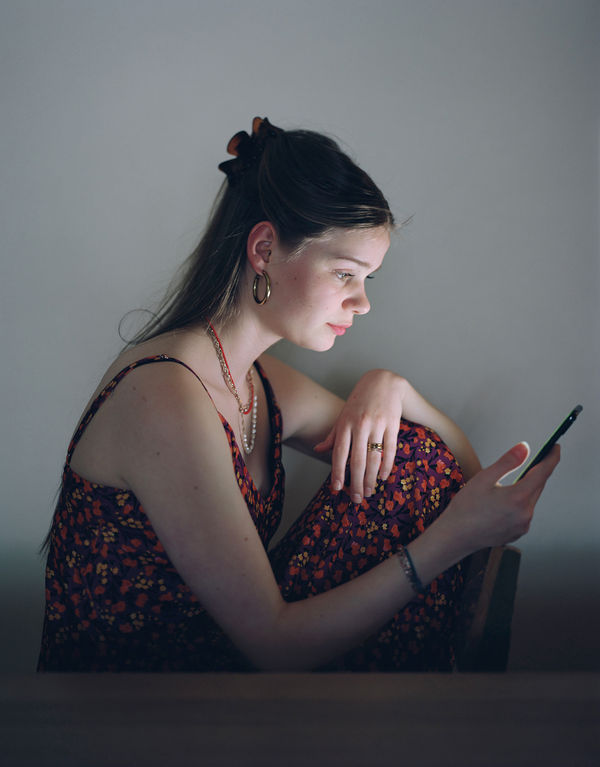
Julia, Amsterdam, March 7, 2022, 2022
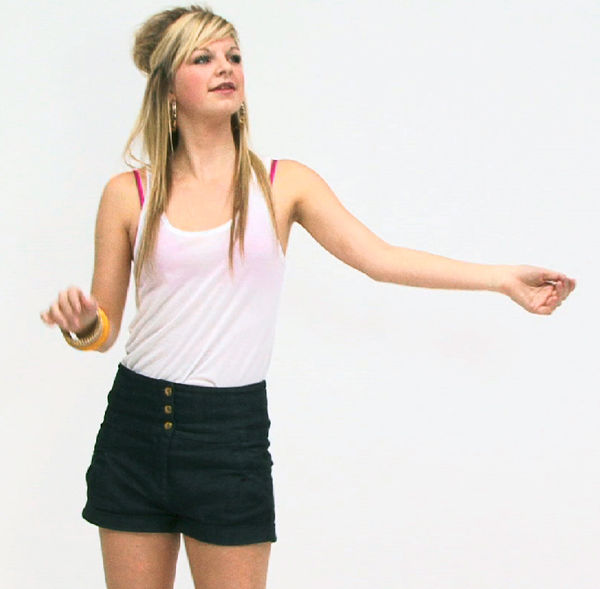
The Krazyhouse, Liverpool, UK (Megan, Simon, Nicky, Philip, Dee) is a full HD video installation displayed across four projector screens in a dark room. The work lasts thirty-two minutes and is shown in a loop, with each image projected on a large scale. The video artwork consecutively presents clips of five teenagers, named Megan, Simon, Nicky, Philip, and Dee in the title, at close-up angles and upper-body views dancing in front of a white studio background to a selected 2000s music track, either Pop, Techno, or Metal. Dijkstra met the teenagers in The Krazyhouse nightclub in Liverpool and asked them to come to a make-shift studio in the club and dance to their favourite song. What is particularly striking about the performances is how each individual is ominously aware of the film camera and adapting differently to being watched. Some, such as Dee and Megan, are shy, adjust their clothes, and hesitantly look into the distance, only gradually gaining the confidence to dance in front of the camera in the white environment that, by typical club standards, can be considered sterile and fully exposing. Others like Simon and Philip indulge in the performance, dancing to the point of physical exhaustion during the brief clips of attention (and fame) offered to them. As such, The Krazyhouse provides an intimate glimpse into the personality of the different protagonists portrayed and so falls into Dijkstra’s artistic practice, which since her Beach Portraits from the 1990s has been concerned with exploring identity.
Tia, Amsterdam, June 23, 1994 (2023) shows a mother standing on her carpet floor at home, embracing a baby. The work draws attention to the practice, common in the Netherlands, of home birth and, like in The Krazyhouse, captures the protagonist – a mother – at a particularly vulnerable moment in her life. The work also recalls the subject of mother and child in art, whether in biblical depictions of the Virgin Mary and baby Jesus or, more recently, in the sculptures of Louise Bourgeois that often capture the existence of mothers, burdened between domesticity and the longing for a community outside. Finally, it also offers a comparison to Shirin Neshat’s work Untitled (Women of Allah Series) (1996), a work showing a young naked tattooed boy next to his mother, veiled in a Hijab; the comparison of these two works from the collection is striking as it draws attention to differing cultural practices of raising children and of exposing one’s body. Julia, Amsterdam, March 7, 2022 (2022) portrays a young woman at side-angle gazing into the light of her phone screen, immersed and unaware of the camera’s presence. When displayed together, Tia, Amsterdam, June 23, 1994 and Julia, Amsterdam, March 7, 2022 capture the passing of time; we could be led to think that the baby in Tia’s arm is Julia; almost twenty-eight years later, the infant has transitioned into an adolescent woman. The titles of the works, referencing their time and place of execution, underline the importance of time to these works.
A central theme throughout the video artwork, as well as both photographs, is the exposure of one’s private life. The dancing adolescents in The Krazyhouse are fully exposed, with the camera often drawing attention to the facial features of the individuals portrayed and the figures shown on a white background, in strong contrast to the viewer of the video artwork, submerged in a darkened and anonymous exhibition space. In Tia, Amsterdam, June 23, 1994, the camera also takes on a distinctly invasive element – almost voyeuristic – with the mother caught in her home right after childbirth. There is an attempt in all artworks to read the psychology and intimate details of those portrayed, even if they may choose to resist exposure. Other artists who have invasively used the camera include Philippe Parreno and Douglas Gordon in Zidane, A 21stCentury Portrait (2006), a 91-minute film that records former French football star Zinedine Zidane during a Real Madrid – Villareal match using 17 synchronous high-zoom cameras, provided by the US ministry of Defence. Artists from the collection who have turned to the camera as a means of self-exposure include Sophie Thun, with works such as Extension 8 x 12 (2015) showing the artist herself naked and photographing herself in the mirror. Thun engages with Feminism and controls her pictorial representation, thus retaining control over her portrayal in a way that Dijkstra’s subjects often lack.
Another central theme shared in the above three works is the passing of time and transition. This has already been alluded to in the case of the photographs of Tia and Julia. In the case of The Krazyhouse, there is also a sense of time’s passing, with the attire of the adolescents and the music danced to of the late-2000s, a time that has long passed. Today’s adolescents listen to different music, wear different clothes, would dance differently, and may even act differently in front of the camera, with the significant encroachment of digital technology and video calls potentially having desensitized them to the camera. In all the above works, we are left wondering: what happened to the figures portrayed? Are Tia, Megan, Simon, Nicky, Philip, and Dee still alive? What do they look like? What do they do and how would they be inclined to reflect on the stage of transition poignantly captured by Dijkstra in film and photographs? Other artists from the collection who reflect on the passing of time include Oliver Laric, with his modern 3D sculptures referencing Neo-Classical forms, which themselves refer to Greek mythology.
Since the early 1990s, Rineke Dijkstra has created a complex body of photographic and video work that modernizes the portrait genre. Her large-scale colour photographs and videos mainly feature young, often adolescent subjects, with minimal contextual details to highlight the interaction between photographer and subject. Her work can be considered diametrically opposed to many of the artists of the Dusseldorf generation of photographers, including Andreas Gursky and Thomas Struth, with Dijkstra tapping into the psychology of the subjects rather than attempting to create a hyper-real sense of objectivity and clarity. Dijkstra was born in Sittard, The Netherlands, in 1959 and studied at the Gerrit Rietveld Academy in Amsterdam from 1981 to 1986. She has received numerous awards, including the Johannes Vermeer Prize (2020) and the Hasselblad Foundation International Award in Photography (2017). Her work has been featured in mid-career retrospectives at notable institutions such as the San Francisco Museum of Modern Art and the Solomon R. Guggenheim Museum in New York. In 2013, the Museum für Moderne Kunst in Frankfurt presented a comprehensive film retrospective of her work.
The Krazyhouse is arguably one of her most significant works. Consisting of an edition of 6 + 2 APs, the present work is among the few not in major institutional collections, with others in the Louis Vuitton Foundation in Paris, Tate Modern in London, Frans Hals Museum and Stedelijk Museum in Amsterdam (joint acquisition), and The National Gallery of Art in Washington D.C. The Krazyhouse was preceded by a video artwork titledThe Buzz Club, Liverpool, England, March 1, 1996 (1997), which consists of short scenes set against a similar white background in two nightclubs.