Gillian Wearing United Kingdom, b. 1963
-
 Me as Artemisia Gentileschi, 2023
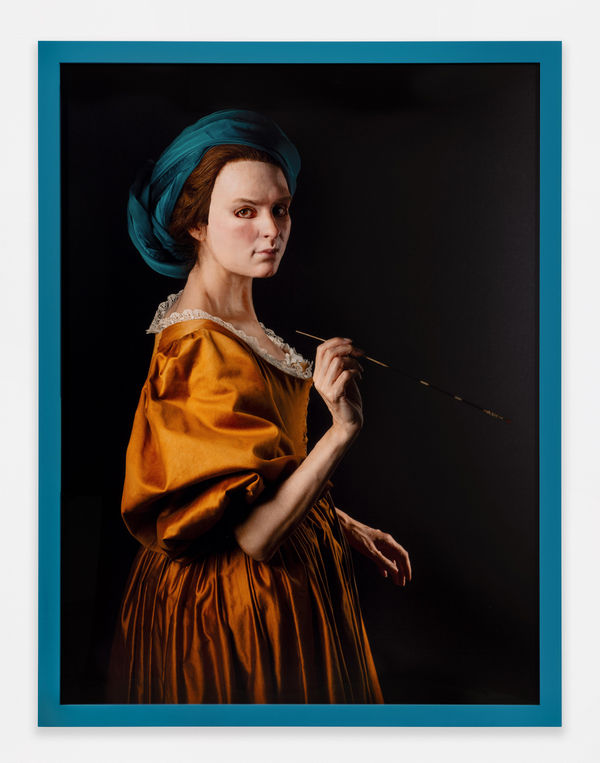
The present work, a staged photograph by Gillian Wearing, shows the artist herself dressed in an ochre Baroque dress wearing a blue headdress. Her elegant right hand is raised, holding a brush; she is looking toward the viewer firmly and seriously, though her face is concealed by an anthropomorphic mask, carefully crafted and fabricated from latex. The artist is standing in profile and well-lit while the background is pitch black; in its contrast of light and darkness, the composition employs the chiaroscuro technique, popular among Baroque painters such as Caravaggio, which effectively heightens the pathos and drama of the composition, suggesting that the image we are looking at is a staged composition of symbolic significance. The work features a blue frame in the colour of the woman’s headdress. This framing alienates the composition from its Baroque context, reminding us that we are looking at a contemporary photograph rather than a historical allegory showing a Baroque female painter.
The title of the work Me as Artemisia Gentileschi (2023) refers to Gillian Wearing presenting herself as the famed female Baroque painter Artemisia Gentileschi. Wearing has been acutely interested in staging herself with masks. In the early 2000s, for the series Album (2003), the artist would dress up as her different family members and wear masks, thus relating herself to the various persons she depicts, suggesting the family lineage, shared history, and emotional baggage that unites her family. She has also taken a keen interest in self-portraits by famous artists she admires, for example, re-staging self-portraits by artists including Robert Mapplethorpe, August Sander, and Diane Arbus. The present work can be seen as a continuation of that series with Gentileschi, like Mapplethorpe, Sander, and Arbus, famed for incisive self-portraits. Gentileschi’s self-portraits are particularly noteworthy for their commentary on the status of female painters in the early 17th Century and Gentileschi’s attempts at standing up against conservative traditions. The present work loosely references Gentileschi’s Self-Portrait as the Allegory of Painting (1638-1639), a bold painting in the Royal Collection in London that is both a self-portrait and an allegory of painting, with the artist confidently choosing herself as the embodiment of this artistic form. Other artists from the collection who have taken a particular interest in staging images include Cindy Sherman, with Sherman often drawing on Pop cliches rather than precise historical references in art or cinema.
In this series Wearing situates herself within art history alongside artists she admires, paying both homage and identifying herself with these figures. Other artists from the collection who have appropriated artworks by canonical figures include Rebecca Warren and Sylvie Fleury, with the works from the collection exploring the artist’s ambivalent reactions to Umberto Boccioni and Allen Jones, respectively. The use of masks, as Wearing had done in the past, is particularly interesting. Masks are at once a way of concealing one’s identity by not showing face but also a way of revealing one’s feelings and inclinations through the veil and deniability that anonymity provides.
Gillian Wearing, a notable Young British Artist from the early 1990s, is renowned for her confessional work, capturing others' secrets through masks and distancing devices. Awarded the Turner Prize in 1997, she has explored various artistic mediums, including photographs, videos, public sculptures, and paintings during the Covid lockdown. Aside from her series of Mask portraits, of which the present work can be considered a descendent, she is famous for a series of 1990s confessional photographs titled Signs that say what you want them to say and not Signs that say what you want them to say and not Signs that say what someone else wants you to say (1992 – 1993), capturing individuals holding self-chosen messages, revealing a complex interplay of personal expression and hidden depths.