Renate Bertlmann Austria, b. 1943
-
 Amo ergo sum, 2019
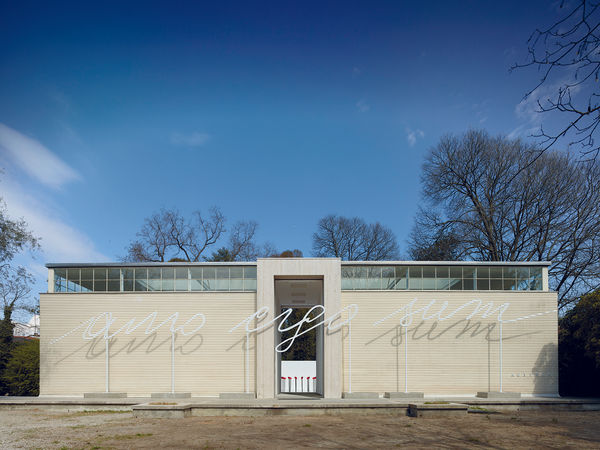
Born 1943 in Vienna, Renate Bertlmann emerged in the 1970s, a period when new attention was drawn to women’s rights and female conditions in society. Her art is most directly associated with feminism, sexuality, gender and eroticism, making Renate Bertlmann a radical and iconic member of the feminist art movement. In younger age she was a passionate reader of pivotal books written by women, and it was after reading Linda Nochlin’s seminal 1971 essay Why Have There Been No Great Women Artists? that she realised that women didn’t have a preeminent role in art.
The 1970s were also the years of her political participation, and other seminal books became an important inspiration for her artworks, such as Thomas Bernhard’s texts. Bernhard was a controversial character in Austria at that time, extremely critical about the human condition in general, exploring subjects like death and loneliness, and very pessimistic about his country. These readings led Bertlmann to realise the wheelchair series, inspired also by Bernhard’s play A Party for Boris about an institution for handicapped people. The meaning of her performances - an iconic one sees a pregnant bride on a wheelchair - is to be found in subjects like motherhood and society’s expectations of women. Her main objective was to challenge the public and invert wider stereotypes about gender, conflating male and female (i.e. “male” condoms turned to resemble breasts).
In 1978 Bertlmann started her most famous series Amo ergo Sum, which became the general credo for her work. The sentence is a development of “Cogito ergo sum”, one of the principles of the philosopher René Descartes (1637) (I think, therefore I am). The first work consisted of 77 plexiglass letter boxes filled with messages by the artist herself and other people, that evolved in the 1980s to a 3-volume book. The volumes were titled Pornography (Part 1), Irony (Part 2) and Utopia (Part 3) - all subjects that she continually rediscovers and remodulates in her art, often mixing up the three subjects together.
In the 2000s Renate Bertlmann received her first important commissions. The peak arrived in 2019 when she was chosen to represent Austria at the Venice Biennale. She realised an installation called Discorgo ergo Sum, including a huge handwritten inscription of her motto “Amo ergo sum” and a field of 312 knife roses. Again, Bertlmann wanted to present the ambiguity and ambivalence of a traditional symbol of love, the rose, which can be dangerous with its thorns, the knives.