Judy Chicago United States, b. 1939
-
 Women and Smoke, 1971 – 1972
Judy Chicago (born Judith Sylvia Cohen, 1939) is an American artist from Chicago, and best known for her multidisciplinary approach to art, that celebrates the diversity of female individuality. She suffered for the loss of her husband at young age, as well as her father’s, and therefore decided to change her name to Judy Chicago, something independent and unrelated to family names or marriage. She has been always critical about the absence of women Western cultural canon. Founder of the first feminist art program in the United States, she is a pioneer of feminist art movement. Her role was primarily to teach other young female artist how to express their creativity, and she organised courses, meetings and discussion groups in Ferno University campus.
Chicago is best known for The Dinner Party (1974-1979), an ambitious multi-media installation on permanent display at the Brooklyn Museum in New York. This consists of 39 elaborate place settings on a triangular table for 39 mythical and historical famous women: Eleanor of Aquitaine, Empress Theodora of Byzantium, Virginia Woolf, Susan B. Anthony, and Georgia O'Keeffe are among the symbolic guests. For each guest a panel describes the importance of the person. Despite strong criticism from the art world, the work has been a success for the general public, and it was shown on a long tour exhibition reaching thousands of people.
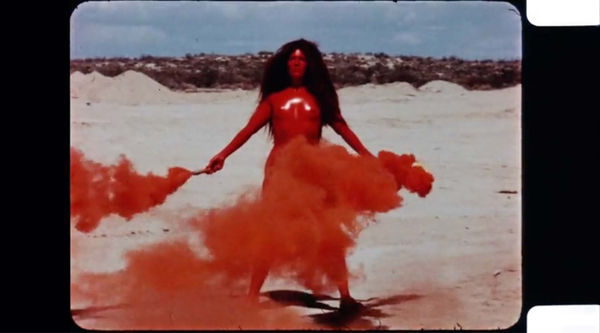
Judy Chicago’s art spans many mediums, not just painting and sculpture, but also ceramics, textiles, photography, stained glass, needlepoint, and printmaking. She also explored video acts, like the acquired artwork, where she displays a collection of smoke performances, realised with the use of fireworks. For this kind of performance, Chicago worked with her students, colouring their body in contrast with the colour of the smoke. Some of these videos, titled Atmospheres, were intended to instil a feminine energy into the environment, while others are focused on re-creating women-centred activities like the kindling of fire or the worship of goddess figures. The idea came from the artist’s interest in practice of immolation like Sati, an Indian practice in which widows are forced to throw themselves into the flames of a funeral fire.
Women and Smoke gathers a series of performances that Chicago choreographed in California. The film opens with the artist walking towards the camera, followed by a series of smoke performances in which pink-toned smoke rises from an empty landscape and a more dramatic dark smoke erupts from a bridge overlooking a busy crossroads. The movie progresses with performances of female figures coloured in pigments that move away from the foreground as they become surrounded in clouds of coloured smokes and that seem to merge with the dry landscape. The following scenes represents the Sati ceremonial aspects investigated by Chicago. The film is concluded by Woman with Red Flares, in which Nancy Youdelman, heavily painted in red slowly advances towards the camera brandishing red smoke cylinders as if performing a ritual. Chicago ends the film with a striking image: the performer stands upright in a red cloud, her scarlet body glimmering in the desert sun, and her arms and legs spread apart in a final incarnation of strength. Through Women and Smoke, Chicago demonstrates her visionary approach to artistic creation as a tool to enact socio-environmental change.