Collection Highlights
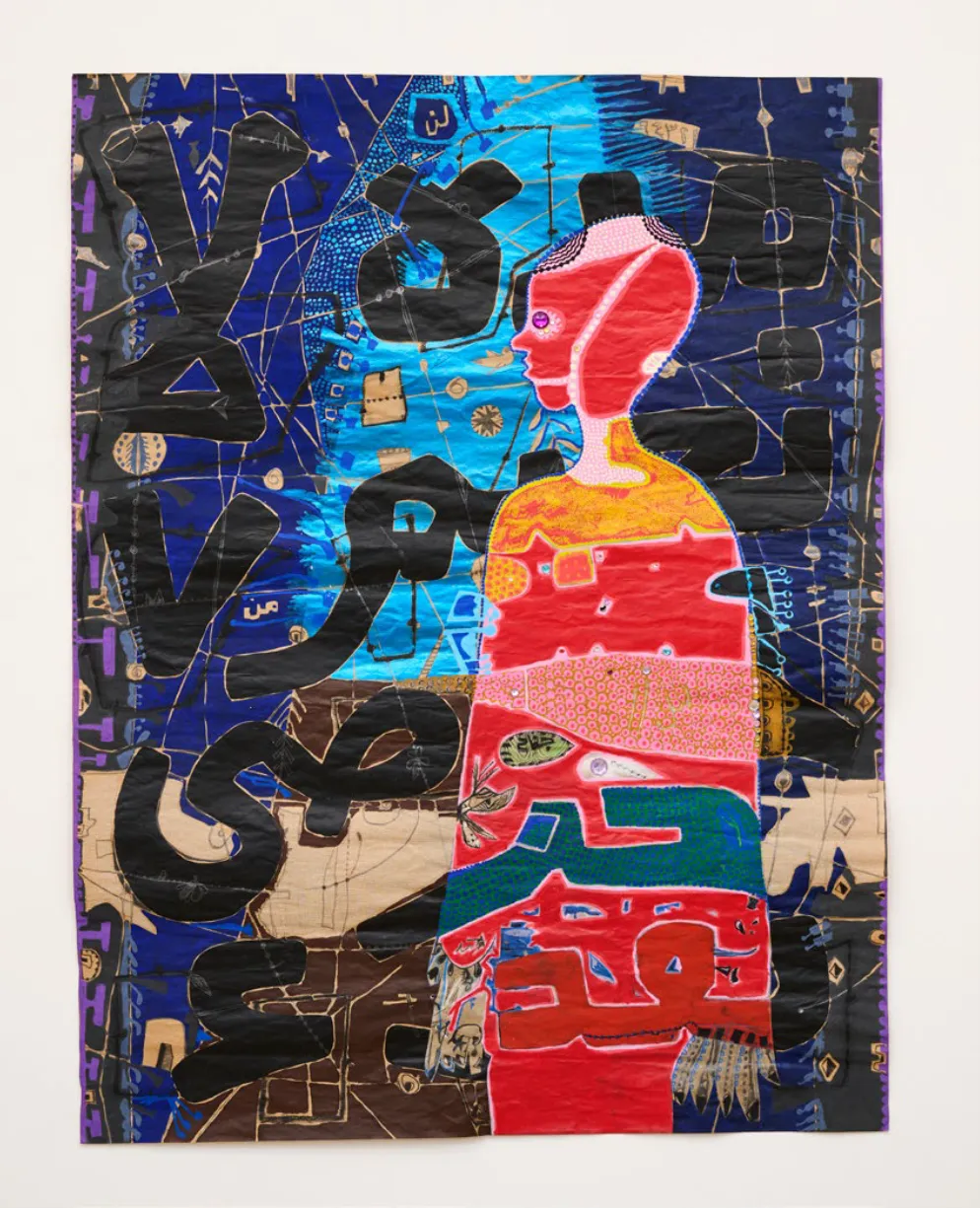
Fathi Hassan Egypt, b. 1957
29 1/2 x 19 1/2 in
Fathi Hassan was born 1957 in Cairo but his family was originally from Nubia, the desert region in the south of the country. The family was forced to leave when the Aswan Dam was built in 1952, as this part of the country was to be flooded with water to create the Lake Nasser. Not only families had to relocate: the famous ancient Egyptian Aswan Temple was rebuilt in a higher location to avoid being submersed. In the 1980s, Hassan moved to Italy, Naples, where he won a grant to study in the local art school graduating in 1984. Since then, he has lived many years in Italy, moving only recently to Edinburgh. He was one of the first African artists to be invited to the Venice Biennale in 1988 and is now an established name within UAE art fairs and biennials.
Hassan plays with Arab calligraphy, but he also loves mixing materials, landscapes and cartographic scenes, where colours are bright and dominant. In his most recent show with Richard Saltoun Gallery, where the present work is currently exhibited, Hassan’s Nubian roots are still predominant, to the point that the exhibition title, Akkij, is the artist’s childhood Nubian name. A name that, as Hassan writes, is “a voice that
comes from afar, from before writing, before imposed silence, before exile.” The works in the show evoke the lost languages of ancient civilisations. They are like “unwritten pages” made with different techniques that speak in silence.
While in early work Hassan focuses on calligraphy against colourful structures, in these recent works on paper compositions are more complex. Written words and letters are still important, but they appear as symbols, parts of metaphors. This is the result of the evolution of Hassan’s style and the impact that his life experience, including his background and life spent in different places, had on his production.