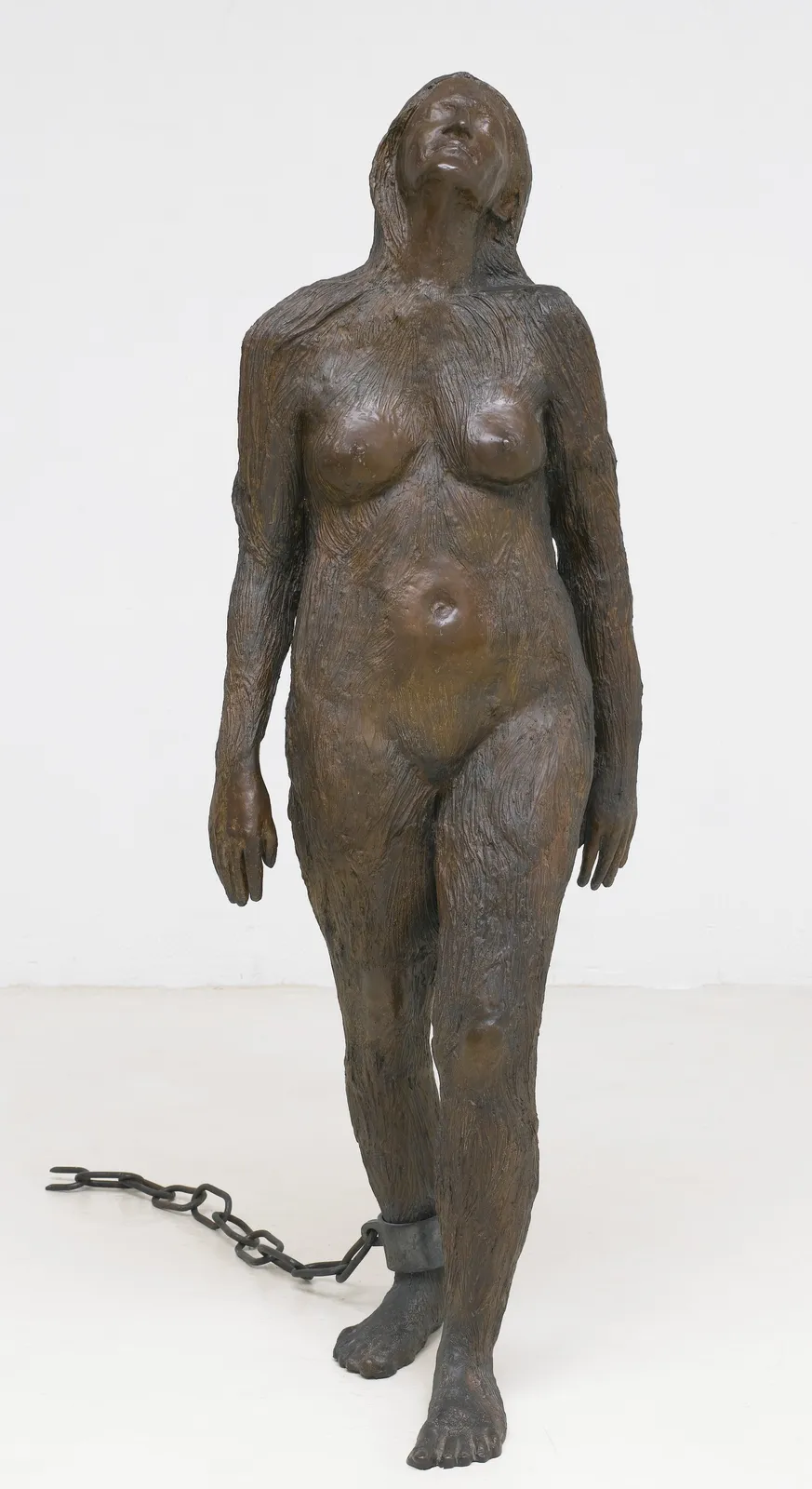
Kiki Smith Germany, b. 1954
60 x 20 1/2 x 21 1/2 in
Vulnerable figures, whether human or animal, are a mainstay of Kiki Smith’s art. The German-born American artist (b.1954) rose to prominence in the 1980s with provocative figurative sculptures of the female body in materials as diverse as bronze, wax, porcelain and paper. Her explorations of mortality and decay were prompted by the death of her sculptor father Tony Smith (1912–1980), and later the AIDS epidemic, which claimed the lives of friends and family members. Hand in Jar, from her morbid series of dismembered body part sculptures, features an algae-coveredhand submerged in pond water to evoke a forensic pathology specimen.
Raised by a Catholic mother, Smith has a longstanding interest in mysticism and religion. She explored these themes in her 1990s sculptures of the Virgin Mary and Mary Magdalene. In the former, Christ’s mother is depicted flayed like a martyr, while the latter shows the sinner-turned-saint shackled and covered in hair, a reference to Southern German Renaissance artworks portraying her as a wild woman wandering the desert.
From the early 2000s, Smith drew inspiration from folk tales and literature. A body of work relating to Lewis Carroll’s Alice’s Adventures in Wonderland (1865) includes the ethereal sculpture Seer (Alice I), which reimagines the story’s young protagonist as a future-seeing oracle from Greek mythology.
Themes of environmental angst and climate breakdown coalesce in Smith’s large-scale jacquard tapestries, which are inspired by the Apocalypse Tapestry, an epic cycle of late-14th-century French textile hangings illustrating scenes from the biblical book of Revelation. In the dreamlike Congregation, a menagerie of woodland creatures surround an unclothed woman sitting on a fallen tree. Stem-like forms protruding from their eyes form a web-like structure, suggesting the interconnectedness of all things. For Smith, this and related compositions speak to “the wondrous and precarious nature of being here on earth”.