-

The judgment of Paris is one of the great fables of western art. According to the ancient story, the Trojan prince Paris was living as a shepherd on Mount Ida when he was asked to judge a beauty contest between three Olympian goddesses. Renowned for his fairness, the rustic prince was not, in the end, impervious to bribery. Hera, Athena and Aphrodite each made him a fabulous promise. It was Aphrodite’s pledge – the love of Helen of Sparta, the most beautiful of mortal women – that swayed him.
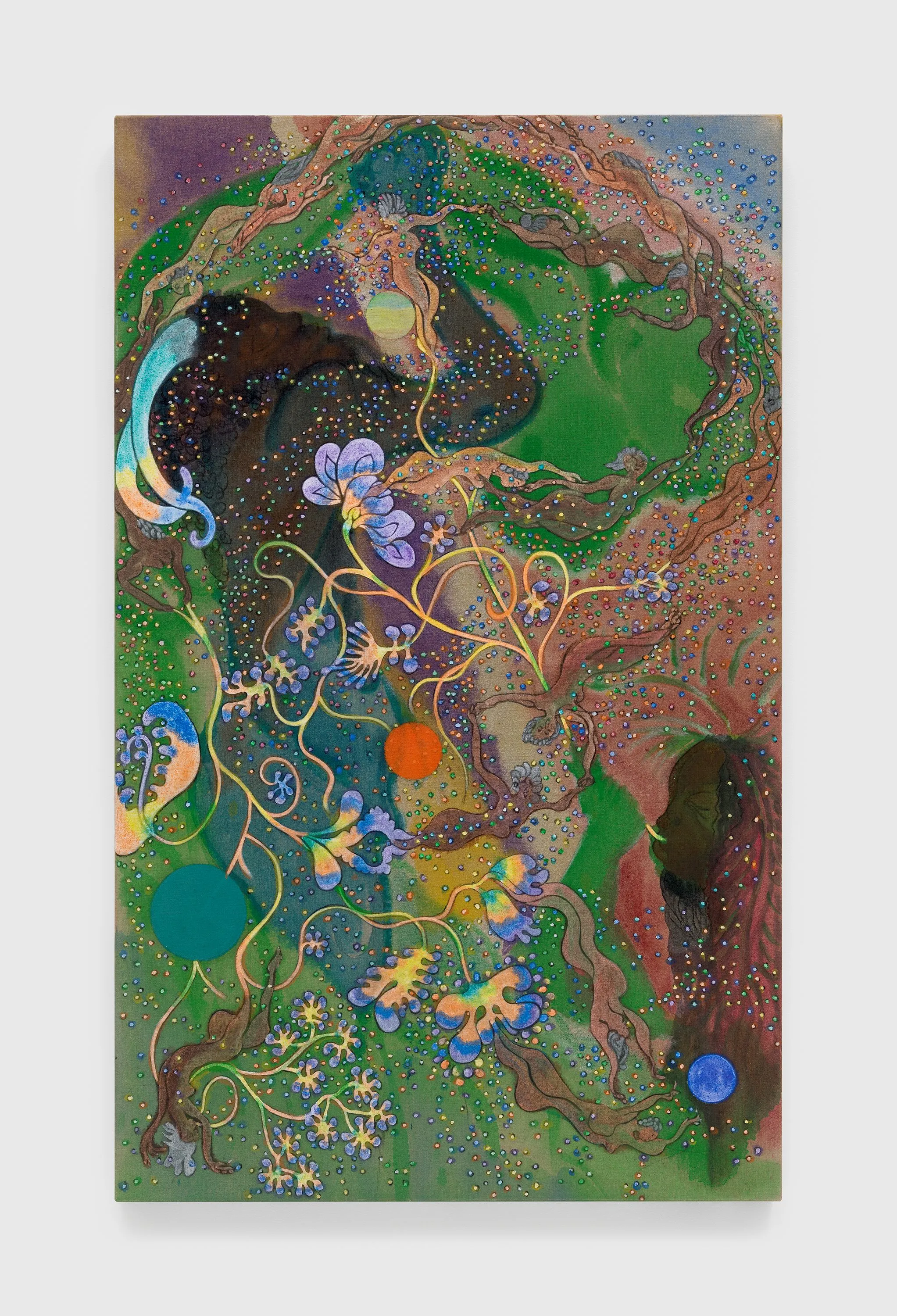
In Chris Ofili’s painting The Judgment of Paris – Actaeon (2011-2023), Paris appears as a muscular figure with curling horns that gleam bright blue – a strange incarnation, but then he always was a disguise artist. (His rural life on Ida was a cover: he had been adopted as a baby by a herdsman after his royal parents cast him out.) Rising from a whirlpool of bubbles, tendrils and eel-like swimmers, he holds up an arm, seeming to grasp – or to release from his grip – an iridescent shower of pearls. The scene bears witness, perhaps, to an interior metamorphosis: the moment at which discrimination gave way to temptation, when Paris clutched desirously at the pearls of Aphrodite’s promise.
The painting itself is the product of a metamorphosis. Originally, it represented the myth of Actaeon, the hunter who spied the goddess Diana naked, prompting her to transform him into a stag. Twelve years later, Ofili reworked the painting and changed the myth, although the figure’s icicle-blue horns (albeit not the antlers of a stag) point to the earlier story.[1] Each is a story about looking – about the gaze of a mortal man upon the female, divine body, whether the forbidden sight of Diana or the licensed view of the three goddesses in the contest. And each ends in disaster: Actaeon, having been turned to a stag, was torn apart by his hunting dogs, while Paris’s abduction of Helen from Sparta led to the Trojan War.
Ofili evokes these shared currents of beauty, desire and discord. The main figure is like a personified constellation, an anthropomorphic shape materialising of ‘random’ nature, and yet the scattering pearls or bubbles seem to presage a disintegration, a coming chaos. A sense of aesthetic allure converges with a subtler note of disorder. Ofili is less concerned with the particulars of either story than with the capacity of myth itself to change shape, or to contain a mass of allusions. The figure in the bottom right, who holds a flowering sprig in his mouth, is a reference to Jean Siméon Chardin’s Soap Bubbles (1733-34; Metropolitan Museum of Art, New York), in which a young man blows a shimmering bubble through a straw. The biomorphic swimmers refer, meanwhile, to Pablo Picasso’s 1928 series, Ballplayers on the Beach.[2] Ofili’s cosmic, sensuous vision is also a gaze inward: a beauty contest of influences and ideas.
-
Striking a Pose
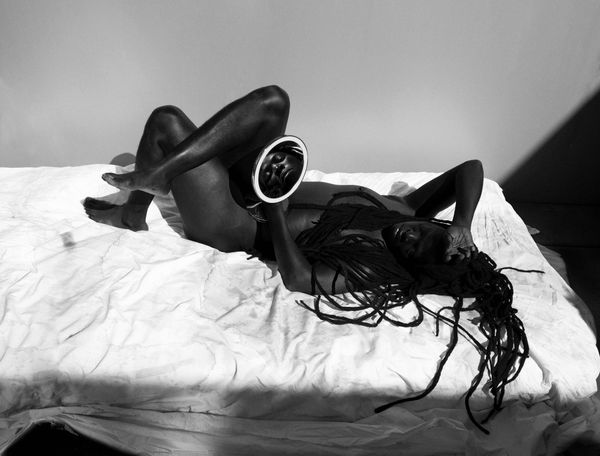
Myth is rarely the escapist fantasy it might seem. Its Janus-like perspective, simultaneously casting into history and attentive to the present, is traceable in Zanele Muholi’s photograph Bona III, ISGM, Boston (From Somnyama Ngonyama series) (2019), which forms part of a series of self-portraits by the South African artist.[3] Cast in stark black-and-white, the artist appears in the guise of a goddess, specifically Venus (the Roman Aphrodite) as imagined by Diego Velázquez in The Toilet of Venus (The Rokeby Venus) (1647-51; National Gallery, London): a nude, recumbent woman gazing into a mirror as she lies back on a couch.
Muholi plays with the recognisability of the Baroque precedent, while also jolting us out of any single category.[4] This is a real, Black body, the photograph seems to say, not that of an historical paragon. Spreading across a scuffed and stained mattress, that body perhaps expresses a challenge to the perceived passivity – the objectification – of female nudes throughout history.[5] The mythic reference is also, in this way, a moment of demythologisation: how does a body such as mine, Muholi demands, conform with ingrained notions of beauty, divinity or sex?
As with Ofili’s painting, the mythic ‘turn’ in Muholi’s photograph is also a turn inward: a reflection on the artist’s identity as a Black South African squaring up to – staking a claim to – the western tradition.[6] The artist’s raised right arm nicely expresses this dual quality, directing us (almost literally) towards ancient models while equally betokening self-absorption.
Identity, Muholi reminds us, is an act of mythmaking. In the wider series from which this photograph derives, Muholi assumes a variety of guises – a feathered headdress, for instance, or a crisp white bath towel, the latter suggesting both an everyday occurrence and a knowing piece of orientalism. These ‘disguises’ express the double-edged nature of identity, exposing the self while also (perhaps necessarily) deflecting or dissembling. The historical allusion might alternately be seen as a mask or a paradoxical route to the truth.[7] In Bona III, the artist’s face is cast in shadow. Its reflection in the mirror is impassive – resistant to interpretation.
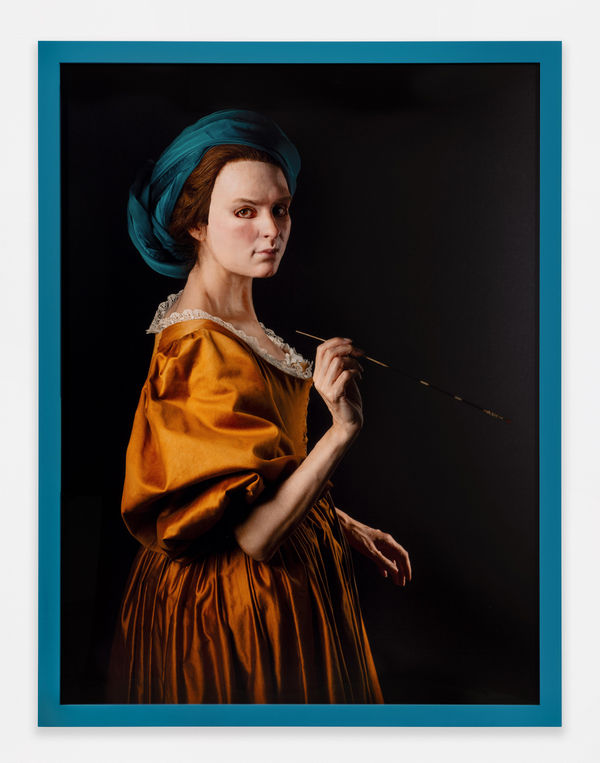
Self-mythologisation is even more overtly the subject of Gillian Wearing’s photograph Me as Artemisia Gentileschi (2023). In this, Wearing assumes a persona – dons a mask. Like Muholi, she mimics and subverts Baroque painting: there is a glancing similarity to Artemisia Gentileschi’s Self-Portrait as the Allegory of Painting (1638-39; Royal Collection, London), although the photograph doesn’t quote any single precedent. In line with Wearing’s previous series, she has placed a latex mask over her face; her real eyes puncture the prosthesis.[8] The self, Wearing suggests, is an unstable composite. Her real body and face are overlaid by an historical persona, or the idea of one: there is a knowing artifice about her performance.
The classicist Helen Morales has observed: “myths enlarge people when they overlay them with attributes and accomplishments from the figures in the ancient tales.”[9] Gentileschi, who achieved artistic fame after the early trauma of a rape and the public trial of her attacker, might be regarded as such a figure: her life story has attained the level of hagiography. And yet, Wearing’s disguise is not an act of self-aggrandisement so much as a staging of the anxiety of influence.[10] She seems to scrutinise herself through the eyeholes of her mask, wondering whether she measures up.[11]
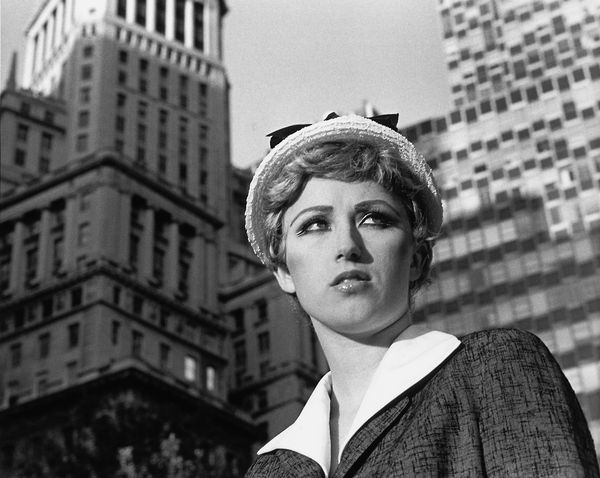
Wearing’s constructions of identity owe much to the photographic fictions Cindy Sherman, whose work has long dealt with self-mythologisation of an everyday variety. The character in Untitled Film Still #21 (1978) is not an antique heroine or a canonical artist, but the protagonist of a movie – the Hitchcockian office girl in a designer suit, concealing her anxiety behind a frown.[12] Sherman plays the part of a young woman playing a part, masking herself (whether consciously or not) through the emulation of a cinematic type. This is the kind of modern myth conceived of by Roland Barthes in his 1957 study Mythologies. Striking a pose, framed in close-up, the woman in the picture becomes symbolic of something more than herself, and yet she remains – vulnerably, defiantly – herself. In this respect, she is a more mundane version of the ‘face’ that Barthes perceives in Greta Garbo in Queen Christina (1933), offering “a sort of Platonic idea of the human creature … when the archetype leans towards the fascination of mortal faces.” [13]
-
Realness
The shift between the archetype and the mortal face – or to put it another way, between art and nature – has been a fixation of artists and theorists of art since antiquity. Ovid in the Metamorphoses (c. AD 8) recounts the story (already famous by his era) of the Cyprian sculptor Pygmalion, who carved an ideal woman – a Platonic ideal, akin to Barthes’s Garbo – and then prayed to Venus that she might become real. His wish was granted: the ivory softened into flesh. But even before the divine intervention, Pygmalion was entranced by his statue’s capacity to seem real: “art lay hidden beneath its own artistry.”[14]
It is one of numerous myths in which the dynamic between living and sculpted bodies is fluid or elusive. A more visceral expression of that dynamic occurs in Théodore Géricault’s two paintings Severed Limbs (1818 and c. 1819), studies of a severed foot and hand piled up on a table.[15] Each image achieves a sense of the uncanny by presenting real bodies as though they were chunks of marble or plaster. Grisly naturalism is countered (partly through candlelit chiaroscuro) by a suggestion of Greco-Roman fragments of the kind that artists routinely drew from in the nineteenth century. As Linda Nochlin has observed: “The mood of these works shockingly combines the objectivity of science – the cool, clinical observation of the dissecting table – with the paroxysm of romantic melodrama.”[16]
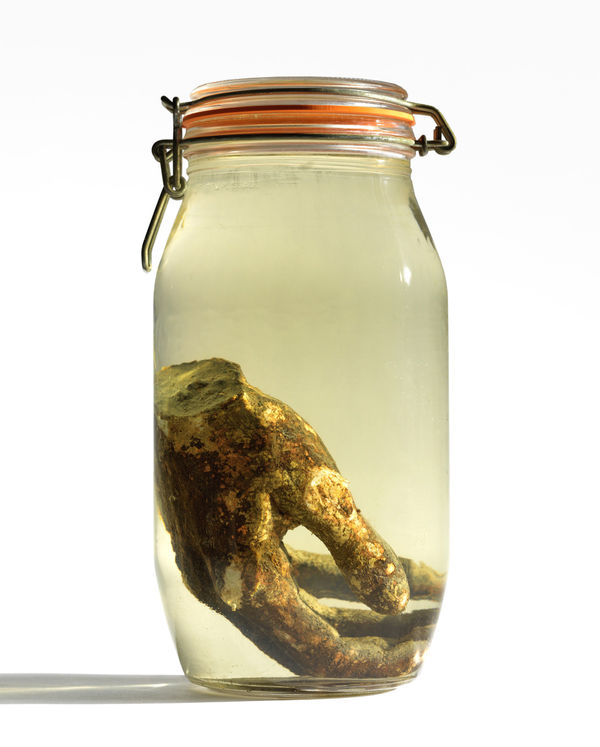
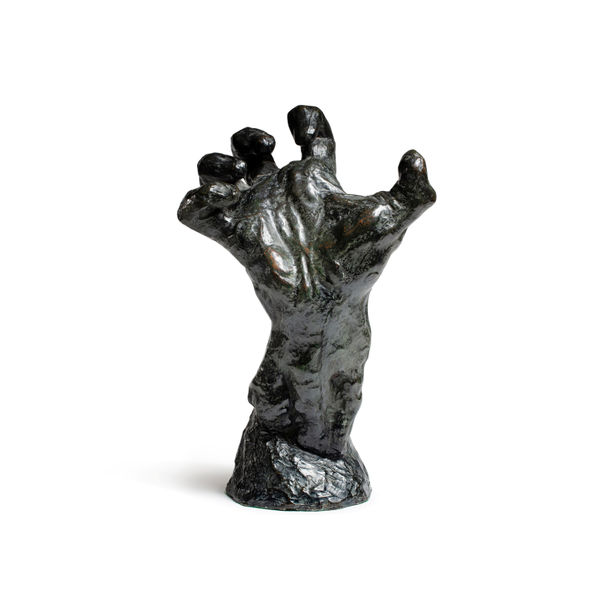
Seen together, the two disembodied hands represented by Kiki Smith’s Hand in Jar (1983) and Auguste Rodin’s Main crispée droite (1898/1926) express the same opposition: an anatomical specimen versus a sinewy, flexing body part.[17] Between the two objects, there is a strange upending of the Pygmalion myth. The hand in the jar might be seen as an offcut of ‘real life’, a literal body rather than a represented one, and yet (as with Géricault’s studies) life has dwindled into dull matter. By contrast, Rodin’s sculpture suggests a fragment of statuary that has clenched into life – broken out of it staid neoclassical limits to become muscular and expressive. Reality has become static, while art seems to be teetering on the brink of animation.
Rodin and Smith’s sculptures play, in their distinct ways, with the concept of realism (the one employing an emotive realist style, the other simulating the appearance of an actual body part), while also implying two distinct categories of fragment – antique sculpture and the anatomical specimen. They hint equally at the possibility of these categories dissolving together. For one thing, the specimen in Smith’s jar is not an actual severed hand, but a plaster substitute covered in algae and copper leaf. The assemblage dates from a period when the artist focused on ideas of abjection, mortality and the body (in the mid-1980s, she studied to become and emergency medical technician to gain practical knowledge). In 1990, the critic Christopher Lyon noted: “Smith’s is a timely subject – the body has become a political battleground, as the various organs of social control fight over it – but her approach has very ancient roots.”[18]
Indeed, for all its blunt literalism, Hand in Jar anticipates Smith’s more explicitly ‘mythological’ works of the 1990s and 2000s (Virgin Mary, 1992; Mary Magdalene, 1994). The embalmed hand seems to be acquiring a patina of verdure and lustrous metal – changing, that is, from a body into an art object. The variegated pattern introduces an unlikely note of aestheticism to the severed body part, as well as a semblance of measureless age. Smith’s hand has apparently undergone the kind of slow, alchemical metamorphosis pictured by Ariel in The Tempest: “Of his bones are coral made; / Those are pearls that were his eyes”.[19] It is as if the object had grown its strange carapace over countless centuries.
A similar dualism of modernity and antiquity characterises Rodin’s sculpture. Like the majority of his stand-alone hands, Main crispée droite was modelled some time in the 1880s or 1890s, and may originally have been conceived as a study for The Burghers of Calais (1884-89), a figure group in which romantic melodrama glimmers beneath an aspect of rugged, noble realism. [20] Tensed as if in spasm, the hand is a riposte to the idealising forms of neoclassicism. It contorts itself “as if to clutch the void, squeeze it and knead it into a sort of jinxed snowball to be thrown at the happy passer-by”, in the words of the poet Gustave Kahn.[21] For all its expressive power, however, Rodin’s sculpture was influenced as much by Greco-Roman fragments (objects that he collected avidly) as by an interest in verisimilitude. Far from being an accurate anatomical study, the hand compresses the emotive force – the romantic melodrama – of an absent, perhaps non-existent composition. Like a fragment of classical statuary, or like a myth, it is at once autonomous (possessed of an internal logic) and symbolic of a larger corpus. There is an elegiac wince to the tensing fingers.
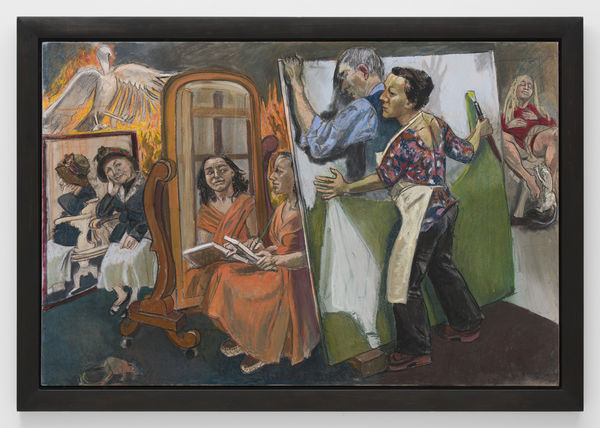
A more comedic reversal of the Pygmalion story may be discerned in Paula Rego’s Painting Him Out (2011), a pastel drawing in which a female artist, possibly Rego herself, effaces the body of a man as he leans against her canvas. The grey-haired, waistcoated victim seems to be submitting dolefully to his own erasure, or simply to have fallen asleep. The artist pulls a large swathe of green across him; this monochrome overlay at once resembles a physical curtain and a layer of pigment that she is applying with a brush. Such an ambiguity between illusion and reality reverberates through the rest of the picture. The act of ‘painting out’ appears to be taking place in a kind of atelier of the imagination: two women sit before mirrors, contemplating or ignoring their reflected images, as though enclosed in separate worlds of thought. In the background, a third woman reclines, parting her naked legs and clasping her breasts, in a more sensualised moment of self-sufficiency.
In this feminist tableau, the figure of Pygmalion – the male creator or lover – is being erased from sight, and yet, in an ambivalence typical of Rego, the act of overpainting has an incongruously compassionate air.[22] It is as if the artist, far from painting a picture, were wrapping an invalid in a blanket or cloaking a corpse.
-
JUST A STORY?
Ovid’s Metamorphoses was a radical reimagining of the category of epic – a long, winding story whose one thread of continuity was the theme of transformation, or “bodies changed into new forms”.[23] The poem continually interrupts itself, seeming to lose its narrative thread or to meander capriciously between places and characters. Stable, linear narrative collapses into something more erratic and imagistic. For this reason, Ovid’s poem has long been regarded as exhibiting a postmodern quality, two thousand years before the event.[24]
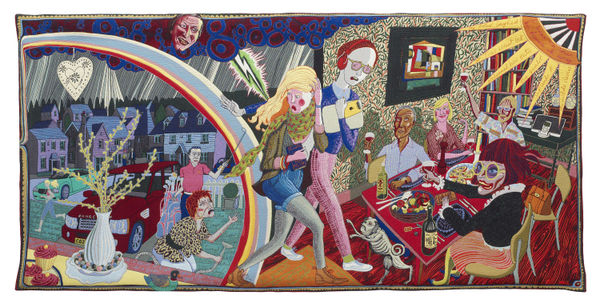
Works such as Grayson Perry’s tapestries, Lamentation and Expulsion from Number 8 Eden Close (both 2012) adopt a synthesizing, quotational narrative style – grappling with the legacy of postmodernism, as it were, from the other end of the historical scale.[25] Familiar stories from art and literature – Adam and Eve’s expulsion from the Garden of Eden, Mary’s lamentation over the dead Christ – are rewoven, literally, as a mural-like hangings. In lurid colours, Lamentation presents a compressed scene of urban life: a dead or dying figure is tended by two others amid a comic-book cityscape; a crashed car in the background indicates the cause of the tragedy. Expulsion from Number 8 Eden Close transposes the tale of Adam and Eve into a soap-operatic episode: a young couple are seen being driven from one nightmarish family drama into another.
The garish colours are matched, in each case, by a meticulous linearity and lurking grotesquery that evoke both medieval woodcuts and German expressionist art. In Lamentation, the body of the injured figure shares the preternatural elongation of Matthias Grünewald’s Lamentation of Christ (circa 1525). But while Perry’s reference to an art-historical precedents might seem to imbue the scene with a tragicomic sense of design and gravitas, it also underlines the absurdity of searching for allegories – for schemes or meanings or narrative threads – amid the chaos and cacophony of contemporary life. The joke here, if there is one, is that real life might aspire to the level of allegory, but can never succeed.
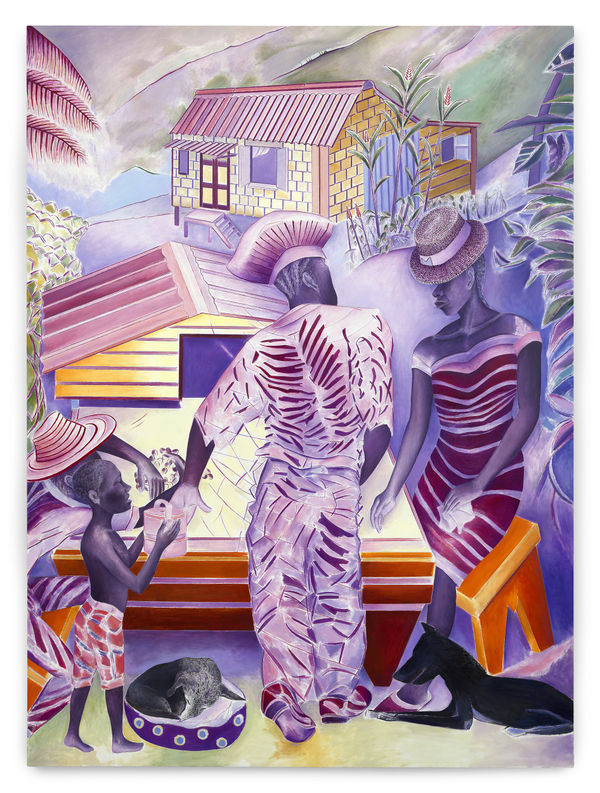
While Perry directs his vision outward to produce an absurdist, hyperbolic form of reportage, the Grenada-born British artist Denzil Forrester appears to mediate more equivocally between the external world and the figments of memory and imagination. As the painter Peter Doig has noted, Forrester’s night-club inspired paintings “emerge as much from [the artist’s] imagination as from his studies of real life”, and possess “a subtlety and form that has perhaps come about because he is reflecting on his past.”[26] In Homenow (2022-23) suggests a story in which different timeframes have coalesced, in the synoptic style of an early Renaissance painting, with memory and the visible world dissolving together across the lilac-hued tableau. The man and woman in the foreground, accompanied by a small shirtless boy and sleeping dogs, might either be the members of a family or the disconnected spectres of a dream. The houses that occupy the space beyond them, across a wall or threshold, are similarly ambiguous in import, either a painted backcloth or a tangible reality. Here, as throughout his practice, Forrester implies the possibility of a narrative – of an episode in medias res – while also sustaining the liminal, phantasmal ambience of the mind’s eye. If Perry offers a Hogarthian view of society, de-elevating canonical stories to the level of ordinary life, then Forrester reminds us of myth’s capacity to be turned inward – to give narrative shape to the psyche.
This is the same interiorised version of myth that we saw in Ofili’s Judgment of Paris, where narrative has given way to a dreamlike amalgam of bodies and forms. The horned figure in Ofili’s picture is not so much Paris as a proxy for the artist himself; the swirling colour and scattering orbs are a terrain of the imagination as much as a mythic setting. And yet Ofili’s work is no less ‘real’ than Perry’s social-realist scenes. Ofili wields ancient mythology as Picasso did in his series of etchings relating to the Minotaur in the 1930s, as a window into the consciousness. Gone are the components of a traditional depiction of the judgment of Paris: the naked goddesses, the rustic adjudicator, the rural backdrop. Instead, rather like Ovid – his ultimate source – Ofili engenders a sense of myth’s own fluidity, its absorption of different narratives, its susceptibility to being rewritten. His mercurial vision of an ancient story is equally a dialogue of the mind with itself, unfolding in the present tense.
-
[1] The horns have become a recurring motif in Ofili’s art – not representative of any myth or character in particular.
[2] The floating spheres and scattering pearls might justbe an allusion to the golden apple that features in the story of the judgment of Paris: it is said that the squabble between the three deities arose when Eris, the goddess of strife, threw a golden apple inscribed with the words “For the fairest” into their midst. Picasso’s series marked a shift, after the neoclassical ‘turn’ of his work of the earlier 1920s, back to a more schematic, geometric and blatantly sexual treatment of the body. Ball Players on the Beach (1928; Musée Picasso, Paris) is one of a group dating from a summer during which Picassso stayed on the Brittany coast. It reflects his love affair with Marie-Thérèse Walter.
[3] Somnyama Ngonyama translates as ‘Hail the Dark Lioness’. [CHECK]
[4] Her upraised right arm resembles that of the ‘Cleopatra’ / Ariadne, a Hadrianic version of a lost Hellenistic statue, and one of various Greco-Roman marbles that were installed in the Belvedere Courtyard at the Vatican in the sixteenth century.
[5] As John Berger famously put it: “In the art-form of the European nude the painters and spectator-owners were usually men and the persons treated as objects, usually women. John Berger, Ways of Seeing (London: Penguin Books, 1972), p. 63.
[6] The photograph, as its title records, formed part of a presentation (‘Being Muholi: Portraits as Resistance’) at the Isabella Stewart Gardner Museum, Boston, 10 February to 8 May 2022.
[7] Annie Ernaux, in her memoir The Years (2008), expresses a similar idea: “She would like to assemble these multiple images of herself, separate and discordant, thread them together with the story of her existence […] an existence that is singular but also merged with the movements of a generation.” Ernaux, The Years, trans. Alison L. Strayer (London: Fitzcarraldo Editions, 2018), p. 169.
[8] Wearing has worn masks in numerous photographic works. The series Album (2003) consisted of photographs of the artist dressed up as various members of her family; the series Spiritual Family (early 2000s) re-staged self-portraits by photographers such as Robert Mapplethorpe, August Sander, and Diane Arbus, with Wearing masking and attiring herself as the earlier artist.
[9] Helen Morales, Antigone Rising: The Subversive Power of the Ancient Myths (London: Headline, 2020), p. xi.
[10] The ‘anxiety of influence’ was seminally theorised by Harold Bloom in The Anxiety of Influence: A Theory of Poetry (New York: Oxford University Press, 1973). The degree to which Wearing’s mimicry of a Baroque portrait fails to conform – the eyeholes of the mask revealing its pretence, for example, or the bright turquoise frame jarring with the Baroque allusion – reflects Bloom’s notion of clinamen, or “poetic misreading or misprision”, whereby a poet swerves creatively away from an earlier poet’s model. Ibid, p. 14.
[11] Speaking about the exhibition in which the work first appeared, Wearing stated: “It’s my way of reaching out into the past. […] [A]rtists like Rembrandt, Matisse and Manet were really important to me [at art school]. I fell in love with them to me, they’re my historical family.” N.a., ‘Artists Glenn Ligon and Gillian Wearing on Making Paintings in a Post-Truth World’, Cultured Magazine, 9 November 2023: https://www.culturedmag.com/article/2023/11/09/glenn-ligon-gillian-wearing-regen-projects. Consulted 15 September 2024. Wearing titled the exhibition ‘Reflections’ (Regen Projects, Los Angeles, 3 November to 23 December 2023) because Gentileschi would have used a mirror to depict herself.
[12] N.a., MoMA Highlights (New York: Museum of Modern Art, 2004), p. 295.
[13] Roland Barthes, Mythologies, trans. Annette Levers (New York: Farrar, Straus & Giroux, 1972), p. 57. Barthes seems to be describing those moments at which Garbo’s face appears enlarged and near-motionless on the screen, an effect similar to that of the ‘film stills’ constructed by Sherman. In each case, the moving image has attained a quality of stillness – and thereby a sense of iconicity.
[14] Ovid, Met. 10.252.
[15] Musée Fabre, Montpellier; Private collection.
[16] Linda Nochlin, The Body in Pieces: The Fragment as a Metaphor of Modernity (London: Thames & Hudson, 1994), p. 19.
[17] Main crispée droite, agrandissement dite aussi “grand modèle” was conceived before 1888, enlarged by Henri Lebossé in 1905, and cast in 1926 (the full title translates as ‘Clenched right hand, an enlargement also known as “large model”’). Suspended in water, Smith’s hand resembles the motley specimens housed in the Hunterian Museum, London, many of which originated in the collection of the Scottish surgeon John Hunter (1728-1793): body parts encased in jars of alcohol.
[18] Christopher Lyon, ‘Kiki Smith: Body and Soul’, Col. 28, No. 6, February 1990, p. 102. Smith’s themes resonated with the AIDS crisis of that decade. Compare her visceral-lyrical treatments of human organs in sculptures such as Glass Stomach (1985/1986; RISD Museum, Providence) and Womb (1986; Private collection).
[19] William Shakespeare, The Tempest (1611), Act 1, Scene 2, 397-8.
[20] It was one of at least seven casts made by the Parisian bronze caster Alexis Rudier between 1926 and 1945, commissioned by the Musée Rodin. The earliest stand-alone hands that Rodin made in the 1880s were studies for his masterwork, The Gates of Hell (1840-1917). See Antoinette Le Normand-Romain, The Bronzes of Rodin: Catalogue of Works in the Musée Rodin, Vol. 2 (Paris: Musée Rodin, 2007), p. 499.
[21] Gustave Kahn, ‘Les Mains de Rodin’, La Plume, special edition, No. 266, 15 May 1900, pp. 316-17. Quoted and trans. in Le Normand-Romain, 2007, p. 499. [CHECK REFERENCE].
[22] Rego cited Honoré de Balzac’s short story ‘The Unknown Masterpiece’ (‘Le Chef-d’oeuvre inconnu’, 1831) as a point of reference for the drawing. At the culmination of the story, the painter Frenhofer unveils his magnum opus – a picture that has been a decade in the making, depicting a beautiful courtesan; but the image appears to the other characters as nothing but a confused mass of colour. Out of the abstract ‘mess’ emerges the solitary image of a bare foot, the one remaining element of a masterpiece that the deranged Frenhofer has
obliterated. See Juliet Rix, ‘Paula Rego – interview: “I’m interested in seeing things from the underdog’s perspective. Usually that’s a female perspective”’, Studio International, 20 June 2019: https://www.studiointernational.com/index.php/paula-rego-interview-obedience-and-defiance-mk-gallery-milton-keynes. Consulted 17 September 2024.
[23] Ovid, Met. 1.1-2.
[24] [reference to follow]
[25] The works form part of a series of six tapestries, The Vanity of Small Differences, in which Perry examined British social mores and tastes. The narrative of these works was inspired partly by William Hogarth’s series of paintings, A Rake’s Progress (1732-34; published as prints in 1735).
[26] [reference to follow]
Mythic Realities: James Cahill
Learn more about collection themes viewing_room