-

In Paris in 1925, the Surrealists printed and dispersed a papillon (flier) in the streets of Paris that read “If You Love Love You’ll Love Surrealism”. They were not referring to the clichéd ‘love’ of red roses, romantic poems, or bourgeois marriage proposals, but an ambition to re-ignite the world, after the trauma of world war, through love. As avant-garde artists and writers they saw love as a vital, living, force for creativity and socio-political change. They represented love as a means and model to promote Eros, the life drive, and by extension to combat hatred and war, or Thanatos, the death drive. Almost a century later, Austrian artist Renate Bertlmann threw what we might describe as a supersized neon papillon at the world when she installed a 24 metre sign outside the façade of the Austrian Pavilion at the 2019 Venice Biennale that read “Amo Ergo Sum”. Translating into English as “I Love Therefore I Am”, this declaration was also a call to love in a war-torn world. Bertlmann, a feminist neo-avant-garde artist, harnessed love in all its familiarity as a socio-political act.
The subversive but poetic power of Bertlmann’s “Amo Ergo Sum” is twofold: firstly, it relies on our familiarity with the philosophical principle “Cogito Ergo Sum” (I think, therefore I am), and secondly it enacts a disobedience on that Cartesian model. René Descartes’ oft cited phrase from Meditations on First Philosophy (1641) in which he aligns perception with truth and privileges the “I” as a universal (male, white) subject is repurposed. The large, emphatically hand-written calligraphy ensures instruction becomes unfixed, and the spectator’s act of reading, thinking, and imagining demanded. In discussing her textual work, Bertlmann’s words reverberate with an understanding of Eros, explaining how she took the title and concept AMO ERGO SUM to explore “what is LOVE but a constant alternation between self-creation and self-destruction, between finding oneself and losing oneself […] And so it happens that LOVE, unifying, infinitely exhilarating LOVE, can all of a sudden become the playground of vanities, of pathos, of obscenities and the most cruel injuries.” [1]
In the context of a Biennale, specifically the 58th International Art Exhibition, curated byRalph Rugoff and titled May You Live In Interesting Times, this work complements Rugoff’s ambition for the Biennale toreflect upon the precarious aspects of existence, and his invitation to artists and the public “to consider multiple alternatives and unfamiliar vantage points, and to discern the ways in which ‘order’ has become the simultaneous presence of diverse orders”.[2] Bertlmann’s work mobilises curiosity, relies on the fact that no one’s mother tongue is Latin, and makes an existential assertion. AMO ERGO SUM embodies a “curatorial activism” in refusing to touch or be embedded in the historical pavilion, designed by Nazi sympathiser Josef Hoffman, as well as exposing more broadly the idea that “master narratives of art – those that exclude large constituencies of people and present constructed boundaries and hierarchies as natural ones – continue to be discriminatory discourses that are rarely challenged”.[3] The installation is an open work of art that harnesses desire as playful and performative as well as an agent of power, in keeping with her wider body of work since the 1970s and their exploration of the easy slippage between tenderness and touch and pornographic imagery and kitsch.[4]
-
Activating Eros
The dialogue between the avant-garde that dominated the first half of the twentieth-century and the neo-avant-garde from the Sixties often lies in the mobilisation of Eros, understood as “a privileged place, a threat of provocations and prohibitions, in which life’s most profound urges confront one another.”[5] Feminist artists have been especially active in mobilising this avant-garde “politics of Eros in recognising that “Like Eros and the pleasure principle, Woman is traditionally controlled by society, for the good of ‘civilisation’ […] she was effectively the embodiment of Eros.”[6] They share a refusal to pathologise desire though they often reference the writings of Sigmund Freud to better understand taboo, transgression, fetishism, and more. The dismembered, decapitated, fragmented, body plays into the psychoanalytic understanding of Eros as linked to the pleasure principle, whilst also permitting greater sensorial play as smell, touch, or taste are invoked.
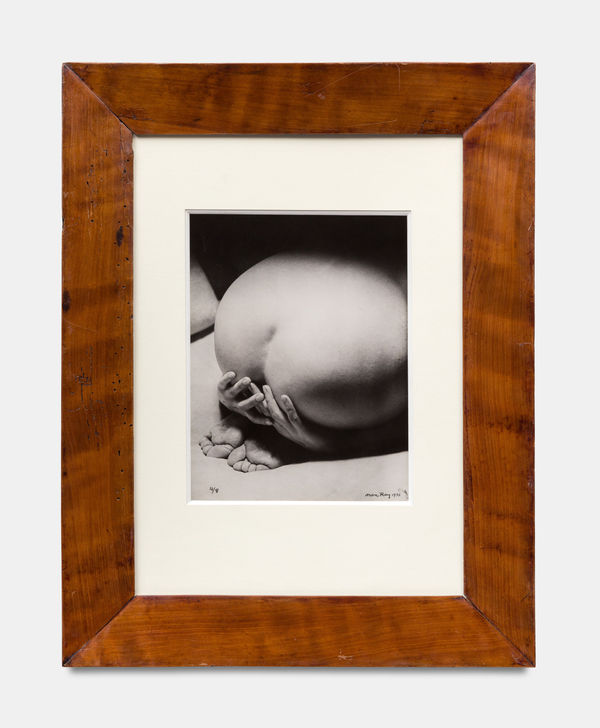
Sensorial overload was central to the surrealist concept of amour fou (mad love), rather than traditional amour (love), and they pioneered the use of photography for the exploration of a “convulsive” sense of reality whether by cropping, close-up, montage or techniques such as double exposure and solarization.[7] Man Ray’s La Prière (1930 / 1960) exemplifies this aesthetic of amour fou as it relies on the clash between the beauty of form and the shock of subject matter. A nude kneeling woman is seen to cup her buttocks, her fingers intertwining as if in prayer. It is the struggle between the sacred and the profane, objecthood and subjecthood, that lends the cropped figure study a poetic and political frisson through Eros.
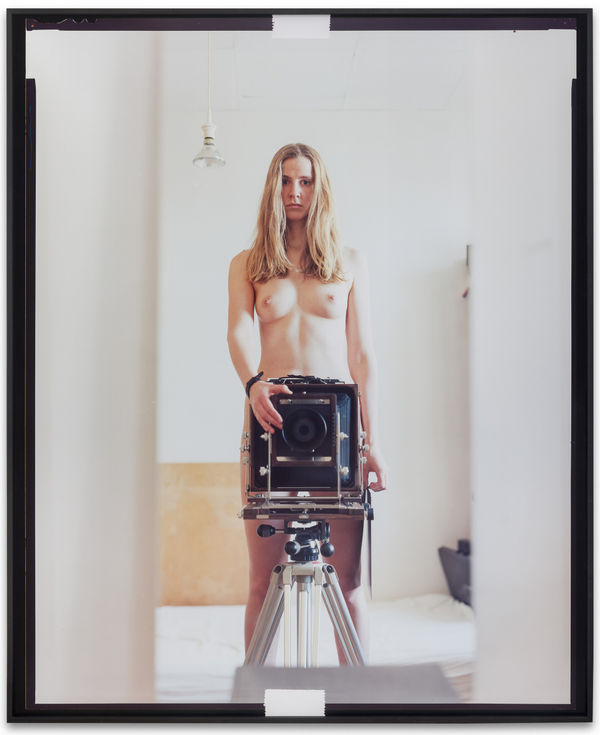
Sophie Thun may be seen to counter the phallic gaze witnessed in Man Ray’s work in employing the camera as a phallic prop and staging herself on both sides of its lens in Extension 8 x 12 (2015). In Ramo secondo della Pegola, 7-12.05.2019, FTH (2019) Thun continues this double-edged approach, now uniting two dated photographs and including the bold outline of her own white hands – she literally exposes the artifice of the making of the photographic work and its role in seducing the viewer. This work also invokes the racial ramifications of ‘black’ and ‘white’, likely referencing Man Ray’s exploration of black / white binarism in his photographic series Noire et blanche (1926) with his fetishisation of artist Alice Prin (Kiki de Montparnasse) through her coupling with an Ivory Coast Baule-style mask.[8]
-
Our Shared Humanity
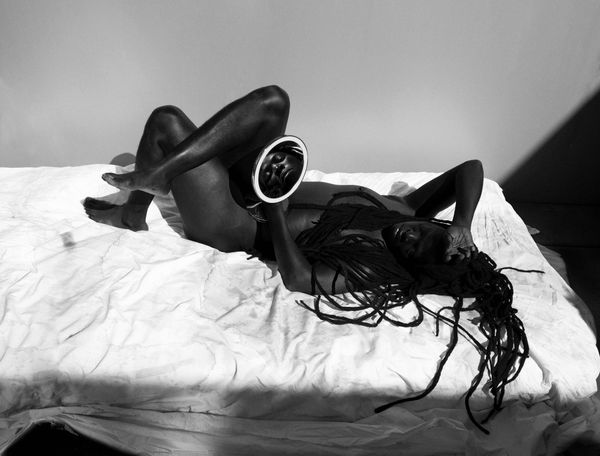
Zanele Muholi’s Bona III, ISGM, Boston (from the series Somnyama Ngonyama) of 2019 also employs photography as a form of resistance. Using black and white film to give a voice to Black and LGBTQIA+ people through the spirit of ‘ubuntu’, a Nguni Bantu term meaning “our shared humanity”, Muholi knowingly reference a tradition of black and white photography that easily fetishises racial difference. Somnyama Ngonyama, which translates as “Hail, the Dark Lioness” in isiZulu, is dedicated to the artist’s mother Bester Muholi (1936–2009). The chosen title “bona” (“see” or “look” in isiZulu) reflects how it is a work that explores being seen as well as seeing. The hand-held mirror that dominates the centre of the composition ensures this concept is manifest, just as the formal arrangement of the body as an elongated nude on a used bed with loose hair references a long tradition of racialised voyeurism in the western art canon – one thinks of Edouard Manet’s Olympia (1863) for example. Muholi’s work dismantles the exoticisation of the black and black LGBTQIA+ body as ‘Other’.
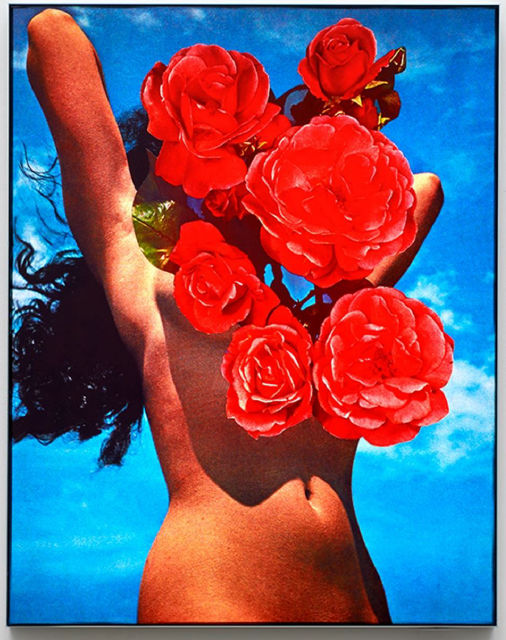
In contrast, Linder Sterling uses a vibrant kitsch colour palette to illuminate erotic politics, though she also turns the familiar strange in her iconography. Linder cuts photographs of roses out of old editions of The Rose Annual books to newly ‘dress’ soft porn pin ups that are culled from various soft-porn magazines including Girls of the World, Lui, Lewd Lezzies, Claws, Black & Blue, Girl Illustrated, and Stroke UK. Harnessing the cliché symbol of love - a rose - she plays peek-a-boo with the spectator so that full frontal nudity is camouflaged but erotic imaginings encouraged. A tanned curvaceous pin up stands against a bright blue sky in The Goddess Who is Permanent as Well as Temporary (2020) to magnify the kitsch nature of the pornographic imagination but as with other photography work discussed here, we note a clever to-and-fro between the looker and the looked-at as this pin up morphs into a punk-feminist goddess who claims voyeuristic desire as her own. Linder advances the avant-garde’s activism for the post-modern age image statured age as well as calling for a more humanist future. As she once explained, her work aims to serve “as a mouthpiece for all the feminist literature I had read so voraciously […] The Brontë sisters were able to guide my scalpel, along with Betty Friedan and the ghost of Raoul Hausmann”.[9]
-
The Desire to be Loved
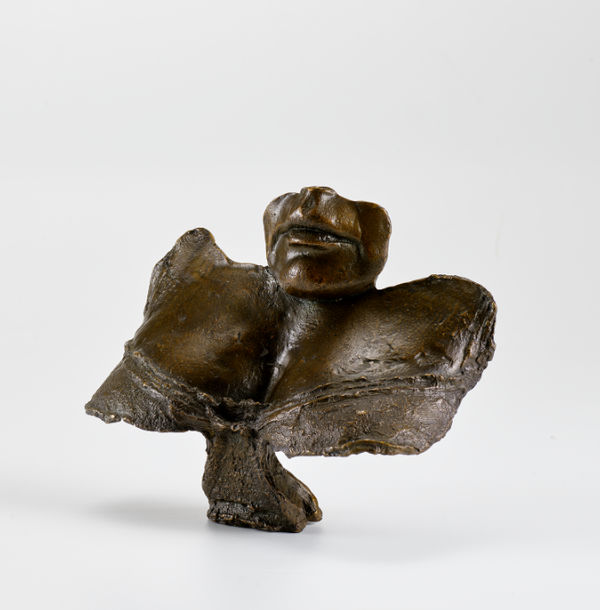
Sculpture allows the traditional idealised ‘whole’ female form to be subverted in other ways, often through the dismantling of form, focus on a body part, or the use of a ready-made object. André Breton noted the haptic mnemonic potential of these sculptural ideas in explaining how its material objecthood had the power to emanate “the desire to love and be loved in search of its real human object.”[10] With Alina Szapocznikow, whose work emerges out of late Surrealism, sculpture offers a materiality with which to explore memory as well as fantasy. A Polish Jew and survivor of the Holocaust, Szapocznikow’s Autoportret II (1966, cast 2012) is cast directly from the lower part of her face, a practice of using her own body that she introduced to her sculpture after 1962. The work's winged shape, made by the cast of her breasts, is a form that she repeated throughout the late 1960s, here inviting the spectator to move all-round her body parts with our own. This idea is magnified by the fact that it is a two-sided partial bust: on one side we see (her) lips and two toes paired suggestively like two parted legs; on the other we see a more classical casting of (her) décolletage under chin and lips.
A focus on the intimate body fragment allows Szapocznikow to address the trauma of her personal experience as well as the fractured and dehumanised nature of modern society for all. Recalling avant-gardist collage in challenging the expectation that art should offer a seamless mimetic or idealised image of the world this work offers ideas on the need to be loved, as well as the act of loving as care.
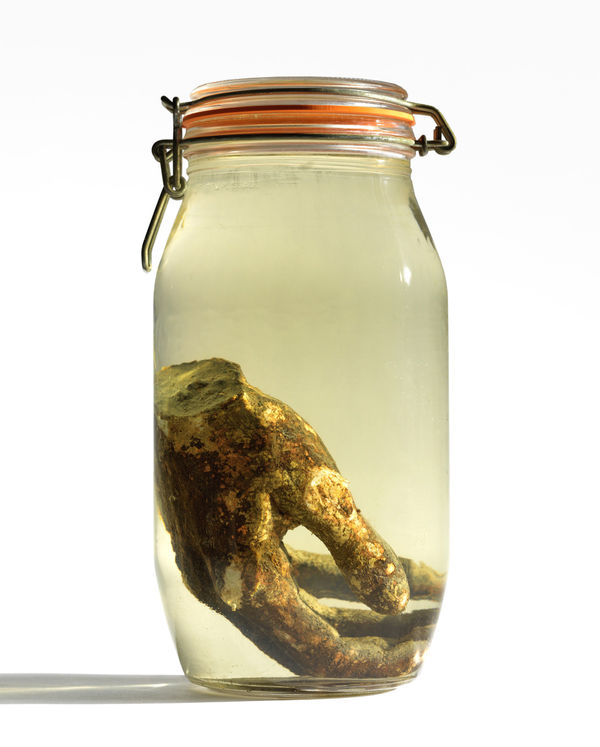
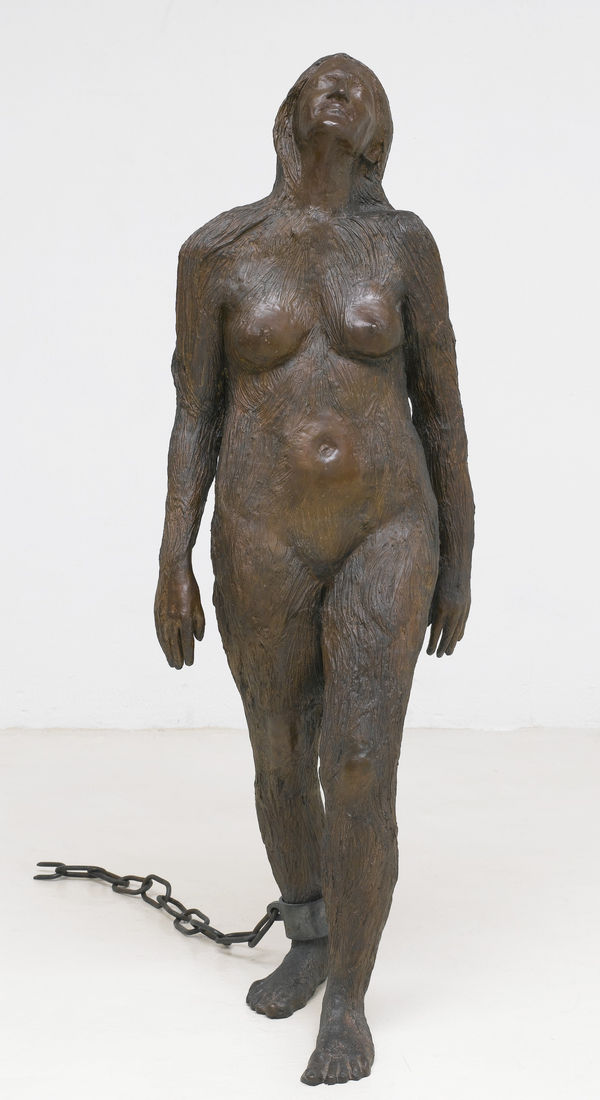
Kiki Smith also uses the classical medium of bronze to redress history and lend it a her-story perspective. Her art is informed by fairy tales and mythology as well as Judaeo-Christian imagery of woman and their attendant and emphatically gendered narratives of good and evil. If Hand in a Jar (1983) recalls the scientific or morgue specimen then it also alludes to the relic, where a body part or piece of clothing of a saint or holy person is cherished and preserved as a ritualistic part-object that symbolises the perfect whole. Her numerous sculptures of Biblical characters - including Lot’s Wife, Eve, Lilith, Mary Magdalene and the Virgin Mary, advance this idea on a larger scale. Her rendition of Mary Magdalene (1994) also teases out the secular and the spiritual: there are no obvious historical or religious details to the figure’s form but the unusual ‘dressing’ of her body in animalistic hair that grows from her long hair to her toes recalls the Renaissance sculptor Donatello's white poplar wood Penitent Magdalene (circa 1440) with her bedraggled long hair, bowed head and torn dress. Smith’s more animalistic portrayal of Mary Magdalene and the addition of the curious detail of a chain to her right ankle refutes the association with penitence however as there is no suggestion of subjection or prayer. Rather it is as if this Mary Magdalene has broken away from the chains of western ideology, her face titled up to the light rather than bowing down to anyone.
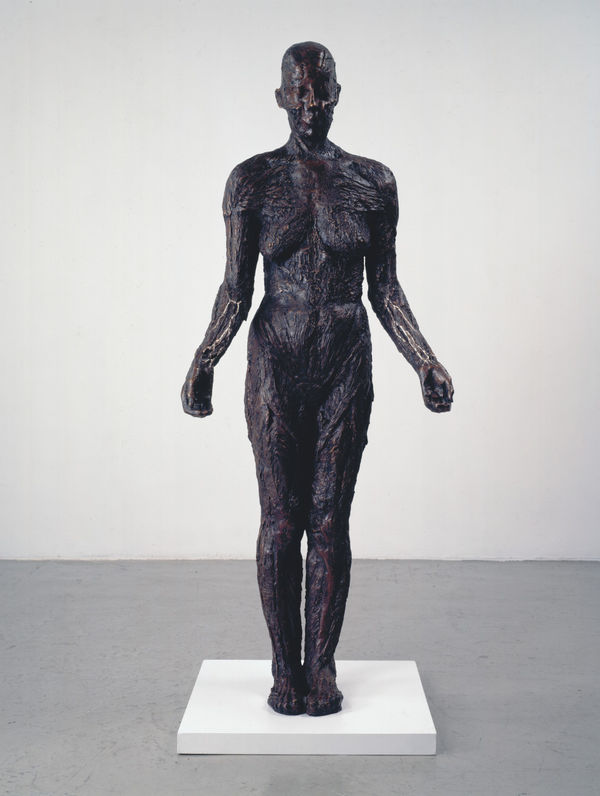
Smith’s rendition of the Virgin Mary (1992) also rejects all traditional Marian palettes and finery and instead recalls the écorché (flayed) anatomical studies of the Enlightenment where the flesh-less muscles of the body are visible. Here a bent head and outstretched hands with palms facing forward does reflect her role as mother and martyr though again we note how Smith strips the body of any obvious religious or historical reference. In so doing she ensures the spectator responds as one human / body to another, the experience is emphatically phenomenological. Smith was reared in the Catholic faith and has explained, “I’m stuck with it [Catholicism]. I’ve always been spiritual. That’s always been the most important part of my life, thinking about God or Gods.”[11] The female form is stripped of its eroticism in these works in favour of a search for a common spirituality devoid of grand patriarchal narratives and yet a tenderness remains as despite the choice of medium of bronze the body is presented as exposed, as vulnerable, to our presence.
-
Intimate Possibilities
Nicole Wermers unveils the voyeurism of the classical tradition in Reclining Female #4 (2024) both in using crude plaster to sculpt the reclining body of a female nude whose hardened surface is the very antithesis of soft flesh, and in positioning her on a cleaner’s trolley complete with duster, cleaning aerosols and cloths, rather than a timeless plinth. Woman as labourer and sex object are co-joined through function and labour, and the titular word ‘reclining’. At the same time, there is the possibility of an element of surrealist black humour in the mix. Surely a female worker disrobing, rejecting her work tools and leaping onto a moveable work trolley reminds us of the power of the imagination to liberate us from the banality and neglect of the everyday; a reclinging day dreamer may also be a revolutionary statement.
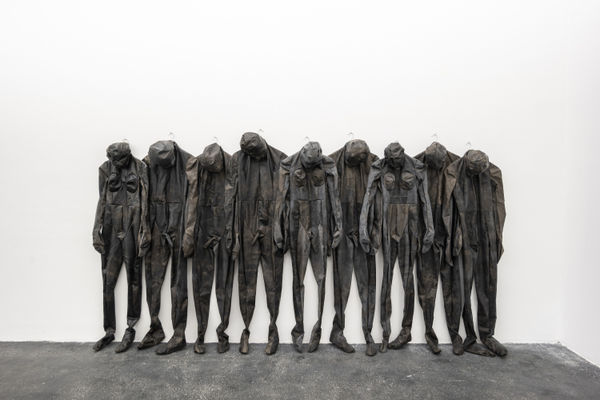
Alexandra Bircken’s Deflated Figures (2022), takes us away from the lone self or female form and brings the male and female form side by side, as fellow objects, and continues this play with associations and whether we approach art through logic or the senses. Lined up like a regiment, the nine bodies that make up this huge sculpture are uniformed, with genitalia reduced to a crude appendage, and all cast in a funereal shade of grey. The artist refuses any distinction between the sexes or their clothing, ensuring a faceless, mechanised troop. We note her use of familiar domestic materials - latex, cotton fabric, wadding and coat hangers. Black latex, typically associated with fetish wear, allows us to consider the automaton-like figures as deflated post pleasure, or even as building up a collective strength to act again. Whether the idea of this gathering as orgy-like strikes the viewer on first viewing or not, her critique of sexual objectification through the found domestic object dismantles traditional hierarchies and expectations. Most of all it is the work’s powerfully haptic materiality that ensures these Deflated Figures retain their power to slip and slide between the banality of cruelty or the pleasures of something else. The work invites the spectator to complete and re-inflate it.
One hundred years after the first Surrealist manifesto was published in 1924, the avant-garde’s call for life and love surely holds firm across media, activism, and the need for curiosity in art and the spaces that display it. The search for disorder but intimacy, for a critique of power but a play with it too, and for the imagining of the touch of lips or toes or rose petals or latex all speak to the fragility of life and love as well as their resilience. The daring challenge of “I Love therefore I Am”, persists.
-
- Renate Bertlmann
- May You Live in Interesting Times, 58th Venice Biennale, 2019
- Maura Reilly, Curatorial Activism: Towards and Ethics of Curating, London, Thames & Hudson, p.21
- See Magdalena Felice, “Love & Sex: L’arte di Renate Bertlmann negli anni settanta/ Renate Bertlmann’s Art in the 1970s” in Gabriele Schor (ed), DONNA: Avantguardia Femminista Negli Anni ’70, Rome: Galleria nazionale d’arte moderna/ Electa, 2010, pp.116 - 118
- André Breton, “Introduction to the International Surrealist Exhibition” (1959), Appendix VI in Investigating Sex, Surrealist Discussions 1928-1932, ed José Pierre, trans. Malcolm Imrie, Verso, 1992, pp.167-171, p.167
- Alyce Mahon, Surrealism & the Politics of Eros, 1938-1968, London: Thames & Hudson, 2005, p.
- See Rosalind Krauss et al, L'amour fou: photography & surrealism, Washington, D.C.: Corcoran Gallery of Art; New York : Abbeville Press, 1985, p.28
- See Wendy A. Grossman and Steven Manford, “Man Ray’s Noire et blanche”, American Art, Vol.20, No.2, Summer 2006, pp.134-147
- Linder, in conversation with Dawn Ades, in Linder, ed Doro Globus, Manchester: Ridinghouse, 2014, p.12
- André Breton, Mad Love, trans. Mary Ann Caws, London, 1987, p.26
- Chuck Close, “Interview with Kiki Smith”, Bomb, no.49, Fall 1994, p.44
Amo Ergo Sum: Dr Alyce Mahon
Learn more about collection themes viewing_room